Why Are Smart Baby Monitors So Expensive? $60 Vs $400 Audit:
The first time I added a smart baby monitor to my cart, I genuinely thought there had to be a mistake. I went in thinking it would be another $80 item on the list… and then I saw the price: $300… $400… Some cost more!
When I had my first baby, we used a simple audio monitor that cost less than dinner for two. It did one thing: transmitted sound from the nursery to my bedside table. No app. No video history. No firmware updates. It just worked.
So, when parents ask me why are smart baby monitors so expensive, I understand the confusion, especially when basic audio monitors or even non-WiFi video models sit comfortably under $100.
The price gap feels extreme. And if you’re already budgeting for diapers, a crib, a stroller, and everything else that seems to cost more once the word “baby” is attached to it, this feels like another hit.
So, let’s break down what really drives the cost of smart baby monitors and whether they’re worth it.
TL;DR (Why Are Smart Baby Monitors So Expensive):
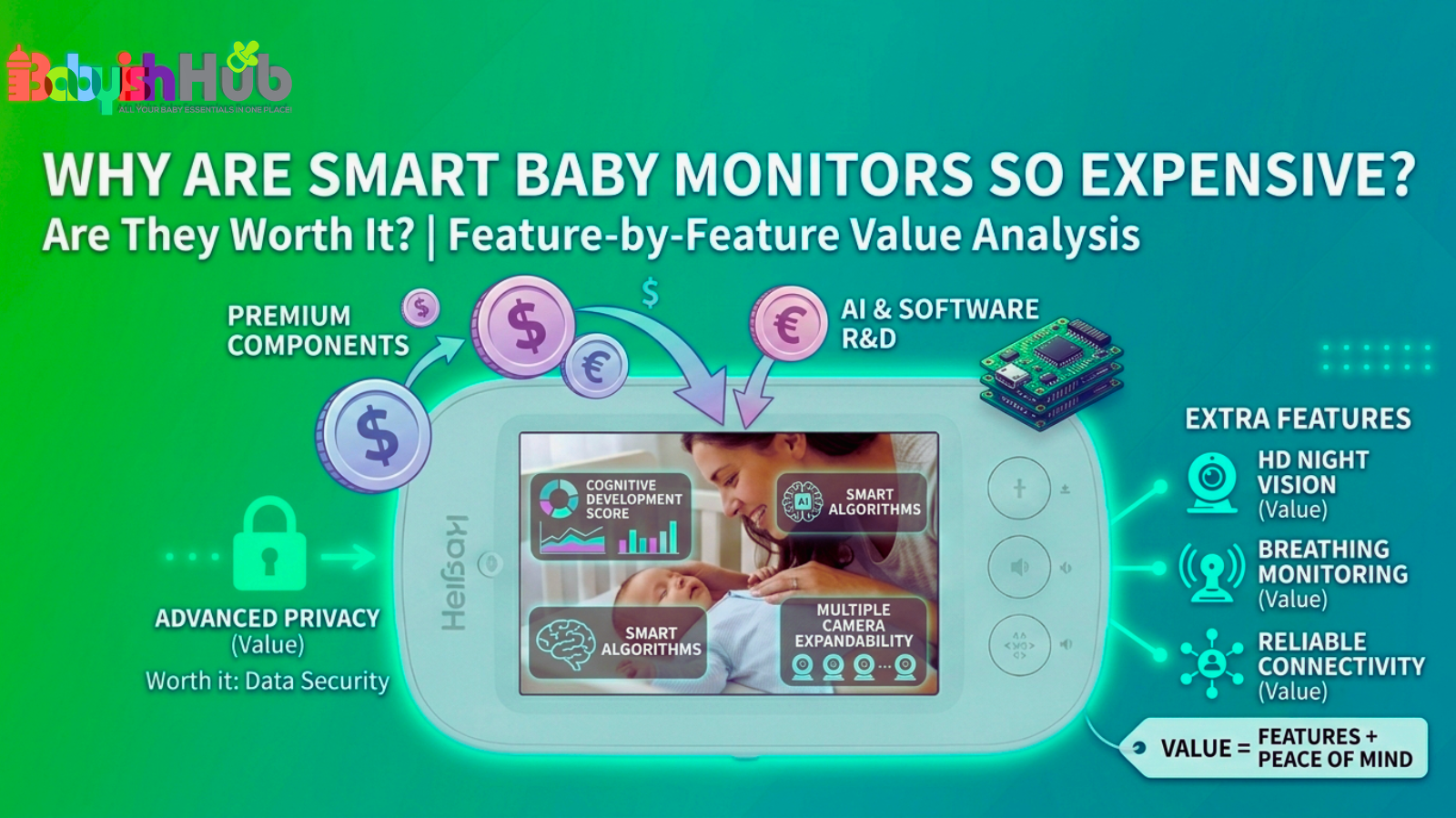
Smart baby monitors are expensive because they’re more like small tech systems than simple baby gear. They connect to your phone, track sleep or movement, store video, and run on apps that need regular updates and security. You’re not just buying a camera but ongoing technology. Whether that extra cost is worth it depends on what you truly need.
What Makes A Baby Monitor “Smart”?
BEFORE we talk about price, we need to clarify what we’re even comparing. Because a smart baby monitor isn’t just a camera with WiFi. It comes as a small ecosystem of its own.
If you’ve ever Googled what is a smart baby monitor, here’s what makes this particular type of baby monitor unit stand out:
WiFi Connectivity
A smart monitor connects to your home internet and streams video directly to an app on your phone.
This means you can check on your baby from work. Grandparents can also log in from their house. And you can peek in during date night without being physically nearby.
This is unlike the traditional non-WiFi monitors, which use closed radio frequencies and only work within a certain range. Once you leave the house, access is gone.
AI and Data Tracking
This is usually the point where the price starts to climb. Apart from their main job of showing you your baby, a lot of smart monitors also try to “read” what’s happening.
Some can track how long your baby slept and how often they woke up. Some monitor breathing or movement. Others send alerts when they think your baby is crying. A few even break sleep down into stages and give you charts in the morning.
Instead of simply watching your baby, the monitor collects information and turns it into data. For some parents, that feels reassuring. For others, it can feel like one more thing to overthink at 2 a.m.
Either way, building technology that can track and analyze those patterns accurately takes a lot more engineering than a basic camera. And this justifies higher price.
Cloud Storage & Video History
Basic monitors will only show you a live feed. When you turn it off, that’s it. But smart monitors? They often record video and store it so you can go back later. This means you can check what time your baby fell asleep, replay a moment to see why they woke up, and even save clips if you want to.
However, keep in mind that the video isn’t stored inside the camera sitting on your nursery shelf. It’s stored online in secure servers. Maintaining those servers costs money every month, which is part of why many smart monitors charge subscription fees.
App Ecosystem & Software Updates
When you buy a smart monitor, you’re not just buying a physical device. You’re also buying into an app that lives on your phone.
That app needs regular updates. It needs bug fixes. It needs to stay compatible when Apple or Android change their operating systems. It needs security updates to protect your video feed.
There’s a whole team behind that software, and their work doesn’t stop after you make your purchase. Keeping the app running smoothly year after year adds to the overall cost of the product.
The Real Cost Drivers Behind Smart Baby Monitors
Now let’s answer the bigger question head-on: why are smart baby monitors so expensive compared to traditional ones?
It all comes down to the layers of technology stacked on top of each other.
A basic monitor does one simple job: it sends sound, or sound and video, from your baby’s room to you. A smart monitor does that too, but it also connects to WiFi, runs through an app, stores video online, sends alerts, and often tracks sleep or movement.
Each added layer makes it more complex to build, run, and maintain. And more complexity usually means a higher price.
#1. Advanced Camera Hardware
A basic audio monitor is pretty simple. It sends sound from your baby’s room to a receiver. That’s it.
A smart monitor, on the other hand, is closer to a small security camera. It usually has a high-definition camera, strong night vision so you can see clearly in a dark room, a wide lens to capture more of the crib, and sometimes motors that let you move the camera from your phone.
All of that costs more to make than a simple sound transmitter.
And I’ll say this from experience: when it’s 3 a.m., and you’re trying to figure out if your baby is awake or just wiggling in their sleep, clear video makes a bigger difference than you expect.
#2. Built-In Sensors (Breathing, Movement, Temperature)
This is a big reason why breathing monitors are expensive.
Monitors that track breathing or movement aren’t just cameras. They often use special pads under the mattress or small wearable sensors that detect tiny movements. Many also measure room temperature or humidity.
These features have to be tested carefully. If a device is going to alert you about your baby’s breathing, it has to be accurate. That means extra engineering, extra testing, and higher safety standards.
That level of precision isn’t cheap.
#3. Software Development and AI Technology
The hardware is only part of what you’re paying for. Many smart monitors use software that tries to tell the difference between a real cry and normal sleep sounds. Some track sleep patterns and turn them into simple charts inside the app.
Building this kind of system takes a team of engineers. And they don’t stop working once the product is sold. The software needs updates, improvements, and fixes over time.
If the cry alerts were constantly wrong, parents would lose trust fast. Making the system accurate takes time and money. This software layer is a major reason why smart baby monitors are so expensive. You’re paying for the device and the people behind the technology.
#4. Cloud Storage Infrastructure
If your monitor records video, that footage has to be stored somewhere in the cloud.
Most smart monitors store recordings online, not inside the camera itself. That means companies pay for secure servers that run all day, every day. They also pay for systems that keep your video private.
This is one reason you’ll often see a monthly baby monitor subscription cost. It helps cover those ongoing storage and hosting expenses.
#5. Security and Encryption
When a monitor connects to WiFi, security becomes a big deal. It’s a well-known fact that baby monitors can be hacked. And companies have to protect your video feed from hacking. They need strong encryption and regular security updates to keep the system safe.
Parents are right to care about this. Building and maintaining that kind of digital protection adds to the overall cost.
#6. Brand Reputation and Liability
Some brands position their monitors almost like medical support tools. When companies make claims about breathing alerts or safety features, they have to back them up.
That often means legal reviews, safety certifications, and customer support teams trained to handle worried parents.
When you buy from a well-known brand, part of the price reflects all of that behind-the-scenes work. It goes beyond just the camera in the box, but also the structure supporting it.
Expensive Vs Cheap Baby Monitors Comparison: Why Basic Baby Monitors Cost So Much Less
To really see the price difference between smart and basic monitors, let’s step back and compare them in simple terms…
A basic baby monitor does one job: It sends sound, and sometimes video, from your baby’s room to a handheld parent unit. It doesn’t use your home WiFi. It doesn’t store recordings online. And it doesn’t run through an app on your phone.
Here’s what this means: There’s no cloud storage. No monthly servers running in the background. And there’s no software team working tirelessly to push updates.
Once you buy a basic baby monitor, that’s mostly the end of the company’s involvement. It’s a one-time piece of hardware that works within its set range.
That’s a big part of the difference between smart and regular baby monitors.
Smart monitors are more like small tech systems that rely on internet connections, apps, data storage, and ongoing support. And this added complexity is what drives the higher price.
When A Smart Baby Monitor Might Be Worth the Price
There are families where the high cost of smart monitors truly makes sense. Working parents who want to check in during the day often find remote access invaluable.
Families in larger homes appreciate strong WiFi coverage and app-based notifications.
Parents who love tracking patterns may also appreciate sleep analytics.
And for some, recording and playback features help identify routines that aren’t obvious in the moment.
If you’ll actively use most of these convenient features, then a smart baby monitor may be worth the cost for you.
When A Smart Baby Monitor Might Not Be Worth It:
On the flip side, there are situations where buying a smart bay monitor may be overkill.
In a small apartment, where you can hear your baby from anywhere, an audio monitor might be enough.
If you only need sound alerts, paying for AI sleep analytics doesn’t make practical sense.
Families who prefer non-WiFi privacy often feel more comfortable with closed-circuit monitors.
And if you strongly prefer one-time purchases without subscriptions, smart monitors may frustrate you.
This is where the question “Is a smart baby monitor worth it?” really depends on lifestyle, not marketing.
Hidden Costs To Consider Before Buying A Smart Monitor
When buying a smart baby monitor, you also need to understand that the upfront price isn’t the whole story.
The hidden costs of smart baby monitors can surprise you later. They come in the form of monthly subscription fees can add up significantly over a year.
There are also replacement accessories, especially wearable sensors, that may not be one-time purchases. If you want additional cameras for multiple rooms, that’s another investment.
Some breathing or movement sensors also require periodic replacement.
While these aren’t deal-breakers, they’re important to factor into your real budget before you go ahead with your purchase.
How To Decide If the Price Is Justified for You
When friends ask me whether a smart baby monitor cost is worth it, I don’t start with brands. I start with questions.
First, what problem are you trying to solve? If you’re worried about breathing, will a wearable monitor genuinely help you sleep, or will it have you opening the app every twenty minutes to double-check?
Next, you need to be honest about how you live. Are you really going to use most of the features? Or do you mostly want to hear your baby and peek in now and then?
Then think about the money side. Are you comfortable with a monthly fee, or do you prefer buying something once and being done?
And maybe the most important question is: will this technology make you feel calmer, or will it become one more thing to manage, charge, update, and troubleshoot?
When you answer those questions honestly, the right choice usually becomes much clearer.
My Final Thoughts As A Mom
After everything we’ve unpacked in this guide, here’s my honest advice: when you’re wondering why are smart baby monitors so expensive, remember that you’re paying for layers of technology, not just another baby monitoring camera. The price makes sense from a tech standpoint, but that doesn’t automatically mean you need it. The idea is to choose the monitor that helps you sleep better, not the one with the longest feature list. The right choice is the one that fits your budget, works for your family, and gives you peace of mind.