Are Baby Monitors Safe for Newborns? What You Need to Know
Bringing a newborn home changes everything. I remember sitting beside the crib at night, listening for every tiny sound and wondering if a baby monitor would give me peace of mind or create new worries. When you are exhausted and adjusting to this new season, even small decisions can feel overwhelming.
If you are wondering, “Are baby monitors safe for newborns?”, you are not overthinking it. You are doing what a caring parent does. In this guide, I’ll walk you through what pediatric experts say about baby monitors, what the research shows, and how to safely use a monitor from day one without adding unnecessary stress to your already full plate.
TL;DR; Are Baby Monitors Bad for Newborns?
Standard baby monitors are safe for newborns. They use non-ionizing radiation (like your Wi-Fi), which doesn’t damage DNA. However, the physical setup is where most parents mess up. If your camera is within 3 feet of the crib, it’s no longer a monitor but a hazard!
What Does “Safe” Mean for A Newborn?
When we ask if something is “safe” for a newborn, we usually mean more than one thing.
First is physical safety. The biggest real-world risk with baby monitors is cords. They should always be mounted well out of reach of the crib, never draped over rails or attached to the sleep space.
A securely mounted camera on a wall or high shelf is far safer than placing it on a nearby dresser with dangling wires.
Then there is digital and health safety. If you are using a WiFi monitor, privacy matters. Using strong passwords and regularly updating software goes a long way in preventing unwanted access.
As for radiation or EMF exposure, standard baby monitors emit very low levels, far below established safety limits (Source). From both research and experience, proper placement and smart setup matter far more than the signal itself.
Are Baby Monitor Emissions Harmful To Newborns?
This is one of the biggest worries I hear from new parents. Baby monitors, especially WiFi models, emit radiofrequency energy, which falls under electromagnetic fields, often called EMF.
That sounds scary at first, but it is the same type of non-ionizing radiation used by WiFi routers, smartphones, and even Bluetooth devices. Non-ionizing radiation does not damage DNA the way ionizing radiation, like X-rays, can.
Current research has not shown consistent evidence that standard consumer baby monitors cause harm when used as intended. The levels they emit are far below international safety limits.
In fact, your phone held to your ear typically exposes you to more radiofrequency energy than a monitor mounted several feet away from a crib.
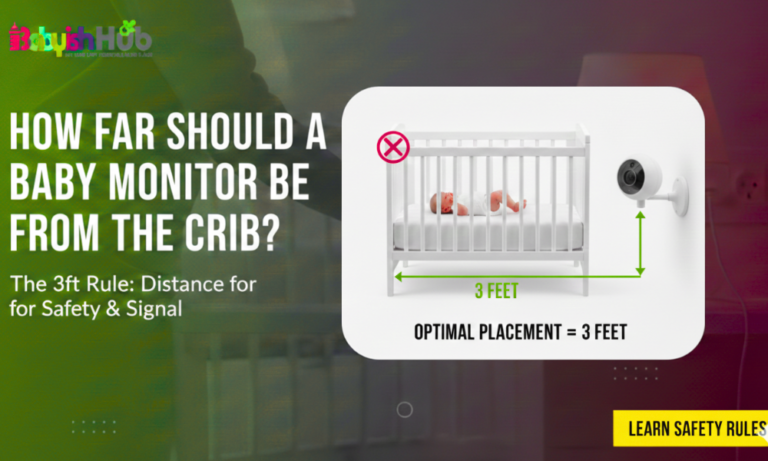
If you want to ensure maximum safety against EMF from baby monitors, mount your baby camera 3 feet from your little one’s crib rather than directly beside it.
How Do You Safely Place Baby Monitor In Your Newborn’s Room?
If there is one area where safety truly matters, it is where you put your baby monitor in the nursery. A baby monitor should never be within your newborn’s reach.
As a general rule, ALWAYS mount the camera at least three feet away from the crib. This gives you a clear view while keeping cords and devices far from tiny hands that will eventually start grabbing everything.
Cord safety is critical, too. Never drape the cords over the crib, tuck them under the mattress, or attach the monitor directly to crib rails. Strangulation risks are real and preventable!
I strongly recommend wall mounting your monitor as the safest option because it keeps everything elevated and secure.
If wall mounting is not possible, place the monitor on a high, stable shelf well out of reach and use cord covers to keep wires safely tucked away.
WiFi vs Non-WiFi Monitors: Which Is Safer for Newborns?
From experience, the biggest difference between WiFi and non-WiFi monitors is exposure to internet risks.
WiFi monitors let you check in from anywhere, which is convenient, but they also open the door to potential hacking if passwords are weak or software isn’t updated.
Non-WiFi monitors communicate directly between the camera and parent unit, so no one can access them online, making them inherently more secure.
The type of monitor to choose depends on your lifestyle. If you work, travel, or want remote access, a WiFi monitor with strong passwords and firmware updates makes sense.
If you mostly stay home, a non-WiFi monitor is a more suitable option. This unit hugely reduces hacking risk and is simple to use.
Can Baby Monitors Affect Your Newborn’s Sleep?
As a parent, it’s easy to worry that monitors might disturb your baby’s rest.
In reality, most monitors are designed to minimize disruption, but a few things can compromise your baby’s sleep.
For instance, the bright LED lights on the camera or parent unit can catch a newborn’s attention, so it’s best to position the monitor so the light doesn’t shine directly into the crib.
Background sounds, like white noise or soft lullabies, are generally harmless and can even soothe your baby to sleep.
If your monitor comes with a two-way talk feature, you should use it sparingly, as sudden voices can startle your newborn if activated at night.
With proper placement and minimal use of these interactive features, a monitor will support your baby’s sleep rather than interfere with it.
Common Safety Mistakes Parents Make With Baby Monitors
Even the most careful parents can make simple mistakes when using their monitors that put their baby at risk.
One of the most common mistakes is placing the monitor too close to the crib or letting cords hang within reach, which can create strangulation hazards.
Another common error is neglecting firmware updates or using unsecured WiFi, which increases the risk of baby monitor hacking.
Over-relying on your breathing or movement trackers is also a mistake. These devices can sometimes give you false alarms and create unnecessary anxiety.
Following basic safety steps and using monitors as a helpful tool, not a replacement for supervision, keeps your newborn safe.
What Pediatricians Say About Baby Monitor Safety
I often come across this question on different parents’ forums and communities: Do pediatricians recommend baby monitors?
As pediatricians often explain, baby monitors are tools for supervision, not medical devices, and not substitutes for safe sleep practices.
The American Academy of Pediatrics recommends room sharing without bed sharing for at least the first six months, ideally the first year. A monitor can support this kind of setup, but it does not reduce the risk of SIDS on its own.
From a medical standpoint, standard baby monitors emit very low levels of radiofrequency energy, far below established safety limits.
There is no strong clinical evidence linking properly used monitors to harm newborns.
What doctors emphasize is safe placement. This involves keeping your camera and cords well out of reach of the crib, mounting securely, and avoiding attaching devices directly to the crib.
Pediatricians caution against overreliance on consumer breathing or oxygen tracking features. AAP clearly states that these devices are simply meant to make parenting easy and do not meet the criteria for medical devices. This means you can’t use them to diagnose, cure, or prevent any disease condition in your little one. (Source).
Baby Monitors Safety Frequently Asked Questions
Let’s look at some of the most common concerns parents ask about baby monitor safety:
Do pediatricians recommend baby monitors?
Pediatricians see monitors as helpful tools for awareness, especially for room-sharing setups, but they emphasize that monitors do not replace safe sleep practices. They are optional, not mandatory, and most are used to give parents peace of mind.
Are baby monitors safe for newborns?
Yes, standard monitors are safe when placed correctly and used according to instructions. Physical hazards like cords or improper placement are a bigger risk than the signal itself, and digital emissions are far below harmful levels.
Do babies absorb wireless radiation?
Babies are exposed to very low levels of non-ionizing radiation from WiFi or Bluetooth monitors. Current research shows this is far below international safety limits and unlikely to cause harm when devices are used properly.
At what age can you start using a baby monitor?
You can use a monitor from day one, especially for room-sharing setups. For preemies or babies with medical needs, it may be essential. The key is proper placement and adherence to safe sleep guidelines.
Do baby monitors prevent SIDS?
No. Monitors do not prevent SIDS. Safe sleep practices (i.e., placing babies on their backs, using a firm, uncluttered crib, and room sharing) are the only proven methods to reduce risk. Monitors simply provide awareness.
Can you use a baby monitor with a newborn?
Absolutely. Monitors can safely be used with newborns if cords are secured, the device is out of reach, and safe sleep practices are followed. They help parents check in without disturbing the baby.
Are baby breathing monitors worth it?
For most healthy newborns, baby breathing monitors are not necessary and can create anxiety or false alarms. They may be helpful for preemies or infants with medical concerns, but you should always consult your pediatrician before relying on them.
So, Are Baby Monitors Safe for Newborns?
Baby monitors are generally safe for newborns when you use them correctly. The devices help you keep an eye—or ear—on your newborn, giving peace of mind. If you mostly stay in the room or nursery, monitoring systems are optional. But if you’re an anxious parent, you do night shifts, or your baby has special needs, a monitor can be a helpful tool.
Here’s my final word: A monitor is a wonderful tool for your sanity, but it isn’t your teammate. It’s there to give you a breather, but it should never replace your “mom-stincts.” Keep the cords 3 feet away, secure your Wi-Fi, and always prioritize safe sleep practices. Use the extra peace of mind to rest—you’ve earned it.