
Baby Sleep: The Ultimate Evidence-Backed Guide for Every Age and Stage

Baby sleep is one of the first things parents lose and one of the last things they stop thinking about. Whether you’re in the middle of the newborn haze, wondering if your baby sleeping in two-hour stretches will last forever, or deep in a four-month regression you didn’t see coming, this guide covers everything you need to understand what’s happening and what you can do about it.
Baby sleep patterns are not one-size-fits-all. They change constantly with age, developmental changes, feeding needs, and your baby’s individual temperament. What looks like a problem at six weeks may be perfectly typical, and what seems like a strange new habit at eight months might be a textbook sleep regression. This guide walks you through all of it, from newborn sleep through toddler sleep, with evidence-backed guidance at every stage.
Jump to a section:
What Is Normal Baby Sleep?

Before anything else, you need to understand what baby sleep is and why it looks so different from your own. Infant sleep is not a quieter, smaller version of adult sleep. It is a biologically distinct state that serves specific functions in brain development, immune function, and physical growth. And it operates on a completely different structure than what adults experience.
How Baby Sleep Differs from Adult Sleep
Adult sleep cycles last roughly 90 minutes and are heavily weighted toward deep, restorative NREM sleep in the early hours of the night. A baby’s sleep cycle runs about 45 to 50 minutes, and newborns spend roughly 50% of their total sleep time in active sleep, sometimes called REM sleep, compared to about 20% for adults.
This lighter, more active state is where much of a baby’s critical brain development occurs. It means babies are easier to rouse, more likely to twitch or startle, and more prone to partial wakings between cycles, none of which are signs of a problem.
Why Babies Wake So Often
Frequent nighttime awakenings are one of the most normal features of infant sleep, especially in the first six months. Babies wake for the following reasons:
- They wake due to hunger because their stomachs are small and require frequent refilling.
- They wake during sleep cycle transitions because their ability to link cycles and return to sleep without help takes months to develop.
- They wake because sleep associations, the conditions present when they fell asleep, are no longer available when they rouse between cycles.
- They also wake because developmental leaps, teething, illness, and environmental disruptions all interrupt sleep in predictable ways throughout the first two years.
Factors That Influence Baby Sleep
No two babies sleep the same way, and that’s not a failure of parenting. Some crucial factors that shape how well and how long a baby sleeps include:
- Age (this is the strongest predictor of sleep capacity)
- Feeding method
- Growth spurts
- Individual temperament
- The sleep environment
- Current health of the baby
- Approaching developmental milestones
A baby going through a major gross motor development phase, learning to roll or pull to stand, will often sleep less consistently than they did the week before. A baby cutting a tooth will sleep differently than they will once it breaks through. All of this is normal.
Signs Your Baby Is Getting Enough Sleep
Every baby has unique sleep needs, so it’s normal if your little one’s schedule doesn’t look exactly like someone else’s. Instead of focusing only on the number of hours they sleep, pay attention to these signs that indicate your baby is getting the rest they need:
- Wakes up in a reasonably content mood.
- Has predictable energy and fussiness patterns throughout the day.
- Feeds well.
- Shows appropriate interest in their surroundings during wake windows.
- Doesn’t struggle to fall asleep despite obvious fatigue.
- Takes naps that are not short or fragmented.
- Doesn’t consistently wake very early in the morning.
- Seems content and is growing well, even if their sleep schedule doesn’t look like what you expected.
Baby Sleep Needs by Age
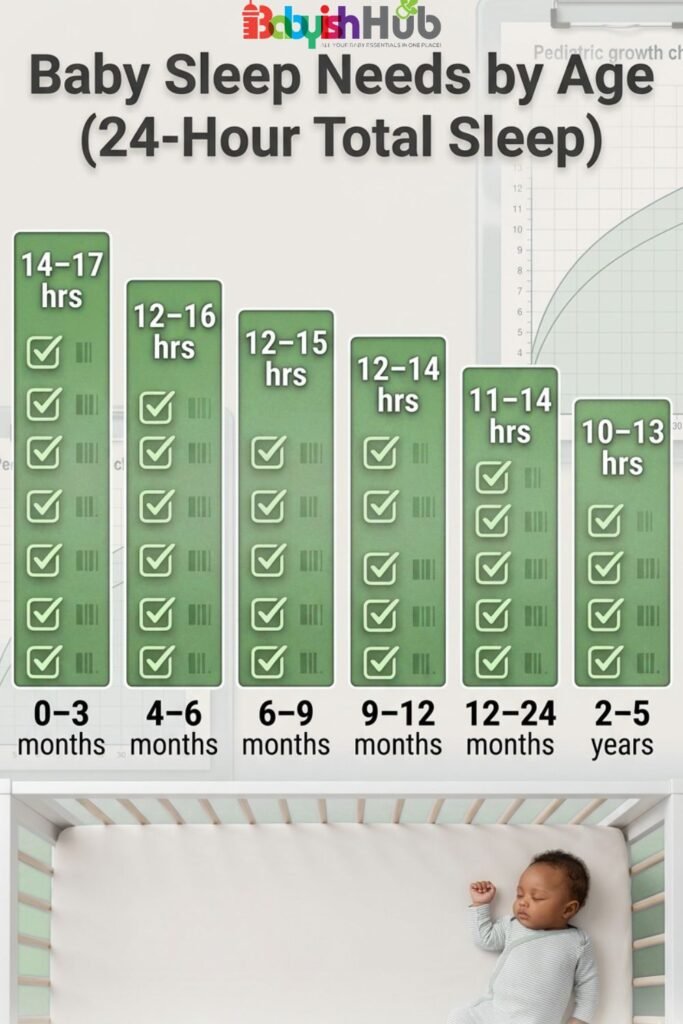
The following sleep totals are based on guidance from the American Academy of Sleep Medicine and the National Sleep Foundation, and they cover total sleep in a 24-hour period across both daytime naps and nighttime sleep.
| Age | Total Sleep Per 24 Hours | Typical Night Sleep | Typical Naps |
| 0 to 3 months | 14 to 17 hours | Variable, broken into 2-4 hr chunks | 4 to 5 naps |
| 4 to 6 months | 12 to 16 hours | 9 to 11 hours with wake-ups | 3 to 4 naps |
| 6 to 9 months | 12 to 15 hours | 10 to 11 hours | 2 to 3 naps |
| 9 to 12 months | 12 to 14 hours | 10 to 12 hours | 2 naps |
| 12 to 24 months | 11 to 14 hours | 10 to 12 hours | 1 to 2 naps |
| 2 to 5 years | 10 to 13 hours | 10 to 12 hours | 0 to 1 nap |
Newborns (0 to 3 Months)
Newborn sleep is inherently unpredictable. A newborn has not yet developed a circadian rhythm, the internal clock that distinguishes day from night, and their tiny stomachs need filling every two to three hours around the clock.
Expecting any consistent newborn sleep schedule in the first four to six weeks will set you up for frustration. The goal in this stage is safe sleep, frequent feeding, and learning your individual baby’s early sleepy cues.
By six weeks, some pattern begins to emerge for most babies. By eight to twelve weeks, longer stretches at night become more possible as the circadian rhythm starts to develop.
It is best for a newborn not to sleep longer than four to five hours at a stretch in the first five to six weeks, as their small bodies need frequent feedings.
Babies 4 to 6 Months
This is when your baby sleep development becomes more intentional and when the infamous four-month sleep regression typically arrives. At four months, the structure of sleep changes permanently, with babies developing adult-like sleep cycles, including light sleep stages that didn’t exist before.
This shift means babies who were previously sleeping in long stretches may suddenly begin waking more frequently. It’s not a setback — it’s a sign of neurological maturity.
By four to six months, many babies begin sleeping longer stretches at night, and most infants this age take two to three naps during the day. This is also when consistent bedtime routines begin to pay off, as the developing circadian rhythm responds well to predictable evening cues.
Babies 6 to 9 Months
By six months, many babies can begin consolidating overnight sleep, with the National Sleep Foundation noting that by six months, nighttime feedings are usually not necessary for most healthy, well-growing infants, though this varies significantly by individual baby and feeding method.
Two to three daytime naps are typical in this window, often transitioning toward two naps by around seven to eight months.
Separation anxiety begins developing around this age and can introduce new nighttime awakenings that weren’t present before, even in babies who had been sleeping well.
Babies 9 to 12 Months
Most babies consolidate to two naps per day in this window, with total daytime sleep gradually decreasing while overnight sleep capacity continues to improve. Wake windows lengthen considerably, and the gap between last nap and bedtime often extends to three to four hours. Many babies achieve their first true overnight sleep stretch during this period, while others continue waking once or twice for feeds or comfort.
Toddlers 12 to 24 Months
The transition from two naps to one typically happens between twelve and eighteen months, and it’s often a bumpy few weeks as the schedule adjusts. Total sleep needs drop to eleven to fourteen hours, and toddlers increasingly resist bedtime as their developing autonomy and awareness make settling harder. The eighteen-month sleep regression, one of the more intense of the toddler regressions, falls in this window.
Preschoolers and Beyond
Most children between two and five years need ten to thirteen hours of total sleep, with napping usually dropping off completely by age three to four for many children, though some continue napping until five. Nighttime fears, active imaginations, and the social stimulation of starting daycare or preschool can all complicate sleep in this stage.
Understanding Baby Sleep Cycles
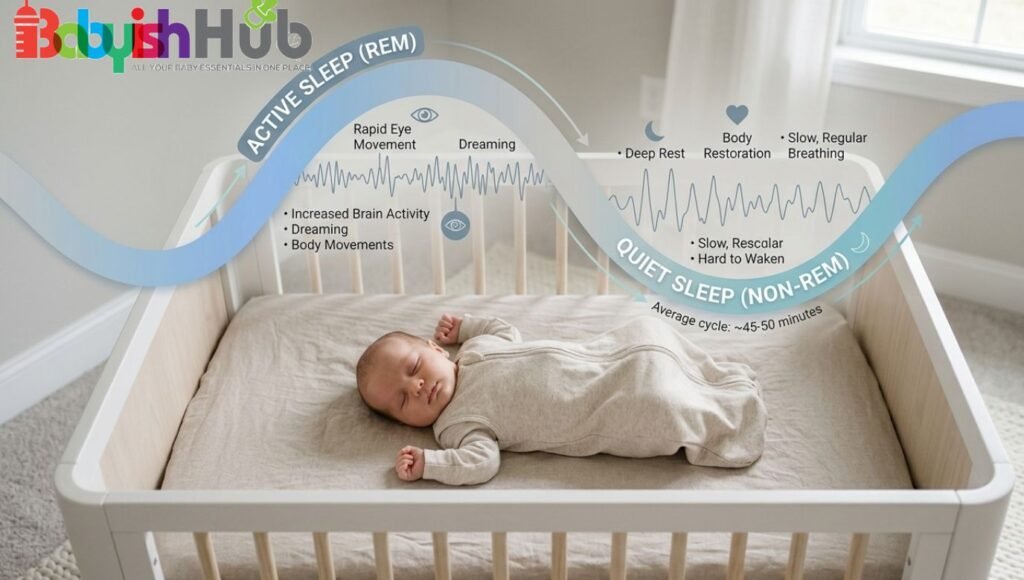
Understanding how your baby’s sleep cycles work can help you set realistic expectations, recognize normal sleep patterns, and support healthier, more restful sleep as they grow.
Active Sleep vs. Quiet Sleep
Babies cycle between two primary sleep states: active sleep, which is high in REM activity, and quiet sleep, which is the deeper, restorative state. Newborns enter sleep through active sleep first, unlike adults, who enter through deep sleep.
This clearly explains why a newborn who looks asleep may startle awake if you put them down before they have transitioned into deeper quiet sleep. That’s because they were in the lighter active sleep phase when you made the transition.
REM and Non-REM Sleep
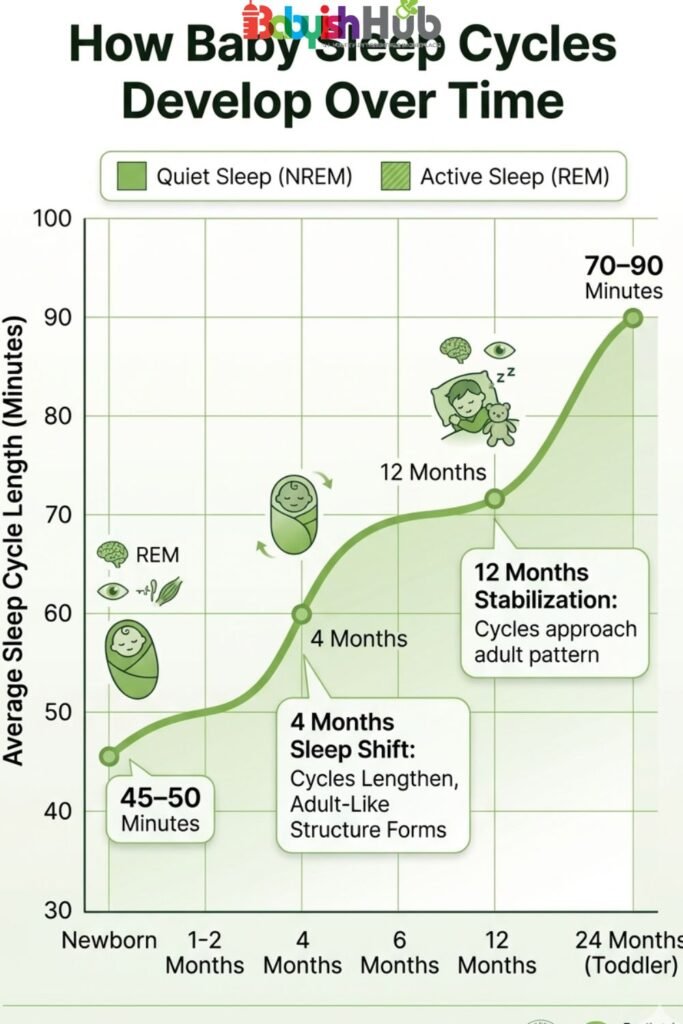
REM sleep, or rapid eye movement sleep, is associated with dreaming, memory consolidation, and brain development. Babies spend roughly 50% of their sleep time in REM, compared to about 20% for adults.
This high proportion of REM sleep in babies is thought to support the extraordinary rate of brain development occurring in the first year of life.
Non-REM sleep, or quiet sleep, is the deeper, restorative stage where physical growth and tissue repair are most active. As babies grow, the proportion of non-REM sleep increases and the balance shifts gradually toward the adult pattern.
Why Babies Partially Wake Between Cycles
At the end of each sleep cycle, roughly every 45 to 50 minutes, babies come to a lighter state of arousal. Adults do the same but typically fall back asleep unconsciously. Babies who have learned to fall asleep independently can often do the same.
Babies who rely on a specific sleep association, being fed, rocked, or held to fall asleep, may rouse fully and signal for that same condition to return before they can transition into the next cycle.
This is the core mechanism behind many common infant sleep patterns and sleep associations, including why a baby might wake every 45 minutes like clockwork.
How Sleep Cycles Change with Age
Sleep cycles gradually lengthen as babies develop, from about 45 to 50 minutes in early infancy toward the 90-minute adult cycle by late childhood. The proportion of REM sleep decreases while deep non-REM sleep increases.
By four months, sleep architecture has already shifted significantly toward a more adult-like pattern, which is why baby sleep development at that age tends to feel like a big transition for families.
Baby Sleep Schedules and Wake Windows by Age

A baby’s sleep schedule changes rapidly throughout the first two years. Understanding age-appropriate wake windows and daily sleep patterns helps you time naps and bedtime more effectively.
Why Baby Sleep Schedules Are Important
A schedule built around age-appropriate sleep needs gives your baby the structure their developing circadian rhythm can latch onto. It prevents both overtiredness and undertiredness, both of which make falling asleep harder, and helps parents anticipate nap windows, feeding timing, and bedtime with more consistency.
That said, a schedule for a baby is not the same as a schedule for an adult. The goal is a loose, predictable rhythm, not a minute-by-minute plan. Flexibility within a consistent framework tends to serve families better than rigid schedules that create anxiety when they break down.
Wake Windows by Age
Wake windows are the stretches of awake time a baby can handle between sleep periods before overtiredness sets in. Missing the optimal window often results in a baby who fights sleep, takes longer to fall asleep, or has shorter sleep periods. The first wake window of the day tends to be the shortest, and the last one before bedtime tends to be the longest.
| Age | Typical Wake Window |
| 0 to 4 weeks | 45 to 60 minutes |
| 4 to 8 weeks | 60 to 90 minutes |
| 2 to 3 months | 75 to 110 minutes |
| 4 months | 90 minutes to 2 hours |
| 5 to 6 months | 2 to 2.5 hours |
| 6 to 8 months | 2.5 to 3.5 hours |
| 8 to 10 months | 3 to 4 hours |
| 10 to 12 months | 3.5 to 4.5 hours |
| 12 to 18 months | 4 to 6 hours |
Flexible vs. Strict Sleep Schedules
Some parents find a clock-based schedule helpful, particularly once a baby is past three months and patterns are more predictable. Others prefer to build the day around predictable cycles, feeding, activity, and rest, rather than strict hourly plans. Both approaches can support healthy baby sleep habits. The important thing is consistency in the underlying pattern rather than rigidity about exact times.
Signs Your Baby Is Overtired
An overtired baby is not simply tired. Once overtiredness sets in, the body releases cortisol and other stress hormones, making it harder for your baby to fall asleep and stay asleep. Common signs of an overtired baby include:
- Increased fussiness or irritability beyond typical hunger cues.
- Difficulty settling despite obvious signs of fatigue.
- Red-rimmed or glazed-looking eyes.
- Frantic or erratic movements.
- Fighting sleep even when they are clearly tired.
- Short, fragmented naps.
- Frequent nighttime waking.
You can easily catch these signs early by paying attention to both wake windows and your baby’s individual sleep cues. And this makes it easier for them to settle and get more restorative sleep.
Baby Sleep Cues You Should Watch For
Understanding your baby’s individual sleep cues is one of the most useful skills in early parenting because no chart or clock tells you precisely when your specific baby is ready for sleep. The cues do:
- Early Sleep Cues: Early sleep cues appear when a baby is comfortably tired and ready to begin the wind-down process. These include slowing down movements, a brief gaze into the middle distance, decreased engagement with toys or faces, yawning, and rubbing eyes or ears. Catching sleep cues early, before a baby tips into overtiredness, makes settling significantly smoother.
- Late Sleep Cues: Late sleep cues signal that the window has been missed and the baby is now overtired. These include escalating fussiness that doesn’t respond to typical soothing, arching of the back, difficulty making eye contact, and frantic movement. A baby showing late cues may need additional soothing support before they can settle. Next time, aim to start the nap routine when early cues appear rather than waiting for escalation.
- Hunger vs. Tiredness: The overlap between hunger cues and tiredness cues is one of the most common sources of confusion in early parenting. Both involve fussiness, seeking comfort, and difficulty settling. Hunger cues tend to be more persistent and often include rooting, sucking motions, and hands moving toward the mouth. Tired cues often include decreased interest in surroundings and slower, heavier movement. Context is important: if a baby has recently been fed, tiredness is a stronger explanation for fussiness than hunger.
Why Timing Is Crucial: Timing a nap or bedtime just right, after the wake window but before overtiredness, results in faster sleep onset, longer sleep, and a calmer settling process. Getting it consistently wrong in either direction, too early or too late, compounds over a day and can lead to a baby who seems to fight sleep at every opportunity despite being exhausted.
How To Create A Healthy Baby Bedtime Routine
A consistent bedtime routine helps signal to your baby’s brain and body that it’s time to sleep, making bedtime calmer and supporting healthier sleep habits over time.
Why Bedtime Routines Improve Sleep
A consistent baby bedtime routine works through a simple but powerful mechanism: it trains the brain and body to anticipate sleep. The sequence of events preceding sleep becomes a cue in itself, triggering the release of melatonin and shifting the nervous system toward calm. Research supports consistent routines as one of the most effective, non-controversial tools for improving infant sleep.
Sample Bedtime Routine
A functional bedtime routine doesn’t need to be long or elaborate. For a young baby, fifteen to twenty minutes is sufficient. For older babies and toddlers, twenty to thirty minutes gives enough time to wind down from the day’s stimulation.
A basic structure might include a warm bath, a feed, a dimmed room, and two to three minutes of quiet song or gentle rocking before placing the baby in their sleep space.
Older babies and toddlers often benefit from the addition of one or two books, which provide a calming, predictable element they begin to anticipate.
Best Calming Activities Before Bed
The hour before the bedtime routine begins is just as important as the routine itself. High-stimulation play, screens, and loud environments in the thirty to sixty minutes before bed work against the wind-down process.
Dimming lights, lowering voices, and shifting to quieter, slower activities in the lead-up to the routine give the nervous system time to begin its own natural settling process.
Consistency vs. Flexibility
The value of a bedtime routine comes from its consistency, not its complexity. A simple routine done reliably every night produces better outcomes than an elaborate one done sporadically. When travel or illness disrupts the usual routine, keeping whatever elements are most portable and calming, a familiar song, a specific book, a consistent feed-before-bed pattern, maintains the signal even in an unfamiliar environment.
Common Bedtime Mistakes
Starting bedtime too late is the most common mistake, and it compounds because an overtired baby takes longer to fall asleep and wakes more frequently overnight. Rushing through the routine when you’re tired makes the signal less reliable. Introducing stimulating activities like screen time in the final hour before bed competes directly with the neurological wind-down that the routine is trying to support.
Safe Baby Sleep Guidelines You Should Know
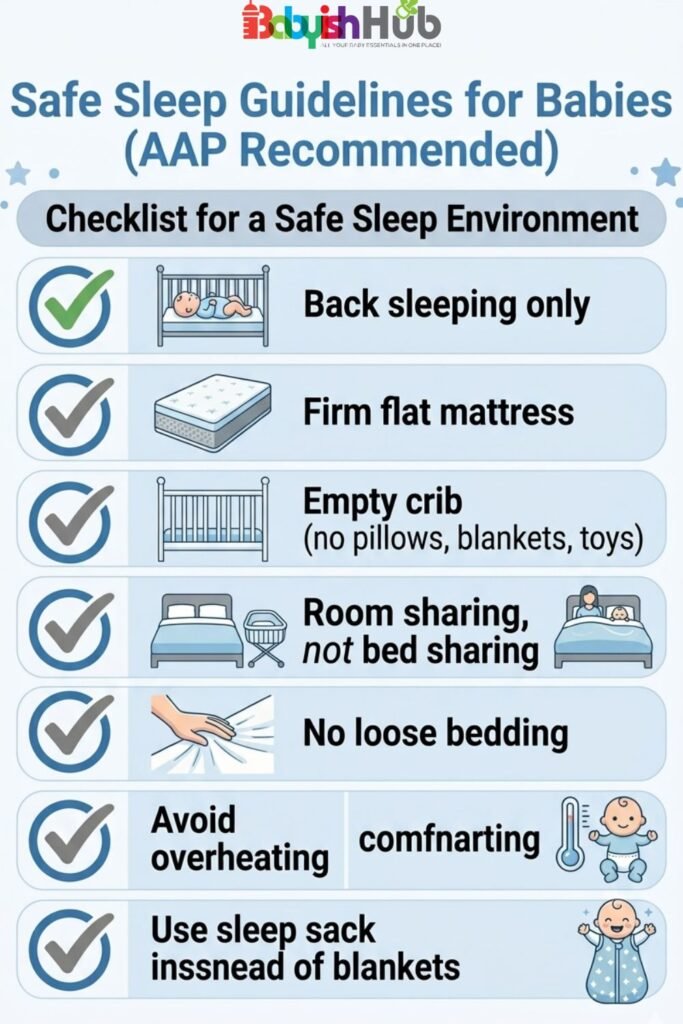
Safe baby sleep is the single most important topic in this guide. Every other sleep optimization technique is secondary to keeping your baby physically safe during sleep.
Safe Sleep Environment
The AAP’s current safe sleep guidelines, most recently updated in 2022 and reviewed in 2025, are built around one core principle: the safest sleep environment for an infant is one that minimizes external risk factors for suffocation, entrapment, and SIDS. The updated guidelines were based on 159 scientific studies and apply to children up to one year of age.
Crib Safety
Always place your baby on a firm, flat sleep surface that meets Consumer Product Safety Commission (CPSC) standards. This includes cribs, bassinets, and portable play yards with firm, flat, non-inclined mattresses. Sleep surfaces with inclines greater than 10 degrees are considered unsafe for infant sleep.
This eliminates inclined sleepers, which have been subject to a CPSC ban since 2022. Sitting devices like car seats, strollers, swings, and infant carriers are not recommended for routine sleep, particularly for babies younger than four months.
Mattress and Bedding Recommendations
Use a firm mattress with a tight-fitting, well-fitted sheet. Nothing else should be in the crib. The AAP recommends no loose bedding, pillows, bumper pads, stuffed toys, loveys, or pillow-like objects until at least twelve months of age.
Soft surfaces, including memory foam, can create an indentation and increase the risk of suffocation if a baby rolls face down. Baby sleep hygiene in this context means a bare environment, not a decorated one.
Room Sharing
The AAP recommends that parents sleep in the same room as their baby, but not in the same bed, for at least the first six months. Room sharing without bed sharing has been shown to reduce the risk of SIDS by as much as 50%. Keeping the crib close to the parental bed makes nighttime feeding, comforting, and monitoring easier and has a documented protective effect.
Co-sleeping Considerations
The AAP does not recommend bed sharing under any circumstances based on current evidence. The risk of sleep-related infant death while bed sharing is five to ten times higher when a baby is younger than four months, and the risk is two to five times higher for preterm or low birth weight babies.
Sleeping with a baby on a couch or armchair carries an even higher risk. If there is any chance you might fall asleep while feeding a baby in your bed, make sure the area is free of pillows, blankets, and any soft bedding before that happens.
Best Baby Sleep Position
Always place your baby on their back for all sleep, including naps, until they are one year old. The back-sleep recommendation reduced SIDS rates dramatically when it was introduced in the 1990s. Side sleeping is not considered safe and is not advised.
Once a baby can roll from back to front and front to back independently, usually around four to six months, it is not necessary to reposition them if they roll during sleep. Until that point, always place them on their back.
Ideal Sleep Temperature
Keep the sleep environment comfortably cool, generally between 68 and 72°F. Overheating is associated with increased SIDS risk. Dress your baby in light, breathable sleepwear rather than relying on blankets for warmth. A good rule of thumb is to dress your baby in one more layer than you would be comfortable wearing in the same room.
Pacifier Use and Sleep
The AAP recommends offering a pacifier at nap time and bedtime. Research shows that pacifier use during sleep is associated with a reduced risk of SIDS, possibly because sucking requires the tongue to be positioned forward, keeping the airway more open.
If you’re breastfeeding, wait until breastfeeding is well established before introducing a pacifier, usually around three to four weeks. Don’t attach the pacifier to anything, including a string or clip, during sleep.
Why Are Baby Naps Important and How Do They Affect Night Sleep?
Baby naps are a key part of healthy sleep development, influencing everything from mood and feeding to nighttime sleep quality.
Why Baby Naps Are Important
Baby naps are not fillers between the main event of nighttime sleep. They are a developmentally essential component of a baby’s total sleep needs. Research has found that naps allow infants to consolidate specific memories and support more generalized learning and brain development that nighttime sleep alone doesn’t fully cover. A well-napped baby typically has a more settled night than a baby whose daytime sleep needs were unmet.
Nap Transitions By Age
Babies move through several nap transitions in the first two years, as we have outlined below:
- Around three to four months, most babies move from five or more brief newborn naps to a more structured three-to-four nap pattern.
- Around six to eight months, many drop to two naps.
- Around fifteen to eighteen months, the transition from two naps to one begins.
- And somewhere between ages two and four, most children drop the remaining nap entirely.
Each transition typically involves a few weeks of disrupted sleep as the body adjusts to the new schedule. Bedtime may need to be temporarily moved earlier during nap transitions to prevent overtiredness.
Contact Naps
Contact naps, where a baby sleeps on a parent’s body rather than in a flat sleep space, are common and completely normal in the early months. Many babies nap far better in contact than alone, which reflects their biological expectation of proximity to a caregiver.
The question parents often ask is: Are contact naps bad for long-term sleep development? The answer is complex: they don’t prevent babies from eventually sleeping independently, but a baby who only sleeps in contact will need to develop other sleep associations to transition to an independent sleep space, which can take time and consistency.
Short Naps
A short nap, typically defined as under thirty to forty-five minutes, often represents a baby waking at the end of one sleep cycle without transitioning into another. Short nap patterns are common before four months, during developmental leaps, and when wake windows are slightly off.
Not every short nap requires intervention: a baby who wakes cheerfully from a twenty-minute nap and handles the next wake window well may simply be getting what they need. A baby who consistently wakes crying and struggles through the next wake window may benefit from a wind-down or settling adjustment.
What To Do When Your Baby Skips A Nap
A skipped nap occasionally happens and is not a crisis. An early bedtime on a skipped-nap day prevents overtiredness from compounding overnight. Frequent nap skipping is more likely a sign of wake windows being too short, a schedule mismatch, or an active sleep regression.
Why Do Babies Wake At Night?
Nighttime awakenings are a normal feature of infant sleep biology, and the most useful thing you can do as a parent is to understand what’s driving them before deciding how to respond. The most common reasons are:
1. Hunger and Night Wakings
In the early months, hunger is the most common cause of nighttime waking. Newborns and young infants have small stomachs and caloric needs that require overnight feeding.
By six months, many healthy, well-growing babies can go longer stretches without a feed, but individual variation is wide. A baby who is growing well, feeding well during the day, and waking at predictable intervals is most likely waking from hunger.
A baby waking irregularly and frequently, but settling quickly without a full feed, may be waking from habit or comfort rather than hunger.
2. Sleep Cycles and Night Wakings
As explained in the sleep cycle section, partial wakings at the end of each 45-to-50-minute cycle are normal. A baby who hasn’t developed the ability to link cycles independently will signal at these transitions. This accounts for the very predictable pattern many parents describe: a baby waking every 45 minutes or every hour on the dot through the night.
3. Developmental Changes and Sleep Disruption
Every significant motor and cognitive leap, learning to roll, sit, crawl, pull to stand, walk, and the accompanying language and cognitive development, affects sleep. Babies appear to practice new motor skills during sleep, and the neurological reorganization involved in major developmental steps frequently disrupts settled sleep for a week or two at a time.
4. Illness and Sleep Changes
Any illness, even a mild cold, disrupts sleep. Nasal congestion makes breathing harder in the supine position, fever increases discomfort, and general malaise keeps babies closer to the surface of sleep. Expect temporary nighttime awakenings during and shortly after illness without interpreting them as permanent regression.
5. Teething and Sleep Disruption
Teething and sleep disruption are closely linked, though the pattern tends to be a few nights of increased waking around each tooth’s emergence rather than weeks of disruption. The discomfort is typically most acute in the day or two before a tooth breaks through.
6. Separation Anxiety and Night Wakings
Separation anxiety peaks at around eight to ten months and again around eighteen months, and it directly affects nighttime awakenings. A baby who was sleeping through the night may begin waking and crying when they find themselves alone. This is a developmentally healthy sign that the baby-parent attachment is intact and functioning. It typically passes within a few weeks.
7. Environmental Disruptions
Temperature changes, noise, light, and disruptions to the sleep environment, including travel, room changes, or changes in caregiver, all affect nighttime sleep. A predictable sleep environment, which is the same temperature, lighting, and sound setup every night, supports better consolidation.
8. Sleep Associations and Sleep Dependence
A sleep association is any condition a baby requires to fall asleep. If a baby falls asleep nursing, being rocked, or with a parent’s hand on their chest, they will likely need those same conditions at each sleep cycle transition through the night.
Building sleep associations that a baby can access independently, like a pacifier, they can replace themselves, a lovey, or white noise that plays all night, supports longer stretches between parental interventions.
Common Baby Sleep Challenges
Here are a handful of common sleep issues that show up across almost all babies:
Fighting Sleep
A baby fighting sleep is usually either undertired, overtired, or overstimulated. Undertired babies have wake windows that are too short. Overtired babies have cortisol spikes that mask fatigue. Overstimulated babies need longer wind-down time before the settling process. Troubleshoot by checking wake windows first, then examining the wind-down environment.
Early Morning Waking
Early morning waking, typically before 6:00 a.m., is one of the hardest sleep challenges to address because the mechanisms are different from general night waking. Early cortisol rises make it biologically harder to stay asleep past a certain point. A fully darkened room delays light exposure, which can help. Ensuring the last nap of the day isn’t too late and that the total schedule isn’t running too early overall is often the most effective adjustment.
False Starts
A false start happens when a baby falls asleep at bedtime and wakes thirty to forty-five minutes later, apparently unable to return to sleep. This often indicates bedtime was too late and the baby became overtired, or that the sleep association used to fall asleep at bedtime isn’t transferable to the middle of the night.
Split Nights
A split night is a long middle-of-the-night waking where a baby is awake, alert, and not easily settled for one to three hours. This usually signals too much daytime sleep for the current developmental stage, meaning the sleep pressure at bedtime is insufficient to sustain overnight sleep.
Catnapping
Catnapping refers to consistently short naps, usually one sleep cycle in length. It’s typical in the newborn stage and often resolves naturally. For older babies, it may indicate wake windows that need extending, a settling issue at the start of the nap, or an environment that doesn’t support cycle transitions.
Overtired Babies
The overtired baby cycle feeds itself: overtiredness causes fragmented sleep, which creates more overtiredness. Breaking the cycle usually requires several days of earlier bedtimes and closer attention to wake windows to rebuild a sleep debt and reset the pattern.
Under-tired Babies
An undertired baby takes a long time to fall asleep, has short or inconsistent naps, and seems alert and cheerful at sleep times. The solution is typically extending wake windows and, for toddlers, dropping a nap sooner than expected.
Only Sleeping While Held
A baby who only sleeps while held has built being held as their primary sleep association. This is not a developmental problem, and it doesn’t indicate permanent future sleep difficulty. Transitioning to an independent sleep space requires gradually introducing the crib as the sleep location through methods like drowsy-but-awake placing, a consistent settling routine, and patience.
Sleeping Only After Feeding
Feeding to sleep is one of the most natural settling tools available to a parent and is completely harmless in the early months. If it becomes a pattern that a parent wants to change, the transition is usually most successful around four to six months, when wake windows are long enough to separate the feed from the sleep onset by a few minutes of quiet, calm activity.
Baby Sleep Regressions
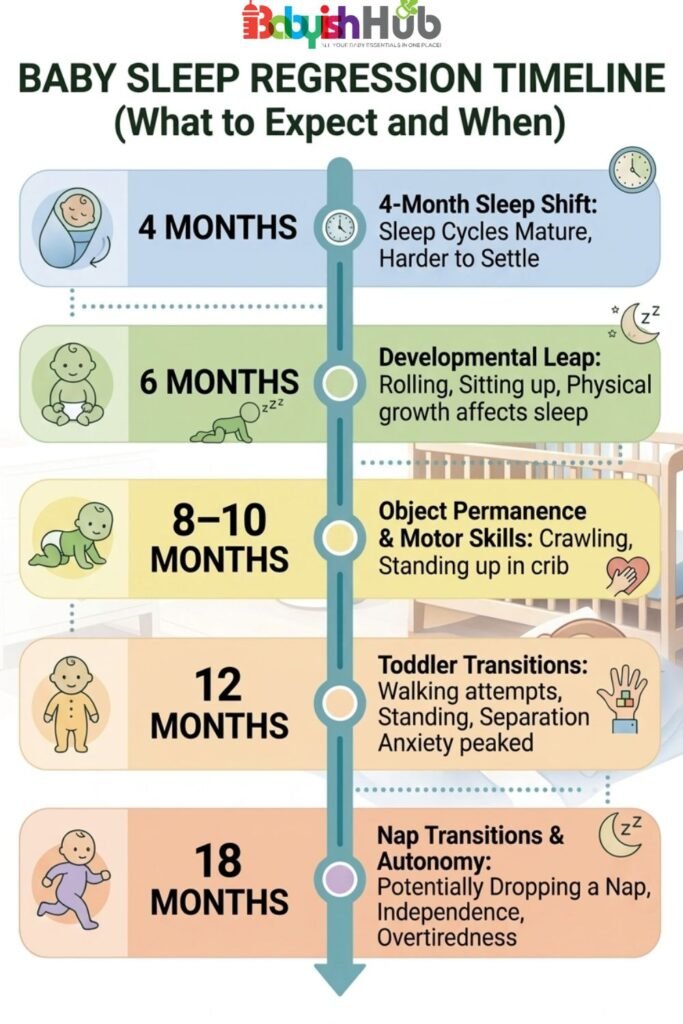
If your baby was sleeping well and suddenly is not, it’s often a sleep regression, and most parents experience this at some point.
What Sleep Regressions Are
A sleep regression refers to a period of disrupted sleep that occurs in a previously settled baby, typically coinciding with a major developmental leap. It’s important to understand that regressions are not a sign that something has gone wrong or that previous sleep was a fluke. They are a predictable feature of infant sleep development.
Typical Ages
Sleep regressions are most common at four months, six months, eight to ten months, twelve months, and eighteen months, though the timing varies between babies. The four-month regression is generally considered the most significant because it involves a permanent change in sleep architecture. The others are more temporary disruptions tied to specific developmental events.
Signs of Sleep Regression
The most common signs of sleep regression in babies include:
- Sudden increased nighttime waking in a baby who had been sleeping well, shorter or more disrupted naps
- Increased fussiness
- Difficulty settling at bedtime
Regressions often coincide with visible developmental changes. A baby who suddenly starts rolling, babbling, pulling to stand, or showing stranger anxiety at the same time their sleep falls apart is almost certainly experiencing a developmentally driven regression.
How Long Do Sleep Regressions Last?
Most sleep regressions last two to six weeks, though the four-month regression involves a permanent shift that doesn’t fully reverse. With consistent routines and appropriate sleep environment support, most babies find their way back to their previous sleep pattern after a regression passes.
What To Do During a Sleep Regression
The most effective approach during a regression is to maintain your existing routine and safe sleep setup rather than introducing major changes. Adding temporary extra settling support is fine. Implementing a complete sleep overhaul during an active regression often makes the process harder because the developmental disruption is still in progress.
Sleep Training Basics for Babies
Sleep training is one way you can help your baby learn to fall asleep more independently and sleep for longer stretches.
What Sleep Training Means
Sleep training is an umbrella term for methods intended to help babies develop the ability to fall asleep independently and link sleep cycles without parental intervention. It is not synonymous with any single method, and it does not always mean leaving a baby to cry. The range of approaches is wide.
When You Might Consider Sleep Training
Most sleep experts and pediatricians suggest that the earliest appropriate age for formal sleep training is around four to six months, when sleep patterns are more consolidated and babies have sufficient neurological maturity.
Before that point, responsive approaches, feeding to sleep, rocking, and holding are developmentally appropriate and not habits that need to be broken.
Whether to sleep train at all is a personal family decision, and it is worth knowing that sleep training is not a requirement for babies to eventually learn to sleep independently.
Common Sleep Training Methods
Here are some of the most common approaches parents use to help babies learn independent sleep:
- Graduated methods, often called the Ferber method or graduated extinction, involve placing a baby drowsy but awake and responding at increasing intervals if the baby cries, providing comfort without picking up and restarting the settling process.
- The chair method: This method, sometimes called Sleep Lady Shuffle, involves a parent sitting near the baby and gradually moving farther from the sleep space over several nights.
- Pick-up put-down method: This involves responding to cries by briefly picking up the baby for comfort before placing them back in the crib.
- Gentle approaches and responsive approaches cover a range of methods that involve staying with the baby through the settling process, responding consistently, and reducing parental presence gradually over time.
Is Sleep Training Necessary?
Sleep training is NOT necessary. Most moms navigate infant sleep without formal training methods. Babies eventually develop the capacity for longer, more independent sleep without any structured intervention.
Sleep training may be helpful when parental sleep deprivation is affecting health and functioning, when a baby’s current patterns are not working for the family’s needs, or when other gentler adjustments haven’t produced improvement.
Choosing an approach that matches your family’s values and your baby’s temperament is more important than choosing a method based on speed or any other single factor.
How Does Feeding Affect Baby Sleep?
Feeding plays a major role in baby sleep, especially in the first months when night wakings are closely tied to hunger and feeding patterns.
Breastfeeding and Sleep
Breastfed babies tend to wake more frequently in the early months than formula-fed babies because breast milk is digested more quickly. Breastfeeding also has a documented protective effect against SIDS, with even two months of partial human milk feeding shown to significantly lower the risk. The closeness involved in overnight breastfeeding supports the development of the feeding relationship and is biologically appropriate for infants.
Formula Feeding and Sleep
Formula-fed babies may have slightly longer stretches between overnight feeds due to slower digestion, but the difference tends to decrease as babies grow and their total overnight sleep needs consolidate regardless of feeding method. Individual variation is wide in both groups.
Night Feeds
Night feeds are necessary in the early months and should not be restricted for babies who need them. The question of when night feeds can begin to reduce is individual and depends on a baby’s weight, growth trajectory, and feeding patterns during the day. Most pediatricians discuss this around the four-to-six-month mark. Reducing night feeds before a baby is ready can lead to increased waking, not less, as hunger waking replaces settled sleep.
Dream Feeds
A dream feed is a late-evening feed, usually between 10:00 p.m. and 11:00 p.m., offered to a drowsy or sleeping baby before the parents go to bed. The intention is to top up the baby’s stomach so they can extend their first overnight stretch. Dream feeds work well for some babies and families and do not affect others. They are worth trying between six and twelve weeks if overnight stretches feel too short, and they can be dropped gradually once night sleep consolidates naturally.
Solids and Sleep Myths
The common belief that starting solid foods will help a baby sleep through the night is not supported by evidence. Solid food introduction is developmentally appropriate at around six months for most babies, but sleep improvements that happen around that time are related to developmental maturity, not to solid food consumption. Starting solids before six months does not improve infant sleep.
Weaning Night Feeds
Night weaning, the gradual reduction of overnight feeds, is generally approached by shortening each feed by a few minutes over several nights, or by gradually stretching the interval between responses. It tends to go most smoothly when done gently over one to two weeks rather than abruptly, and when a baby is developmentally ready and growing well without relying on those feeds for total daily caloric needs.
How To Optimize Your Baby’s Sleep Environment
A baby’s sleep environment plays a major role in how easily they fall asleep and how long they stay asleep. In this section, we discuss how to optimize your baby’s sleep environment to support better sleep day and night.
- Room Temperature: Keep the baby’s sleep room between 68 and 72°F. This range supports comfortable sleep while reducing overheating risk. A room that feels comfortable to a lightly dressed adult is generally appropriate for a baby in a sleep sack.
- Darkness: A fully dark room supports the natural rise and fall of melatonin and helps babies distinguish day from night. Blackout curtains are one of the most practical investments for baby sleep, particularly in summer or for early-morning wakers. Contrary to the common worry, sleeping in darkness does not cause fear of the dark in babies or young toddlers.
- White Noise for Baby Sleep: White noise mimics the constant sound environment of the womb and can significantly smooth the transition into sleep and reduce sensitivity to household sounds that might otherwise wake a baby. It works for both settling and sustaining sleep through environmental noise. The AAP advises keeping white noise machines below 50 decibels and placing them at a distance from the baby’s head rather than inside the crib. A consistent, non-startling sound that runs through the night rather than shutting off after the baby falls asleep tends to be most effective.
- Humidity: Dry air, particularly common in winter or in centrally heated homes, can cause nasal congestion that interferes with the baby’s sleep. Keeping room humidity between 40 and 60%, using a cool-mist humidifier if needed, supports comfortable breathing during sleep.
- Clothing and Sleep Sacks: A baby sleep sack, or wearable blanket, is the safest way to keep a baby warm during sleep without introducing loose bedding. Sleep sacks come in TOG ratings that indicate thermal warmth, which helps parents choose the appropriate weight for their season and room temperature. Avoid weighted sleep sacks, which the AAP advises against due to concerns about chest restriction and breathing.
- Managing Sleep While Traveling: Travel disrupts baby sleep through time zone changes, unfamiliar environments, and the absence of the usual sleep cues. Bringing familiar elements, a portable white noise machine, a familiar sleep sack, and the usual bedtime routine helps maintain sleep signals in new environments. A portable crib that meets CPSC safety standards is the appropriate sleep surface for travel.
RELATED: Can Baby Sleep In A BabyBjörn Bouncer?
Swaddling, Sleep Sacks, And Transitions
In this section, we look at swaddling, sleep sacks, and how to manage the transition between them as your baby grows.
Benefits and Risks of Swaddling
Swaddling reduces the startle reflex that wakes many young babies and provides a snug, womb-like containment that many newborns find deeply settling. It is most effective in the first two to three months, when the Moro reflex is strongest. Swaddling should always be done with hips loose enough to allow hip joint movement, and babies should always be placed on their backs when swaddled.
When To Stop Swaddling
The AAP recommends stopping swaddling as soon as your baby shows signs of attempting to roll, typically around two to four months. A swaddled baby who rolls onto their stomach cannot push up or reposition themselves, which creates a suffocation risk. This is a firm safety recommendation rather than a preference.
Switching from Swaddle To Sleep Sack
Moving from a swaddle to a sleep sack is the standard transition for babies who are approaching rolling. Some families use a transitional swaddle that leaves one or both arms free to help the baby adjust gradually before switching fully to a sleep sack. Most babies adapt within a few nights.
The most common signs that your baby is ready to transition from swaddling include:
- Consistent breaking free from the swaddle
- Turning the head strongly to the side
- Any rolling attempts during tummy time (usually indicates the motor development is close to translating to rolling during sleep)
Baby Sleep During Illness, Travel, and Developmental Changes
Baby’s sleep often changes during illness, travel, and key developmental milestones.
Sick Babies and Sleep
Illness disrupts baby sleep almost universally, and it’s appropriate to respond more readily during this period. An unwell baby needs more comfort and closer monitoring, and protecting their sleep at the expense of short-term independence building is the right call. Once the illness has passed, most babies return to their previous sleep pattern within a few days to a week without needing to re-sleep-train from scratch.
Travel Disruptions
Travelling with a baby challenges their sleep through unfamiliar environments, disrupted schedules, and the absence of usual sleep cues. Maintaining the usual bedtime routine as closely as possible, using portable white noise, and choosing a travel crib over any non-approved sleep surface all support sleep continuity on the road.
Jet Lag In Babies
For young babies, jet lag from significant time zone changes typically resolves in three to five days. Adjusting feeds and sleep windows toward the new time zone from the first day of arrival, keeping the room dark during new nighttime hours, and exposing the baby to natural light during new daytime hours support the circadian shift.
Daycare And Sleep Changes
Starting daycare often disrupts baby sleep temporarily as babies adjust to new schedules, new caregivers, and the additional stimulation of a group setting. Increased night waking for a few weeks after a daycare transition is common and typically self-resolves as the baby adjusts.
Growth Spurts And Sleep Disruptions
Growth spurts, which occur frequently in the first year, often increase hunger and disrupt sleep for several nights. The increased feeding demand during a growth spurt is temporary. Expect two to four days of increased night waking and feed more generously during this period, rather than trying to restrict overnight feeds.
Crawling, Walking, and Sleep Changes
Motor milestones, particularly learning to crawl and learning to walk, are among the most reliably sleep-disruptive developmental events. Babies appear to practice new motor patterns during sleep, and the neurological processing involved in these leaps temporarily increases night waking. This disruption typically lasts one to three weeks around the time the skill is being acquired.
Teething and Sleep Patterns
Each new tooth can affect your baby’s sleep for a few nights around its emergence, particularly the first few teeth and the larger molars, which tend to be more uncomfortable. Targeted comfort measures, a chilled teething ring before bed, or a pediatrician-approved pain reliever if discomfort is significant can support sleep during active teething.
Frequently Asked Questions About Baby Sleep
Here are the most common questions parents have about baby sleep:
How many hours should a baby sleep?
Newborns typically sleep 14 to 17 hours in a 24-hour period across naps and nighttime sleep. Infants between four and eleven months need 12 to 16 hours total. Toddlers between one and two years need 11 to 14 hours. These are ranges, not targets: an individual baby who is growing well, alert during wake periods, and sleeping in age-appropriate patterns is getting enough sleep.
When do babies sleep through the night?
“Sleeping through the night” is often defined as a five-to-six-hour stretch, and many babies achieve this sometime between four and six months, though the range is wide. Sleeping a full seven to nine hours without waking is more common between six and nine months, but some babies don’t achieve this until twelve months or later. Developmental readiness, feeding patterns, and individual temperament all influence the timeline.
Why does my baby wake every hour?
Hourly waking typically indicates a baby waking at the end of each sleep cycle, around 45 to 50 minutes, and needing support to transition into the next cycle. This usually relates to a sleep association, a condition in which the baby needs to be present to fall asleep, which isn’t available in the middle of the night.
Is it normal for babies to fight sleep?
Yes. Babies fight sleep most often when overtired, undertired, or overstimulated. Checking wake windows, extending the wind-down environment, and confirming the sleep environment is calm and dark are the first adjustments to try.
Can babies sleep too much?
In the newborn stage, sleeping longer than four to five hours consecutively is worth noting because of feeding needs. Beyond the newborn stage, a baby who is difficult to wake, persistently lethargic, or sleeping significantly more than the ranges above warrants a check-in with their pediatrician.
Are contact naps bad?
Contact naps are not bad for baby sleep development. They are normal, effective, and appropriate, especially in the first months. A baby who only contact-naps will eventually need to develop the capacity to sleep in a flat space, but there is no developmental evidence that contact naps prevent or damage independent sleep skills.
Should I wake a sleeping baby to feed?
In the first four to five weeks, yes, if the baby has not woken to feed within four to five hours. Newborns need frequent feeds to support adequate weight gain, and some sleep more than they should without waking to signal hunger. After six weeks, once weight gain is established, most healthy, growing babies can be allowed to wake on their own for feeds.
Do babies need complete darkness to sleep?
Darkness significantly helps most babies, particularly for naps during daylight hours and for early-morning waking. It is not an absolute requirement for every nap, but a dark room tends to support longer, more settled sleep by minimizing the light cues that signal wakefulness to the circadian system.
Does white noise help babies sleep?
White noise is one of the more consistently effective sleep environment tools. It mimics the constant sound of the womb, reduces sensitivity to household noises, and helps smooth sleep cycle transitions. Keeping it at a safe volume below 50 decibels and running it throughout the sleep period rather than just during settling produces the best results.
Is sleep training harmful for babies?
The evidence reviewed to date does not support long-term harm from sleep training methods used after four to six months. Multiple studies have found no difference in attachment security, behavior, or stress hormone levels between sleep-trained and non-sleep-trained infants at twelve months and beyond. Sleep training is also not the only path to better infant sleep: many families achieve improvement through routine-building, environment optimization, and gradual schedule adjustments without formal training.
Why did my good sleeper suddenly stop sleeping?
A sudden disruption in a baby who was sleeping well almost always has an identifiable cause: a sleep regression, an upcoming developmental milestone, illness, a schedule shift, a change in environment, or a new sleep association formed during travel or a sick period. Looking for what changed in the two weeks before the disruption usually points toward the answer.
How can I help my baby sleep longer?
The most consistently effective approaches are age-appropriate wake windows, a consistent bedtime routine, an optimized sleep environment with darkness and white noise, and an appropriate bedtime that isn’t too late. For babies waking at sleep cycle transitions, working toward independent sleep onset, meaning placing the baby in their bassinet or crib awake rather than fully asleep, is the most impactful longer-term adjustment.
When To Talk To Your Child’s Healthcare Provider
Most baby sleep challenges are developmental, temporary, and within the range of typical infant behavior. The following situations, however, warrant a conversation with your pediatrician rather than a wait-and-see approach:
- Persistent breathing concerns during sleep, including loud, labored breathing, consistent snoring, or any pause in breathing, should be brought to a provider’s attention promptly.
- Poor weight gain alongside sleep problems may indicate a feeding issue or an underlying medical cause for frequent waking.
- Unusual daytime sleepiness, meaning a baby who is difficult to rouse or shows consistently low alertness, is worth evaluating.
- Persistent insomnia-like symptoms, where your baby simply cannot fall or stay asleep despite appropriate conditions and routine, may benefit from professional evaluation.
- Snoring or pauses in breathing suggest a possible sleep-disordered breathing issue.
- Any sleep issue causing you significant concern is a reason enough to contact your pediatrician. You know your baby, and your instinct that something seems different is worth voicing.
Key Takeaways
Baby sleep changes rapidly throughout infancy and toddlerhood. Frequent waking in the early months is developmentally typical and not a sign of a problem. Safe sleep practices, back to sleep, firm flat surface, bare crib, room sharing without bed sharing, take priority over every other sleep consideration.
Consistent routines, age-appropriate wake windows, and an optimized sleep environment are the most broadly effective non-medical tools for supporting better infant sleep. Sleep training is one option among many, not a requirement, and the best approach is the one that fits your family’s values and your baby’s temperament.
Every baby is different. Sleep books, charts, and guides, including this one, provide frameworks and starting points, but your individual baby’s cues, growth, and development are the most important guides you have. If something isn’t working, it’s almost always worth adjusting one variable at a time before concluding that nothing will help. Better baby sleep is usually within reach.