
How To Adjust Baby To Time Change Travel Smoothly (Hacks That Helped Us)
When my youngest was eight months old, we flew to London for a family visit. A three-hour time difference does not sound like much until you are lying in your mother-in-law’s guest room at 2 a.m., wide awake, watching your baby stare at the ceiling with the unbothered energy of someone who has just had the best nap of their life.
By day three, we were all running on fumes and dry biscuits.
That trip taught me more about how to adjust baby to time change travel than any article I had read beforehand. Because the truth is, most of the advice out there is either too vague to be useful or assumes you have perfect control over a baby’s sleep schedule, which, if you have a baby, you already know is a generous assumption.
What I’ve shared here is the combination of what I learned from that trip, two more international trips after it, and a lot of late-night reading while feeding a baby who had absolutely no interest in sleeping at a normal hour.
Why Babies Struggle With Time Changes During Travel
Adults struggle with jet lag because our internal clock takes time to sync with a new environment. Babies are in the same situation, but with less capacity to reason through the discomfort and no ability to just push through it the way adults sometimes can.
A baby’s circadian rhythm, which is the internal biological clock regulating sleep and wake cycles, is still developing in the first year of life. It is sensitive to light exposure, feeding times, and routine. When you cross time zones, all three of those cues get disrupted at once. Your baby woke up at 7 a.m. at home.
In the new time zone, that internal alarm still fires at the same biological moment, which might now be 4 a.m. or 10 a.m. local time.
The direction of travel is also important. Flying east tends to be harder than flying west for most people, including babies. When you fly east, you lose time, which means your baby is being asked to sleep earlier than their body expects. Flying west gives you extra hours, so you are asking them to stay up longer, which is generally an easier adjustment.
Understanding this does not make the 2 a.m. wakeups disappear, but it will help you approach them with a bit more patience and a clearer strategy.
How To Adjust Baby To Time Change Travel Before Your Trip
This is the step I skipped on that first trip because I thought three hours was not a big enough difference to bother. I was wrong.
A few days before traveling with your baby, begin shifting your baby’s naps and bedtime gradually in the direction of your destination’s time zone. If you are flying east and losing three hours, push bedtime fifteen to twenty minutes earlier each night, starting about four days before you leave.
If you are flying west and gaining time, do the opposite and nudge everything slightly later.
You are not going to get your baby fully adjusted before you board the plane. The goal is to narrow the gap so the adjustment on the other end is smaller and faster.
I started doing this before our second London trip, and the difference was noticeable.
My son still woke once in the night on arrival, but by day two, he was sleeping in recognizable stretches rather than treating midnight as playtime.
How Light Exposure Helps Babies Adjust To A New Time Zone
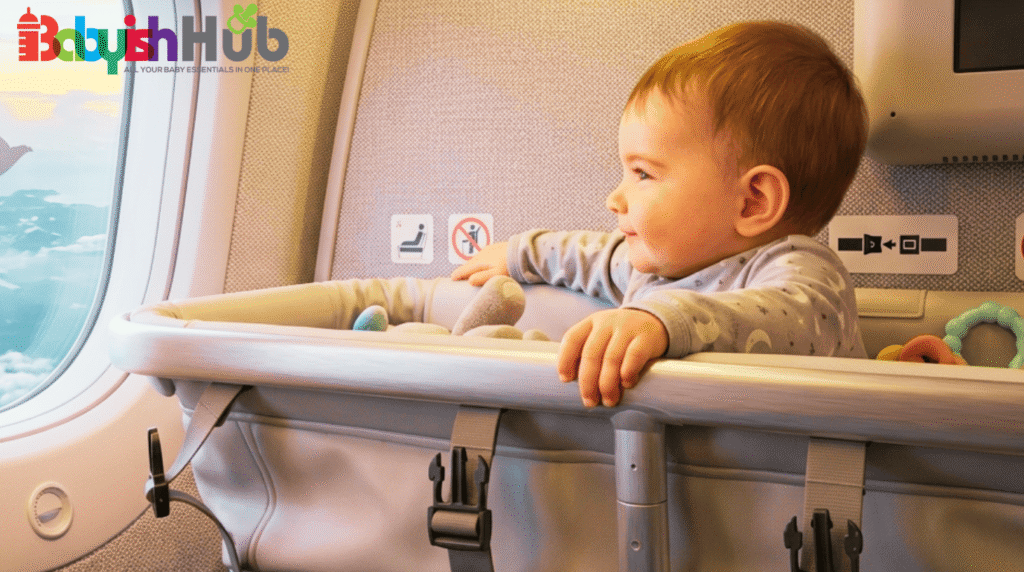
Light is the single biggest regulator of the circadian rhythm, for babies and adults alike. Once you arrive at your destination, use natural light deliberately and consistently.
If you are adjusting to an earlier time zone, get outside with your baby in the morning as soon as possible. Morning light signals to the body that it is time to wake up and start the day. Keep the environment bright and active during the hours you want your baby to be alert.
In the evenings, dim everything down at least an hour before your target bedtime. This means lamps on low, screens off, and the kind of quiet that tells a baby’s nervous system it is time to wind down.
I started traveling with a small clip-on amber night light specifically for this purpose. Hotel rooms are notoriously either completely dark or flooded with artificial light, and having something I could control made a real difference.
If you have a baby who is sensitive to light during sleep, bring a portable blackout blind. There are travel versions that attach to windows with suction cups. They are not perfect, but they block enough light to help a baby who would otherwise wake with the sun at 5 a.m. in a country where summer mornings start early.
How Feeding Schedules Affect Baby Jet Lag
Alongside light, feeding is one of the strongest cues you can use to help your baby’s body clock reset. As much as possible, try to feed your baby at your vacation or trip destination time from the moment you arrive.
I know this sounds easy until you are on the plane and your baby is hungry three hours before the local meal time you are aiming for. Be flexible during travel itself.
Once you land, though, hold your feeding schedule to local time as closely as you can manage.
If you’re formula-feeding your baby, this is a bit more structured and easier to track. (Check out our recent guide on how to travel with baby formula).
For breastfed babies, however, this can mean offering the breast at your target feeding windows even if your baby is not showing strong hunger cues yet. A gentle offer often results in at least a small feed, which helps anchor the biological signal.
On our third trip, which was a five-hour difference, I kept a simple note on my phone with local feed times written out for the first two days.
It sounds overly organized, but when you are sleep-deprived and disoriented, having something to glance at saves mental energy.
Best Nap Strategies for Babies Adjusting To Time Zones
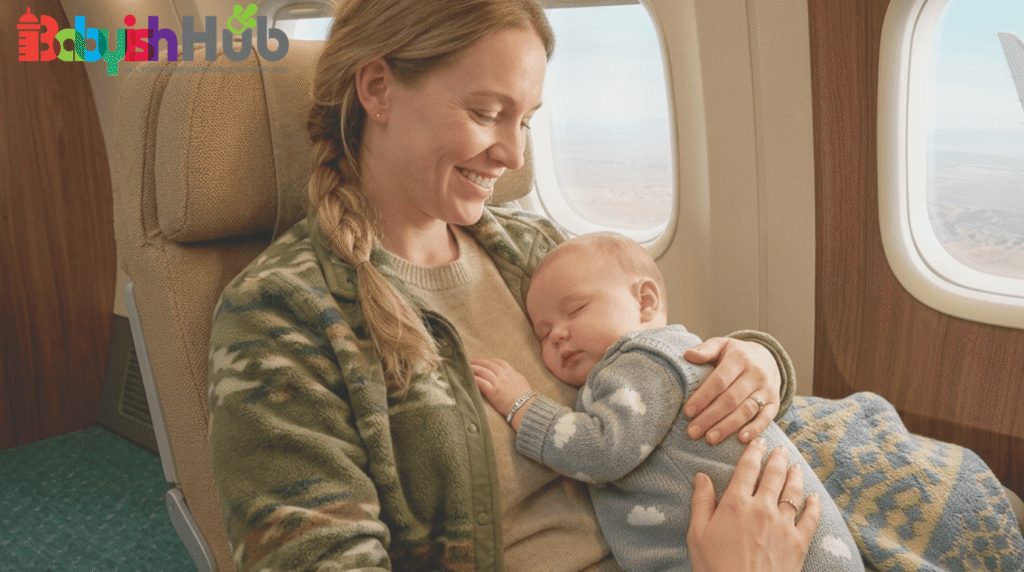
Naps are where time zone adjustments get genuinely complicated, because you need them to bridge the gap without letting your baby sleep so long that nighttime becomes a lost cause.
On arrival day, if your baby needs to sleep, let them. A completely overtired baby adjusting to a new time zone is a harder problem than a slightly off nap schedule. However, try to cap naps at around forty-five minutes if they fall too close to what you want your target bedtime to be.
In the days following, gently nudge nap times toward the local schedule rather than forcing an abrupt shift. If your baby normally naps at 10 a.m. and 2 p.m. and the time zone has shifted those biological windows by four hours, you might see them getting drowsy at unusual local times.
Try to hold them fifteen to twenty minutes past that drowsy window and then offer a nap. You are walking a narrow line between overtired and off-schedule, and it takes a bit of reading your baby’s cues.
What never worked for us was refusing naps entirely in an attempt to force nighttime sleep. A severely overtired baby does not sleep better at night. They sleep worse, and they wake more.
Better to allow a controlled nap and manage the timing than to skip it and deal with a fragmented, miserable night.
How To Help Your Baby Sleep Better In A New Place
This one made a bigger difference than I expected… Babies do not just sleep on a schedule. They sleep by association. If your baby is used to falling asleep with a white noise machine, a certain swaddle, or a specific sleep sack, those things should travel with you.
We had a small portable white noise machine that went everywhere. It helped mask unfamiliar sounds in hotel rooms and created an auditory cue. That said, this is sleep time, even when the visual environment was completely different.
After a few trips, my son would visibly relax the moment he heard it turn on.
Bring the sleep sack or swaddle they use at home. Bring the lovey or comforter if they have one. Try to replicate your bedtime routine as closely as the space allows, even if it is a stripped-down version. Bath, feed, dim the lights, white noise, sleep.
This sequence, even abbreviated, communicates something familiar to a baby navigating an unfamiliar place.
How long does It Take A Baby To Adjust To A Time Change?
Here is the honest part that most travel guides leave out: adjustment takes time, and how much time depends on the age of your baby, the size of the time difference, and the individual child.
A rough guideline is one day of adjustment for every hour of time difference, though babies often need more. A two-hour shift might resolve in two or three days. A five or six-hour shift might take closer to a week.
Plan your trip with this in mind. If you arrive on a Sunday and have an important event on Monday, you are setting yourself up for difficulty.
Also, adjust your expectations for yourself. You are dealing with jet lag too, often on less sleep than usual, while managing a baby who is confused and possibly fussier than normal. Give yourself the same grace you are giving your baby.
On our second trip, I built in two low-key days at the start with no plans and no obligations. Those two days of gentle adjustment made the rest of the trip genuinely enjoyable rather than a survival exercise.
What To Do When Your Baby Wakes Up at Night After Travel?
They will. Even with the best preparation, your baby will likely wake at least once or twice during the adjustment period at an unexpected hour. How you handle those wakings can either help the adjustment along or work against it.
When my son woke at 2 a.m., convinced it was morning, my instinct was to turn on a light, offer a full feed, and engage with her the way I would during a daytime wake.
That made things significantly worse. He was fully activated by the light and the stimulation and took another two hours to resettle.
What worked better was keeping the environment dark, keeping my voice low and calm, offering a brief comfort feed if he was hungry, and resisting the urge to make the wake-up feel like a normal start to the day.
The message you want to send at 2 a.m. is: it is still nighttime, we are going back to sleep. Everything about how you respond reinforces or undermines that message.
If your baby is not hungry but is awake and fussing, try the same settling techniques you use at home rather than introducing something new.
Familiar comfort, minimal stimulation, and patience are your best bets here.
FAQs About Adjusting Baby To Time Change Travel
If you are reading this before a trip and still have specific questions, the ones below come up most often from parents navigating this for the first time.
How long does it take for a baby to adjust to a time change when traveling?
Most babies need roughly one day per hour of time difference to fully adjust, though many take longer. A two-hour shift may resolve within two to three days. A five-hour difference can take up to a week. Younger babies and those with sensitive temperaments often need more time than older, more adaptable infants.
Should I keep my baby on home time or switch to local time immediately when we arrive?
Switch to local time as soon as you land. Keeping your baby on home time prolongs the adjustment and makes it harder for their body clock to reset. Use local light cues, feeding times, and nap windows from day one to help their circadian rhythm sync faster with the new environment.
Is it better to travel east or west with a baby when crossing time zones?
Traveling west is generally easier for babies and adults. Flying west means gaining time, so you are asking your baby to stay up a little longer than usual, which most babies manage reasonably well. Flying east requires falling asleep earlier than the body expects, which tends to be harder and takes longer to adjust.
Can I use melatonin to help my baby adjust to a new time zone?
Melatonin should not be given to babies without explicit guidance from a pediatrician. It is not approved for infants, and dosing is poorly understood in this age group. Light management, consistent feeding schedules, and familiar sleep routines are safer and effective ways to support circadian adjustment in babies.
What if my baby completely refuses to sleep at the new local bedtime?
Don’t get tempted to force sleep. Instead, keep the environment dim and calm, maintain your bedtime routine, and offer comfort without full stimulation. If sleep does not come within thirty minutes, a short, quiet activity in low light can prevent frustration from building. Try again within twenty to thirty minutes afterward.
Finding Your Rhythm
Knowing how to adjust baby to time change travel gets easier with experience. Your first trip may feel messy, especially during those middle-of-the-night wakeups when everyone feels exhausted and off schedule. Most babies settle faster than you expect once light exposure, feeding times, and sleep routines start lining up with the new time zone. Give yourself a few slower days if you can. A flexible mindset, familiar sleep cues, and realistic expectations make a huge difference when traveling across time zones with a baby.