25 Baby Travel Hacks Every Parent Should Know!
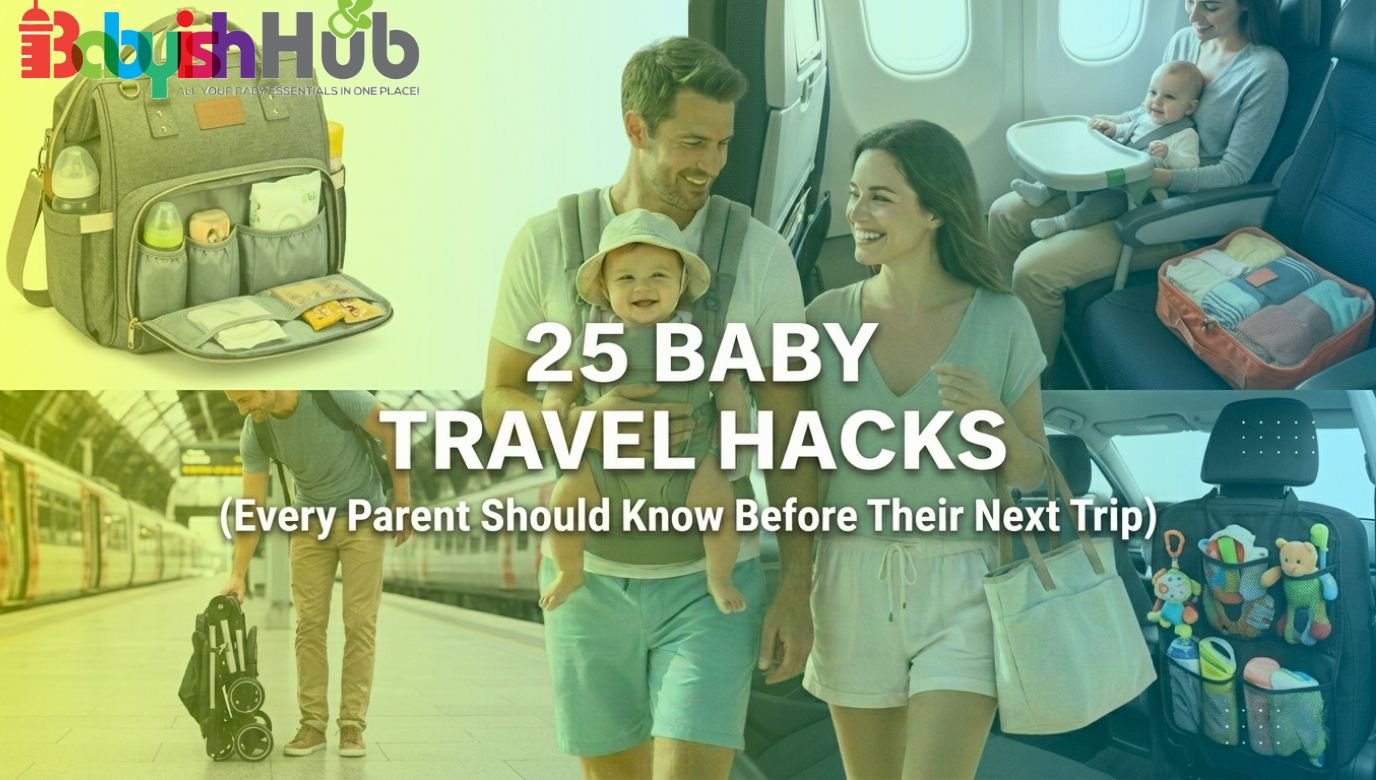
Traveling with a baby sounds terrifying until you do it the first time and realize the biggest problems weren’t the ones you worried about. It wasn’t the flight itself. It was the diaper blowout with no spare outfit within reach, the white noise app that stopped working when the plane hit airplane mode, and the hotel crib that wasn’t available at 10 pm after a six-hour travel day. The right preparation doesn’t eliminate chaos… it just means you have what you need when it hits. These 25 baby travel hacks are the ones that come from experience, the kind you pick up after one trip too many of winging it.
TL;DR: Best Baby Travel Hacks:
The best baby travel hacks include packing individual zip bags with complete outfit changes, traveling during your baby’s nap or sleep window, feeding during takeoff and landing to ease ear pressure, bringing a portable white noise machine for unfamiliar sleep environments, keeping emergency supplies within arm’s reach during transit, and requesting a crib in advance at your accommodation. These strategies reduce the most common travel-day stressors and help the whole trip run more smoothly.
25 Baby Travel Hacks That Make Traveling Easier
These simple, parent-approved tips and clever tricks will help make traveling with a baby smoother, easier, and less stressful.
1. Create A Baby Travel Checklist Before Packing
Start here, every single time! Yes, even if you’ve traveled with your baby before. The mental load of remembering everything a baby needs while also managing your own packing is quite overwhelming, and something will get left behind if you rely on memory alone. A written baby travel essentials checklist you can reuse across trips catches the things your brain drops: the nose suction, the specific brand of diaper cream your baby’s skin tolerates, and the one pacifier clip that stays clipped. Write it once, save it, update it after every trip with whatever you forgot, and it becomes more valuable each time you use it.
2. Pack Outfits in Individual Zip Bags
This single hack changes how diaper blowout emergencies feel on the road. Instead of digging through a full suitcase for a onesie, pants, and socks separately while holding a screaming baby in a gas station bathroom, you pull out one bag and have everything you need in ten seconds. Each zip bag holds one complete outfit: a shirt, bottom, socks, and a spare outfit bag goes in the diaper bag for the flight or car ride. You’ll be surprised how much calmer a messy situation feels when you’re not hunting for matching pieces.
3. Bring More Diapers Than You Think You’ll Need
Whatever number you’ve calculated, add a third more. Delays happen. Traffic happens. The one afternoon you’re stuck on the tarmac for two hours happens. Running short on diapers in an airport terminal or mid-highway is a specific kind of stress that is entirely avoidable. Diapers are also bulkier to buy in small quantities at travel markup prices than to bring from home. Pack the extras, and if you don’t use them, they’ll be waiting for you when you get back.
4. Pack An Extra Change of Clothes for Yourself
Parents remember this one only after they’ve needed it and didn’t have it. Your baby spits up on you at the gate. A diaper change goes sideways mid-flight. You arrive at your destination with formula on your shoulder and nothing to change into until your checked bag arrives. Tuck one complete outfit for yourself in your carry-on. It takes up almost no space, and the one time you need it, you’ll be grateful beyond measure.
5. Use Packing Cubes To Separate Baby Essentials
A packing cube for baby clothing, one for feeding supplies, and one for sleep gear means you never unpack your entire bag looking for one item. When you reach your destination at midnight with a tired baby, you pull out the sleep cube and have everything you need without touching anything else. Packing cubes also compress clothing down significantly, which matters when you’re already carrying more gear than usual.
6. Keep A Dedicated Diaper Changing Kit
A small pouch that stays stocked and ready to grab for any bathroom trip — three to four diapers, a travel-size pack of wipes, a portable changing mat, and a small amount of diaper cream — means you never have to repack the changing setup between outings. You grab the pouch and go. No rummaging through the full diaper bag trying to remember if you refilled the wipes.
7. Schedule Travel Around Your Baby’s Sleep Times
A baby who is already asleep when the car starts moving, or the plane takes off, is a gift you can give yourself with a bit of planning. Night flights, early morning departures, and road trips that begin at nap time all dramatically increase the odds of a calm journey. This isn’t always possible, but when you have flexibility in booking, it is one of the highest-impact decisions you’ll make for the entire trip.
8. Feed Your Baby During Takeoff and Landing
The pressure changes during takeoff and landing cause the same discomfort in a baby’s ears that adults feel. The difference is that a baby cannot pop their own ears and has no way to understand what’s happening. Sucking and swallowing help equalize ear pressure, so feeding during these windows, whether nursing, bottle feeding, or giving a pacifier, gives your baby active relief rather than waiting for the discomfort to pass on its own. Keep a bottle or nursing cover easily accessible before you board, not buried in the overhead bin.
9. Use A Baby Carrier in Busy Airports
A stroller is useful for long stretches of walking, but in the security line, the boarding gate, and any crowded terminal where maneuvering is difficult, a carrier keeps your hands free and your baby close without the spatial negotiation of a frame and wheels. Many parents travel with both: the stroller for the long hauls and the carrier for the tight spots. The carrier also means you can gate-check the stroller early and not have to navigate it through the jet bridge.
10. Take Advantage of Family Boarding
Most airlines offer pre-boarding for families with young children, and it is worth every second. Boarding before the main crowd means you have time to get settled, stow the diaper bag properly, set up your seat area with what you need within reach, and get your baby comfortable before the rest of the plane files in around you. Parents who skip pre-boarding to avoid the plane time underestimate how much easier the setup process is without 150 people trying to squeeze past you.
11. Bring A Lightweight Travel Stroller
A full-size stroller in an airport is manageable until it isn’t — the escalator, the crowded gate, the narrow jet bridge. A lightweight travel stroller under 15 pounds with a compact fold and a gate-check bag gives you mobility throughout the trip without the bulk. You’ll use it in airports, at your destination, and on the way home, and you’ll be visibly relieved every time you fold it with one hand while holding your baby with the other.
12. Pack A Few New Toys
Novelty is one of the most reliable tools for keeping your baby engaged, and a toy your baby has never seen before buys you more distraction time than a familiar favorite. (Source). Wrap two or three small, new toys before the trip — board books, a textured sensory toy, a simple cause-and-effect toy — and bring them out one at a time. The unwrapping itself is often as engaging as the toy. Keep them small enough to fit in a zip bag and quiet enough not to earn glares from fellow passengers.
13. Rotate Toys Instead of Offering Them All at Once
This one feels counterintuitive but works consistently. If you put five toys in front of a baby, they move through all of them quickly and are done with all five in twenty minutes. If you offer one, let them engage with it fully, then swap to the next when interest fades, you stretch the same five toys across an entire flight. Put the not-yet-offered toys completely out of sight. A baby who can see the other options will always want the one they don’t have.
14. Download Entertainment Before You Leave
Airplane WiFi is unreliable, hotel WiFi is slow, and the one episode of the show your toddler will sit still for is absolutely not going to load over a cellular connection in a mountain resort. Download everything before you leave (this includes shows, apps, white noise tracks, and lullaby playlists) and switch devices to airplane mode to confirm everything plays offline before the day of travel. Discovering a download failed is much less stressful at home than at 30,000 feet.
15. Dress Your Baby In Comfortable Layers
Airplane cabins swing between stuffy and freezing, cars do the same, and your baby cannot tell you they’re too hot or too cold beyond the general signal of crying for an unclear reason. Layers you can add or remove quickly (a onesie under a zip-up sleeper, a light jacket that goes on or off in seconds) mean you can respond to temperature changes without a full outfit change. Avoid anything with multiple snaps at the crotch during travel days. You’ll thank yourself every single time.
16. Pack Snacks In Multiple Locations
One pouch of snacks in the diaper bag runs out, and then you’re negotiating with a hungry toddler while your hands are full. Distribute snacks across carry-on pockets, the diaper bag, your personal bag, and even a jacket pocket so you always have something within reach, regardless of what you can access at any given moment. For babies on solids, pouches and puffs travel well, require no prep, and create minimal mess in a car seat or airplane seat.
17. Bring A Portable White Noise Machine
Your baby has been falling asleep to white noise in the same room for months. A hotel room in a city, a vacation rental near a busy street, or a room shared with adults talking in the next bed sounds nothing like home. A portable white noise machine that’s small enough to clip to a stroller or pack in a zip bag recreates the most important sensory cue for sleep in an unfamiliar environment. It is one of the highest-impact items you can pack for any trip where your baby will need to nap or sleep in a new place.
18. Recreate Your Baby’s Bedtime Routine
The routine itself is a sleep cue, not just the individual steps within it. Bath, lotion, pajamas, sleep sack, feeding, song — running the same sequence in the hotel bathroom signals to your baby’s nervous system that sleep is coming, even in a room they’ve never been in before. Bring the specific bath wash they use at home, the same sleep sack, and the same comfort item. Familiar scents and sequences carry more weight than the physical environment when it comes to helping a baby settle in a new place.
19. Request A Crib Before Arriving at Your Accommodation
Call or email ahead to confirm a crib or pack-and-play will be available and set up in your room before you check in. Do not assume it will be there. Many hotels have a limited number of cribs, and they go to guests who ask first. Arriving at 10 pm with a baby who needs to sleep immediately and discovering the crib is in use elsewhere, or worse, doesn’t exist, is the kind of situation that ruins the first night of an entire trip. Confirming in advance takes two minutes.
20. Do A Quick Baby-Proofing Check Upon Arrival
Before you put a mobile baby down, walk the space at their level. Uncovered outlets, exposed cords, low table corners, unsecured furniture, and accessible bathroom doors are the things that weren’t on your radar before you had a baby and are now the first things you notice. Move anything breakable or dangerous out of reach and identify the spaces your baby can safely explore before they do it on their own terms. This takes less than five minutes and eliminates a significant source of trip anxiety.
21. Plan Frequent Stops During Road Trips
A baby who has been in a car seat for three hours needs to get out, move, feed, and have a diaper change before going back in. And trying to push through that need to make better time costs you far more time than the stop would have. Build stops into your road trip route intentionally, roughly every 90 minutes to two hours, and look for rest stops with space to lay a changing pad on a clean surface, or a quiet parking lot where you can spread out for ten minutes. A baby who gets regular resets travels better than one who’s been stretched past their limit.
22. Keep Emergency Supplies Within Reach
Everything you might need in a crisis should be in a bag you can reach while buckled on a plane or in the front seat of a car. That means infant pain reliever for the fever that appears mid-flight, a full diaper change kit, one complete change of clothes for the baby and one for you, extra wipes, and a comfort item if your baby has one. The items you need in an emergency are the ones that do you no good in an overhead bin or a trunk. Pack the emergency kit in the bag that never leaves your reach during transit.
23. Research Where To Buy Baby Supplies At Your Destination
Formula, diapers, and bulky food pouches don’t need to travel with you if you can confirm they’re available near where you’re staying. A quick search before you leave for the nearest pharmacy, grocery store, or Target equivalent at your destination means you can pack lighter and purchase what you need on arrival rather than checking an extra bag of supplies. This is especially useful for formula families, since buying a small amount at the destination can save significant luggage space.
24. Allow Extra Time for Everything
Check-in takes longer. Security takes longer. Boarding takes longer. Meals take longer. Everything you’d normally do in a set amount of time takes between 30% and 100% longer with a baby in tow, and that math compounds when you have multiple transitions in one travel day. Build buffer into your schedule so that a slow restaurant order doesn’t make you late for a reservation, and a longer-than-expected nap doesn’t mean rushing to make a checkout time. The extra time you build in is almost never wasted, and when it is, you’ve earned a few quiet minutes.
25. Lower Expectations and Stay Flexible
This is the baby travel hack no packing list can give you: Some days will go sideways regardless of how well you prepared. A nap that doesn’t happen, a flight delay, a baby who decides the car seat is suddenly the worst thing that has ever been invented — these are not failures of planning. They’re just travel with a baby. The families who come home from trips feeling good are almost always the ones who went in expecting things to go imperfectly and stayed loose enough to adapt when they did. The trip doesn’t have to be flawless to be worth doing.
[BONUS] Quick Baby Travel Essentials Checklist:
Diapering Essentials:
- Diapers (pack more than you think you need)
- Wipes
- Portable changing mat
- Diaper cream
- Zip bags for outfit changes
Feeding Essentials:
- Bottles or nursing supplies
- Formula or breast pump equipment
- Bibs
- Snacks distributed across bags
- Bottle warmer or thermos if needed
Sleep Essentials:
- Sleep sack
- Favorite comfort item
- Portable white noise machine
- Blackout option for hotel windows (a sleep mask or packing tape over gaps works in a pinch)
Health and Safety Essentials:
- Infant pain reliever
- Thermometer
- Nasal aspirator
- Bandages and antiseptic
- Any prescription medications with documentation
Frequently Asked Questions About Baby Travel Hacks
Traveling with a baby can feel overwhelming, but a few simple tricks can make the journey much smoother. Here are answers to some of the most common questions parents ask about baby travel hacks:
What are the best baby travel hacks for first-time parents?
Start with three fundamentals: a written packing checklist you build out before every trip, scheduling travel around your baby’s sleep windows whenever possible, and always keeping your emergency supplies within arm’s reach during transit. First-time parents tend to overpack the non-essentials and underpack the things they’ll need in a pinch: diapers, a change of clothes for themselves, and a portable white noise machine. Get those three right, and the rest becomes easier to manage.
How do I make flying with a baby easier?
Use family boarding so you have time to settle before the crowd boards. Feed during takeoff and landing to help with ear pressure. Keep a fully stocked carry-on with one complete outfit change for the baby and one for yourself, snacks if the baby is on solids, and entertainment downloaded and confirmed offline before you leave. A baby carrier for the airport itself and a lightweight stroller for gate-checking gives you flexibility at both ends of the journey.
What should I always pack when traveling with a baby?
The non-negotiables: more diapers than you’ve calculated, a complete spare outfit per anticipated travel day plus one extra, wipes in quantities that feel excessive, feeding supplies, a comfort item from home, a portable white noise machine, and a small emergency kit within reach at all times. Everything else is helpful but not critical. Pare down the extras if you’re flying carry-on only. The less you carry, the more mobile you are.
Is it better to travel during naps or bedtime?
For most babies, yes. Scheduling a flight or a long drive segment to coincide with a nap or overnight sleep window is one of the most effective baby travel hacks available. A baby who falls asleep shortly after takeoff or after the car starts moving is much easier to travel with than an alert, overstimulated baby trying to make sense of a new environment. The caveat is that some babies find transit too stimulating to sleep regardless of timing, so know your baby’s temperament before you plan the whole trip around a nap that may not happen.
Baby Travel Hacks Key Takeaways
Traveling with a baby is preparation, flexibility, and realistic expectations working together. No single hack makes the whole trip easy, but a handful of the right ones (i.e., the packed spare outfit, the pre-downloaded white noise, and the early crib request) quietly remove the moments that would have derailed the day. Save the checklist, try a few new hacks on your next trip, and adjust as you learn what works for your specific baby. The trips get easier, and the stories from the ones that didn’t go perfectly are almost always the ones worth telling.