7 Baby Travel Essentials For Flights, Road Trips, Hotels & More
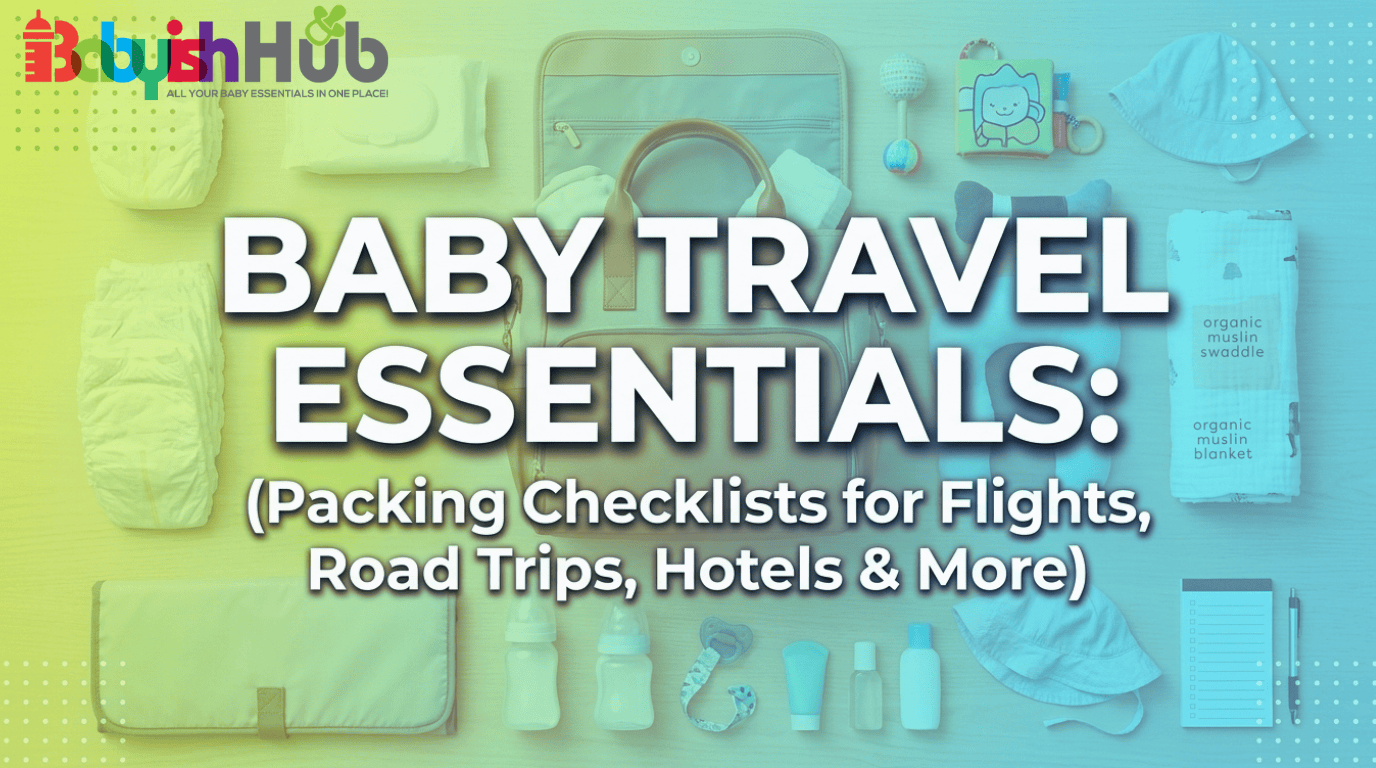
The first time I packed for a trip with my oldest, I stood in the living room surrounded by what looked like the entire contents of a baby store and still managed to forget the nursing cover. We were going through airport security when I realized it, and I spent the next four hours improvising with a muslin swaddle and a lot of, you know, strategic positioning.
That trip taught me something no packing list article had ever told me: the problem is never that parents pack too little. The problem is almost always that they pack the wrong things.
Traveling with a baby doesn’t have to be the exhausting ordeal it gets made out to be in parenting culture. The trips that go sideways are almost always the ones where something important got left behind or where the packing was so disorganized that finding anything in the moment was impossible. Preparation makes all the difference here.
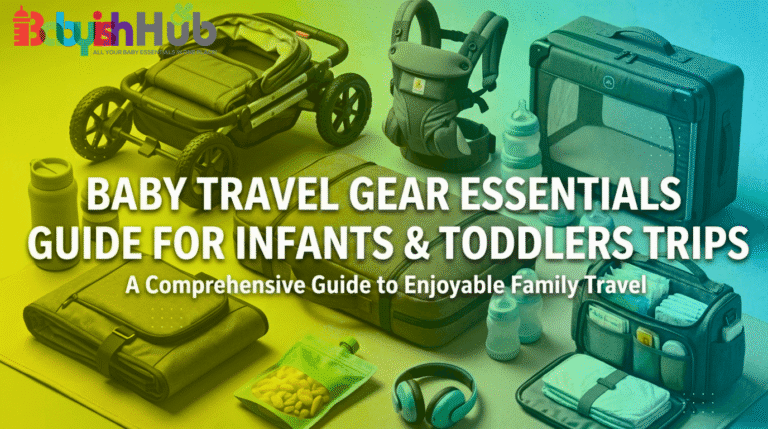
This guide covers what baby travel essentials you need for every type of trip: flights, road trips, hotel stays, short outings, international travel, and longer vacations. You will find a complete baby travel checklist you can print or bookmark, plus specific guidance for each travel scenario so you know what to prioritize and what you can comfortably leave at home.
TL;DR: Baby Travel Essentials Checklist: Key essentials include diapers, wipes, feeding supplies, sleep gear, extra clothes, a stroller or carrier, a car seat, baby medications, comfort items, and entertainment. The exact list varies depending on whether you’re flying, driving, or staying in a hotel, and how old your baby is.
In This Article:
Quick Baby Travel Checklist:
Use this as your starting point before every trip. The left column covers non-negotiables. The right column covers items that dramatically improve your travel experience but allow slightly more flexibility.
| Must-Have Basics | Comfort & Extras |
| • Diapers (more than you think) • Baby wipes • Formula or feeding supplies • Bottles and breast pump parts • Portable changing pa • Diaper rash cream • Extra outfits (at least 2 per day) • Baby blanket • Car seat • Stroller or baby carrier • Medications and thermometer • Health insurance card | • White noise machine • Portable crib or travel bassinet • Pacifiers (bring backups) • Favorite teething toy • Comfort blanket or lovey • Baby sunscreen (SPF 30+) • Portable high chair or clip-on • Snacks for older babies • Bibs and burp cloths • Disposable diaper bags • Plastic bags for dirty clothes • Portable charger |
1. Diapering Essentials
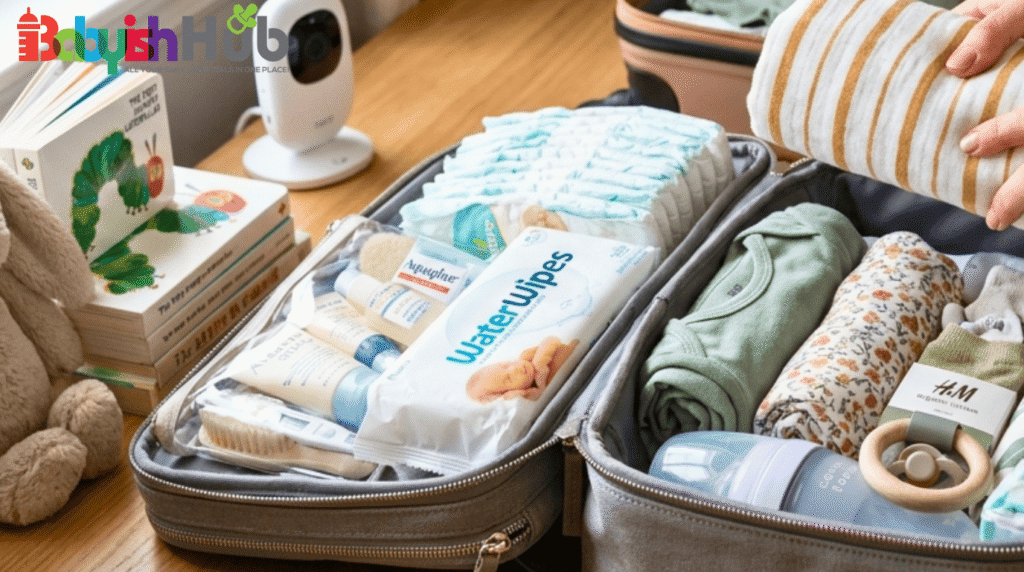
Diapers sit at the top of every baby travel checklist for obvious reasons, but the question parents consistently underestimate is how many to bring. The standard recommendation is one diaper per hour of travel time, plus four to six extras for unexpected situations.
For a three-hour flight, that means arriving at the gate with at least ten diapers in your carry-on, not counting what you need at your destination.
How Many Diapers To Pack
For flights and day trips, the per-hour-plus-buffer formula works well. For multi-day trips, plan on eight to ten diapers per day for newborns and five to six per day for babies over six months.
Rounding up is always the right call. Running out of diapers at 11 p.m. in an unfamiliar city is one of those parenting experiences you only want to have once.
For longer vacations, buying a pack of diapers at your destination rather than lugging a full supply from home is often the smarter move, particularly for road trips where you have cargo space on the return journey. Most major retailers and pharmacies stock the same name brands nationally.
Travel Wipes and Changing Gear
Wipes in a travel-size flip-top container take up far less space than a full pop-up pack and do the same job. Pack one full resealable bag per day of travel and consolidate from there.
A portable changing pad with wipeable material is worth carrying over, rather than relying on whatever surface a public restroom offers. The fold-flat styles that slip into a diaper bag pocket add almost no weight and change the quality of every public diaper change you make.
Diaper rash cream in a small tube, a handful of disposable diaper bags for sealing soiled diapers until you reach a bin, and a small spare changing pad cover round out the diapering category.
None of these items is heavy or bulky, and all of them solve a specific problem that arises regularly during travel.
2. Feeding Essentials
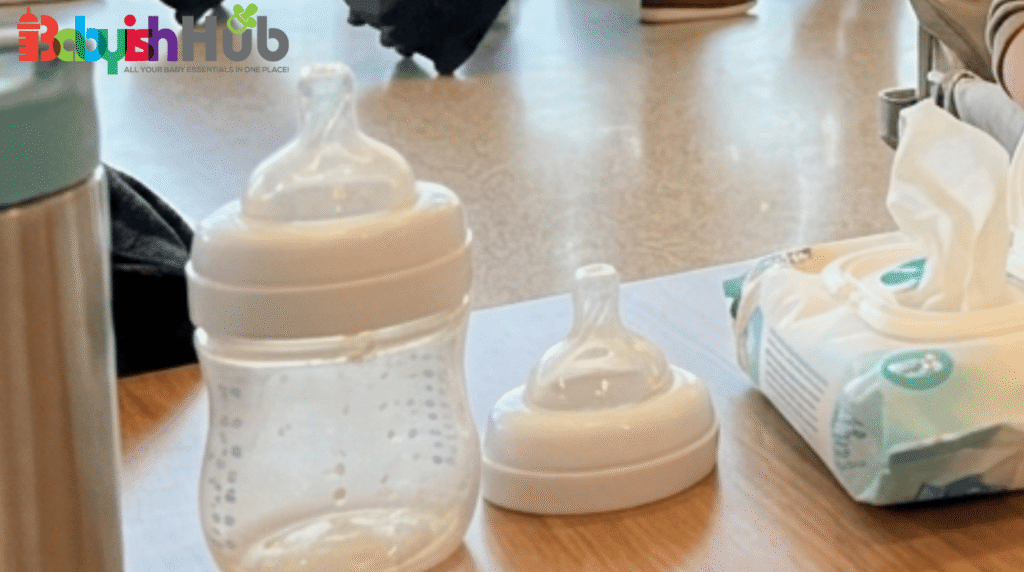
Feeding logistics depend almost entirely on how your baby eats, but there are universal considerations regardless of whether you are nursing, formula feeding, or introducing solids.
Formula and Bottle Feeding on the Road
Pre-measuring formula into individual portions using a formula dispenser container is one of the small preparations that makes a big practical difference.
Measuring formula on an airplane tray table while turbulence hits is not a situation anyone enjoys.
Single-serve formula packets are heavier on cost but light on hassle for flights or day outings where simplicity matters most.
TSA allows formula, breast milk, and juice for infants in quantities exceeding the standard 3.4-ounce liquid rule. You need to declare these items at security, and they may be subject to additional screening.
Keeping feeding liquids in a clearly accessible top pocket of your bag speeds up the process significantly at busy checkpoints.
Nursing While Traveling
A nursing cover or a large muslin swaddle gives you options in public spaces without requiring a dedicated nursing room.
Airport nursing rooms exist at many major US airports, but are not universally available, and relying on finding one at a specific moment adds pressure to an already full travel day.
Having your own coverage means feeding whenever and wherever the baby needs it.
Portable Bottle Warmer
A car-powered bottle warmer is one of the more genuinely useful road trip tools for formula-feeding families.
It plugs into the car’s USB or 12-volt port and brings a refrigerated bottle to feeding temperature during the drive, so the timing works out with rest stops.
For flights and hotel stays, a small insulated bottle bag holds temperature long enough to manage without a warmer in most situations.
Solid Food and Snacks
For babies eating solids, pouch purees are the most travel-friendly option: no utensils required, no refrigeration needed before opening, and easy to portion.
Puffs, small crackers, and soft fruit pieces work well for older babies and give them something to engage with during long stretches.
Pack snacks in a dedicated zippered pouch at the top of the diaper bag so you can reach them without unpacking everything.
3. Baby Sleep Essentials
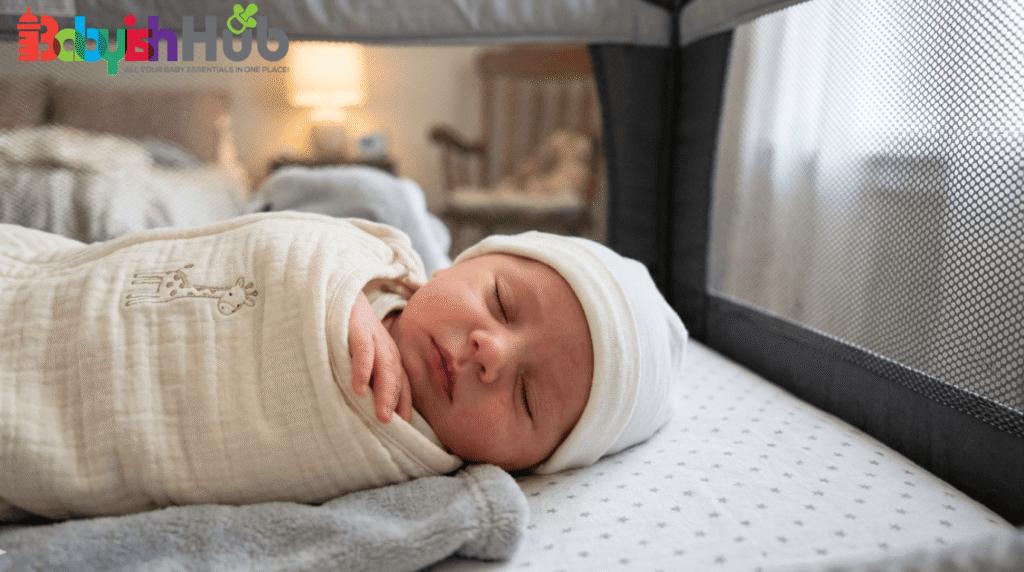
Sleep is where your baby’s travel falls apart most reliably. A baby who sleeps beautifully at home can become a completely different child in a hotel room, and the disruption ripples into everything else about the trip. Getting an ideal sleep setup while travelling takes significant effort. You’ll need:
Portable Crib and Travel Bassinet
Most hotels will provide a pack-and-play on request, but the quality varies, and availability is not guaranteed.
Bringing your own portable/foldable travel crib, particularly one your baby has slept in before, introduces a familiar element into an unfamiliar environment.
For very young babies, a travel bassinet that folds flat fits in most suitcases and creates a sleep space that feels more contained and familiar than a full pack-and-play.
Always check the portable sleep surface you plan to use against current safe sleep guidelines.
The surface should be firm and flat with no added padding, pillows, or positioners. A fitted sheet designed for the specific product is the right bedding choice.
White Noise Machine
A compact white noise machine is one of the most frequently overlooked baby travel must-haves and one of the most impactful.
Hotel rooms sit near ice machines, elevators, and corridor noise. The consistent sound of a white noise machine muffles those disruptions and signals to a sleep-trained baby that sleep time is beginning, even in an unfamiliar place.
Several models fit in a coat pocket. The investment is small, and the sleep dividend is well worth it.
Blackout Solutions
Hotel blackout curtains are inconsistent. The gap down the middle of paired drapes can let in enough morning light to wake a baby who would otherwise sleep another hour.
A portable blackout curtain with suction cups, or even large black trash bags and painter’s tape in a pinch, creates the dark environment that most babies sleep better in.
It takes three minutes to set up and is one of those hotel-stay details that parents who do it once never skip again.
Familiar Sleep Items
Here’s my little piece of advice: Whatever your baby associates with sleep at home, bring it on the trip. A specific swaddle blanket, a particular sleep sack, a lovey that goes in the crib, and the pacifier style they prefer.
Young children often rely more heavily than adults on familiar sleep cues and routines. Transitional objects, bedtime rituals, and consistent sleep environments can help provide a sense of continuity and security, especially when sleeping in unfamiliar locations. (Source).
4. Stroller and Transportation Gear
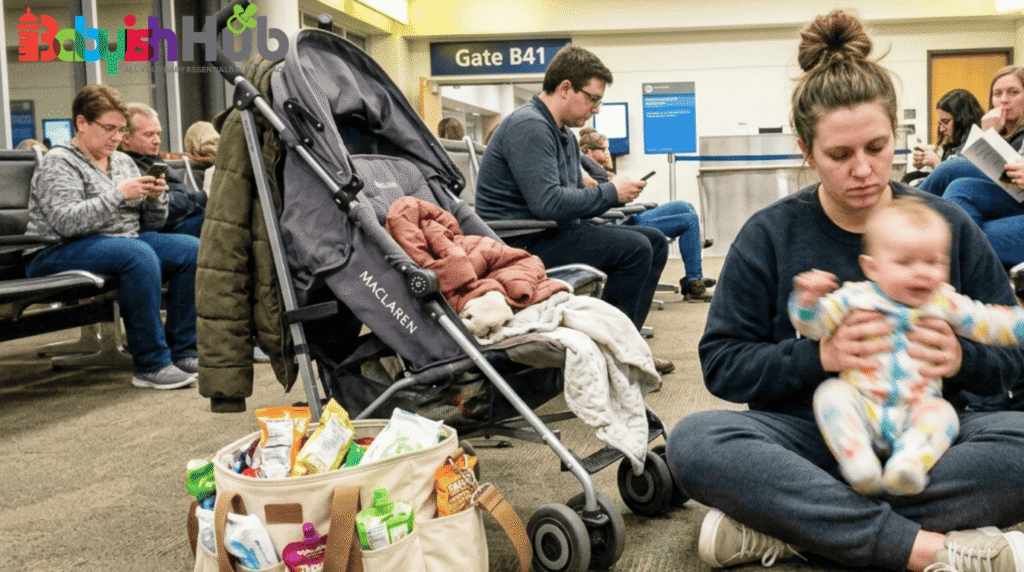
Reliable transportation gear helps you navigate crowded airports, busy streets, and long sightseeing days with ease. The right stroller and travel accessories keep your child comfortable and make every journey more manageable.
Lightweight Travel Stroller Vs Full-Size Stroller
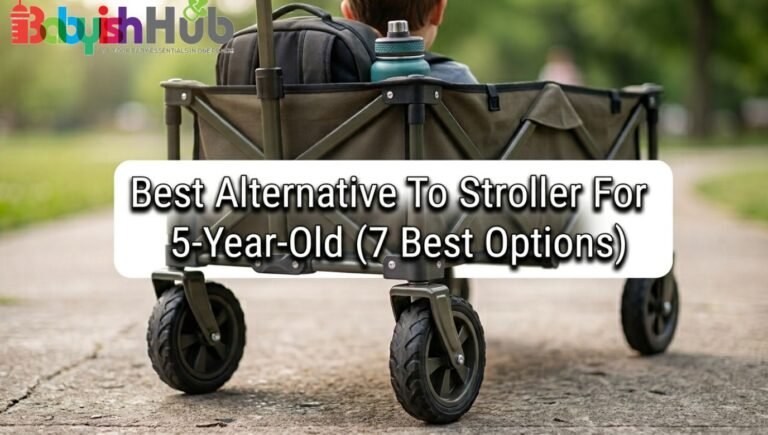
Bringing your full-size stroller on a trip is reasonable for road trips where cargo space exists and for longer vacations with a baby, where you will use it daily.
For flights, a lightweight umbrella-style travel stroller is a significantly better choice because:
- It checks at the gate for free on most US airlines
- It folds quickly
- It fits in overhead bins on some aircraft
- It doesn’t require the heavy-duty protective bags that full-size strollers need to survive the cargo hold.
The tradeoff with lightweight strollers, however, is recline and infant compatibility. (Learn more in our guide on how to choose a baby stroller)
If your baby is under six months and not yet sitting independently, check that the stroller you bring supports a flat or near-flat recline. Some compact strollers are rated for six months and up only.
Related: How To Travel With A Car Seat And A Stroller
Car Seat And Car Seat Travel Bag
Never skip the car seat for any trip that involves a car, rental or otherwise. Installing a familiar car seat in a rental car takes the same time as installing an unfamiliar one, and you know it is properly secured.
For flights, a padded car seat travel bag protects against the rough handling that gate-checked items receive and allows you to carry it as a backpack through the terminal.
Baby Carrier
A baby carrier earns its place on every baby travel essentials checklist because it solves problems that a stroller simply cannot.
Getting through airport security with a stroller involves folding, lifting, reassembling, and managing a baby separately through the scanner.
A carrier keeps the baby on you through the entire process. It also keeps your hands free during boarding, fits through crowds that strollers cannot navigate, and provides a familiar, close-contact environment that often helps babies sleep during transit.
For travel purposes, a ring sling or a structured carrier with quick-adjust buckles is more practical than a wrap-style carrier that requires several minutes to put on and take off correctly.
5. Clothing Essentials
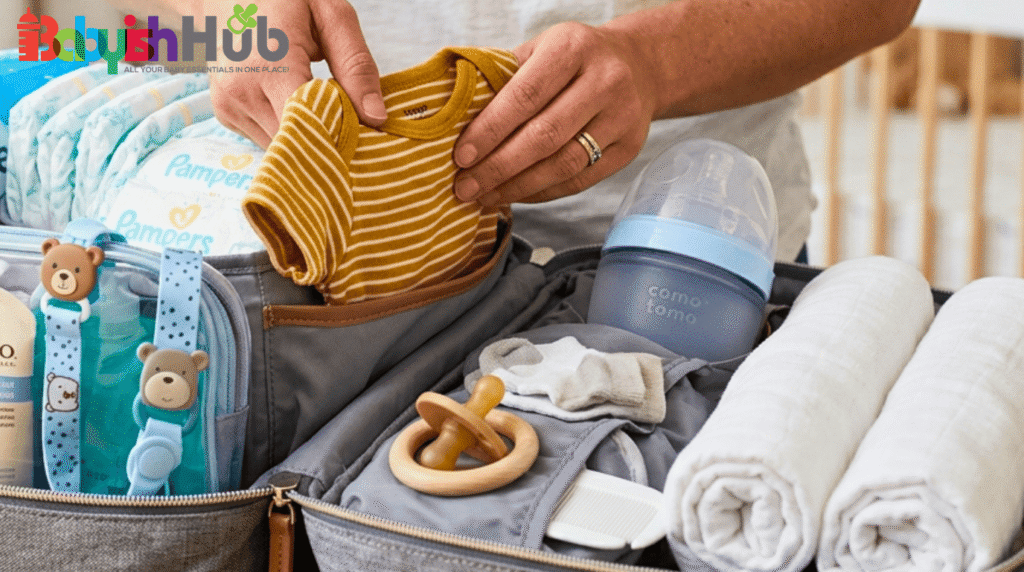
These clothing essentials will help you prepare for everything from travel days and outdoor adventures to unexpected spills and weather changes.
How Many Outfits To Pack for A Baby
The standard guidance for baby clothing is two complete outfits per day, plus two or three spares for the whole trip. In practice, this means packing more than you would for yourself relative to the trip length.
A blowout, a feeding spill, or an unexpected weather change can go through multiple outfit changes in a single afternoon. Running out of clean baby clothes when laundry is not readily available creates exactly the kind of avoidable stress that good packing prevents.
Use The Layering Trick
Dressing a baby in layers gives you flexibility for temperature changes across airports, vehicles, outdoor activities, and air-conditioned restaurants.
A onesie base layer, a light long-sleeve layer, and a zip-up outer layer cover most conditions without requiring large individual garments.
Zip closures are faster for diaper changes than snaps, which becomes genuinely relevant by the sixth diaper change of a travel day.
Weather-Based Packing
Pack for the destination weather instead of the departure weather. If you are leaving a cold climate for a warm destination, your baby needs sun protection, breathable fabrics, and a light layer for air conditioning.
Check the forecast for your destination before packing and build the clothing list from there, rather than from what is currently on your changing table.
Hats are worth packing regardless of destination. Sun hats for warm climates, knit hats for cool ones.
Babies lose heat quickly through their heads and are more sun-sensitive than adults, so head coverage is practical rather than optional.
6. Health and Safety Essentials
No one wants to think about their baby getting sick during a trip, but having the right supplies on hand prevents a minor issue from becoming a major disruption.
This doesn’t mean you should overpack for every medical scenario; you just need to cover the situations that come up regularly. This is what you should pack:
- Infant pain reliever: Pack acetaminophen or ibuprofen dosed for your baby’s current weight. Teething pain, fever, and ear pressure during flights all call for it. Know the correct dose before you travel rather than trying to calculate it while managing a crying baby in a hotel room.
- Digital thermometer: A rectal thermometer for young infants or a temporal artery thermometer for babies over three months takes up almost no space and provides the information you need to make calm decisions if your baby feels warm.
- Baby sunscreen: For babies over six months, a mineral sunscreen with SPF 30 or higher protects during outdoor activities. For babies under six months, the American Academy of Pediatrics recommends keeping them out of direct sun and using protective clothing and shade rather than sunscreen.
- Hand sanitizer: Travel surfaces, airplane tray tables, and restaurant high chairs carry a significant germ load. Keeping a small bottle of hand sanitizer in your bag and wiping down surfaces before your baby touches them is practical prevention rather than paranoia.
- First aid basics: A small travel kit with adhesive bandages, antiseptic wipes, and infant-specific allergy medication if your baby has known sensitivities covers the most common scenarios without requiring a pharmacy bag.
Keep a photo of your baby’s health insurance card on your phone and know the general location of urgent care facilities near your destination.
Most trips never require this information, but having it takes thirty seconds and eliminates significant scrambling if it is ever needed.
7. Entertainment and Comfort Items
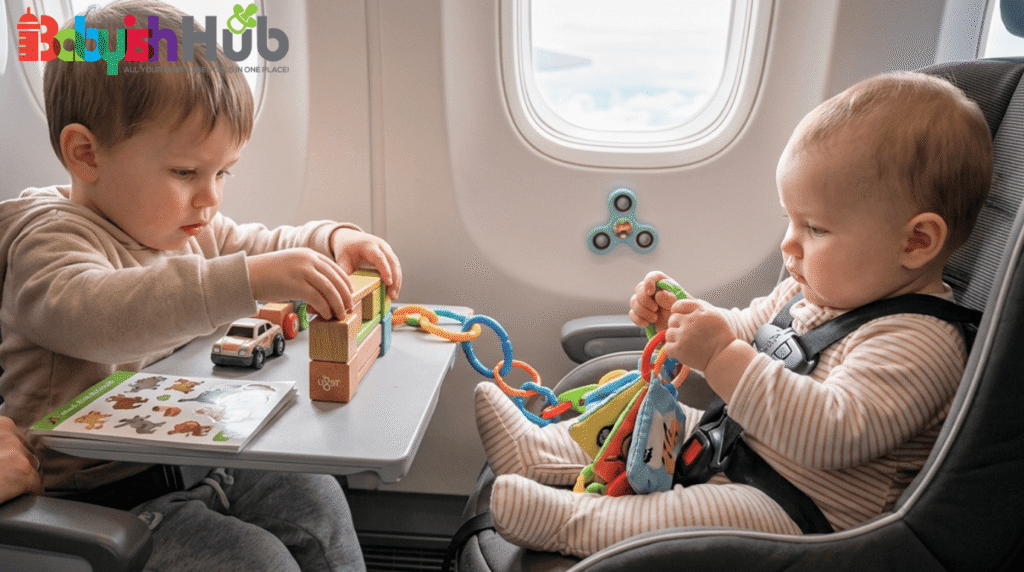
Entertainment tips for baby travel change with age, but some principles hold across most stages. Some essential items to consider include:
Teething Toys and Tactile Toys
For babies in the teething phase, a silicone teething toy or a textured ring provides sensory engagement that keeps hands and mouths busy during transit.
These are compact, lightweight, and solve a specific restlessness problem.
Clipping them to a stroller bar or diaper bag strap prevents them from hitting the floor repeatedly, which they will attempt to do.
Books
Soft fabric books or small board books are among the highest-return entertainment items for babies. They are light, quiet, and familiar.
A baby who has been read the same board book forty times at home will engage with it contentedly on a plane when everything else is unfamiliar. The familiarity is the point.
Tablets and Downloaded Content
For babies old enough to engage with video content, a tablet with a few downloaded shows or apps provides insurance for the stretches of a long flight or drive when everything else has been exhausted.
Download content before you leave rather than relying on in-flight WiFi, which is inconsistent. A pair of baby-safe headphones or earbuds keeps the sound contained to your immediate area.
Comfort Objects
Whatever your baby uses to self-soothe, whether that is a pacifier, a specific stuffed animal, a soft blanket, or a combination of all three, these are non-negotiable travel items.
Keep them in the most accessible part of your carry-on or diaper bag, not buried at the bottom.
In moments of baby distress during travel, needing to excavate the comfort object from a packed bag adds unnecessary time and stress.
Baby Travel Essentials by Type of Trip
The baby travel packing checklist above applies to every trip, but each type of travel has specific priorities worth planning for separately.
| Priority Item | Flight | Road Trip | Hotel Stay |
| Sleep gear | Travel bassinet | Portable crib | Portable crib, blackout |
| Feeding setup | Pre-measured formula | Cooler, bottle warmer | Hotel fridge formula |
| Diaper supply | 1 per hour + 4 extras | Full pack per day | Buy on arrival |
| Transportation | The carrier at the airport | Infant car seat | Compact stroller |
| Entertainment | Tablet, headphones | Window toys, music | Familiar toys from home |
| Health priority | Pain reliever for ears | Motion sickness plan | Surface sanitizing wipes |
Flying With A Baby: What You Need To Know
At airport security, remove your baby from any soft carrier and carry them through the metal detector. Strollers and car seats go through the X-ray machine.
TSA PreCheck significantly reduces the logistics of moving through security with a baby and is worth the enrollment if you fly more than once or twice a year.
During takeoff and landing, feeding your baby either by nursing or bottle helps counteract ear pressure changes. The swallowing action equalizes pressure the same way it does for adults who chew gum. (See how to protect your little one’s ears when flying).
If your baby is sleeping through takeoff, there is no need to wake them unless they show signs of discomfort.
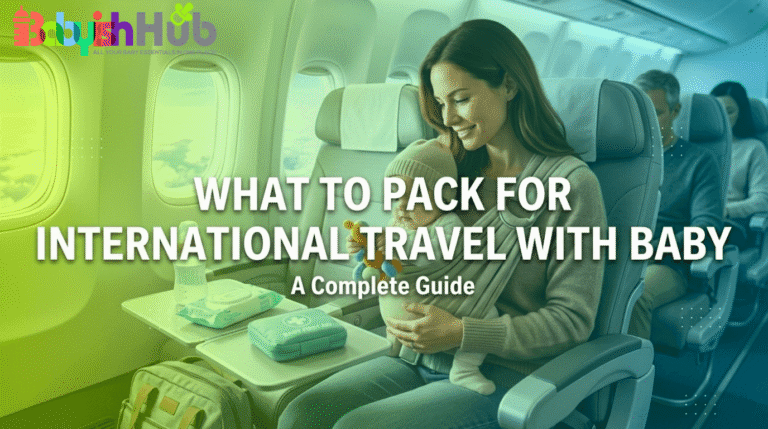
Request a bassinet seat (bulkhead row with a fold-down bassinet) when booking international flights.
These seats are available on a first-come basis on most carriers and allow a sleeping baby to lie flat during the flight rather than requiring you to hold them the entire time.
Road Trips With A Baby
Timing drives on road trips around the baby’s sleep schedule can eliminate hours of in-car fussing. A baby who naps during the first two to three hours of a long drive is a fundamentally different travel companion than one who is awake, bored, and confined to a car seat.
Plan rest stops every two hours, regardless of how well things are going. Babies need to come out of their car seats periodically, and a ten-minute stretch at a rest area is good for everyone in the vehicle.
Pack a small bag of immediate-access supplies in the back seat, within reach from the front, containing wipes, a burp cloth, a pacifier, and a snack.
Stopping the car to dig through the trunk for a single wipe every forty-five minutes adds up over a long drive.
Hotel Stays With A Baby
When you check in, ask housekeeping for extra towels and a mattress pad if you plan to use the hotel-provided pack-and-play.
Make sure you wipe down the hotel pack-and-play mattress surface with a sanitizing wipe before placing your baby in it, is crucial as these items are infrequently deep cleaned.
Set up the sleep space before unpacking anything else: get the white noise machine running, the blackout solution in place, and the familiar sleep items laid out.
This way, if your baby falls asleep in the car or carrier, you can transfer them immediately without scrambling.
What Most Parents Forget To Pack (From Personal Experience)
| Forgotten Item: | Why It Matters: |
| Backup pacifiers | Pacifiers drop and disappear at the worst moments. Pack two to three, kept in separate bags. |
| Infant pain reliever | Teething flares, ear pressure on flights, and unexpected fevers. Dosing by weight matters, so bring the right bottle. |
| Portable charger | Baby monitors, white noise apps, and entertainment tablets all drain battery. A charged power bank is your sanity saver. |
| Plastic zip bags | For wet swimsuits, soiled clothing, half-eaten snacks, and any leak situation. Pack at least ten. |
| Extra bibs | One bib per feeding sounds right until a blowout changes the math. Pack twice what you think you need. |
| White noise machine | Hotel rooms are louder than home. A familiar sound environment can be the difference between a sleeping baby and a wakeful one. |
| Portable nightlight | Middle-of-the-night feedings in an unfamiliar dark room are harder than they need to be. |
| Written feeding plan | If a caregiver watches your baby at the hotel, having a written schedule prevents guessing during tired moments. |
How To Avoid Overpacking for Baby Trips
Overpacking with a baby is extremely easy to do and creates its own set of travel problems: think heavy bags, things getting lost inside large packs, and the mental load of managing more gear than you need.
- Prioritize by frequency: If you will use it multiple times per day, it earns a space in the bag. If it solves a problem that comes up once a week at home, you probably do not need it for a three-day trip.
- Use hotel and laundry services: Most hotels offer laundry service, and laundromats exist at nearly every destination. Packing four days of clothing for a seven-day trip and doing one load of laundry is lighter and simpler than packing seven days of outfits plus spares.
- Buy some items at your destination: Diapers, wipes, formula, baby snacks, and basic medicines are available at pharmacies and grocery stores in virtually every US city and most international destinations. Buying a pack of diapers when you land rather than lugging five days’ worth through an airport is a meaningful weight reduction.
- Organize by category: Using packing cubes or zippered pouches by category (diapering, feeding, clothing, health) means you can find what you need immediately, rather than unpacking the entire bag to locate one item. The time saved across a three-day trip is significant.
Best Baby Travel Gear Worth Buying
Not everything labeled as baby travel gear delivers on the promise, but these few categories will prove worth a purchase, especially if you travel frequently.
- Lightweight travel stroller: A compact umbrella-style stroller with a weight under 15 pounds and one-hand fold handles airports, city streets, and resort grounds with much less friction than a full-size stroller. If you travel more than twice a year, this is a worthwhile dedicated purchase.
- Portable high chair: A clip-on high chair or a fabric travel seat that straps to a standard chair weighs almost nothing and solves the restaurant high chair availability problem, particularly at smaller establishments. For babies eating solids, the consistency of a familiar seat also helps with meal acceptance in new environments.
- Travel bottle warmer: Car-powered bottle warmers are quite useful for formula-feeding families on road trips. They save you from having to ask for hot water at rest stops or wait for restaurant staff to help. For flights, a good insulated bag handles temperature well enough for typical domestic travel durations.
- Compact diaper bag backpack: A backpack-style diaper bag keeps both hands free during travel, distributes weight evenly across both shoulders, and typically has more organized internal compartments than shoulder-style bags. For airport navigation with a stroller and a baby, hands-free bag carrying is a meaningful quality-of-life improvement. (Check out these top-rated diaper bags for international travel)
- Portable white noise machine: Models like the Hatch Rest+ or LectroFan Micro weigh two to three ounces and slip into a coat pocket. For a baby who sleeps to white noise at home, bringing the sound environment is as important as bringing the physical sleep space.
- Travel baby monitor: A compact travel baby monitor provides peace of mind in hotels, vacation rentals, or family homes. Lightweight models with rechargeable batteries and app-based viewing are easy to pack and set up. If your baby sleeps in a separate room, it can quickly become one of your best travel essentials.
Baby Travel Essentials Frequently Asked Questions
Let’s address the most common questions parents ask when choosing baby travel essentials and planning family trips.
What should I pack when traveling with a baby?
Pack diapering supplies (diapers, wipes, changing pad, rash cream), feeding supplies (formula, bottles, nursing cover, snacks), sleep gear (portable crib, white noise machine, sleep sack), transportation gear (car seat, stroller or carrier), health items (thermometer, pain reliever, sunscreen), and comfort and entertainment items. The exact list adjusts based on trip length, baby age, and whether you are flying or driving.
How many diapers should I bring on a trip?
Pack one diaper per hour of travel time, plus four to six extras in your carry-on for flights. For multi-day trips, plan on eight to ten diapers per day for newborns and five to six per day for babies over six months. For week-long vacations, buying a pack at your destination rather than transporting the full supply from home reduces luggage weight significantly.
What is the most important baby travel item?
The answer varies by age, but for most travel scenarios, the combination of a reliable baby carrier and a well-stocked diaper bag covers the widest range of situations. A carrier keeps your hands free, navigates crowds that a stroller cannot, and provides a familiar closeness that helps babies stay calm. A well-organized diaper bag within immediate reach handles the practical needs of every travel hour.
How do you travel easily with a baby?
Plan the trip around your baby’s sleep and feeding schedule rather than optimizing the travel itinerary. Time drives and flights overlap with nap windows. Keep the most-used items at the top of your bag. Build in buffer time at every transition point so that a diaper change or feeding does not cause a cascade of missed connections. And accept that the trip will take longer than it would without a baby, and plan for that reality rather than against it.
What baby items are allowed on airplanes?
Formula, breast milk, and juice for infants are allowed in quantities over 3.4 ounces and must be declared at security. Car seats are allowed in aircraft cabins when an extra seat is purchased. Strollers and car seats are checked at the gate for free. Baby food pouches and purees are allowed but may be subject to additional screening. Check your specific airline’s policy for items like portable cribs or bassinets, as these vary by carrier.
How do you pack efficiently for a baby trip?
To pack efficiently for a baby trip, use packing cubes or zippered pouches organized by category: one for diapering, one for feeding, one for clothing, and one for health items. Pack a separate small bag of immediate-access items for the travel day itself, so you are not digging through the main luggage for a wipe every thirty minutes. Keep the checklist in this article as a template and cross-reference it before every trip rather than rebuilding the list from memory each time.
Final Verdict: The Right Essentials Make Traveling With Your Baby Easier
The parents who travel most successfully with babies are the ones who pack intentionally, set realistic expectations, and build in enough flexibility to adapt when things go differently than planned, because something always does.
Focusing on essentials rather than trying to replicate the exact home environment in a hotel room is a life-saving hack that makes baby travel manageable.
While you cannot control airline delays, teething timing, or whether the hotel pack-and-play is comfortable, you can easily control whether you have the right gear, organized in a way that makes it accessible when you need it most.
Build a reusable packing list based on this guide, personalized to your baby’s specific needs and your most common travel scenarios. Review it before every trip, add to it when you discover something that helps, and remove the items you consistently bring home unused.
After a few trips, you will have a system that works for your family, and travel will start to feel less like a logistics project and more like an adventure you share.