Packing Baby Diaper Bag for Travel (A Stage-by-Stage Guide From My Personal Experience Traveling With Infants and Toddlers)
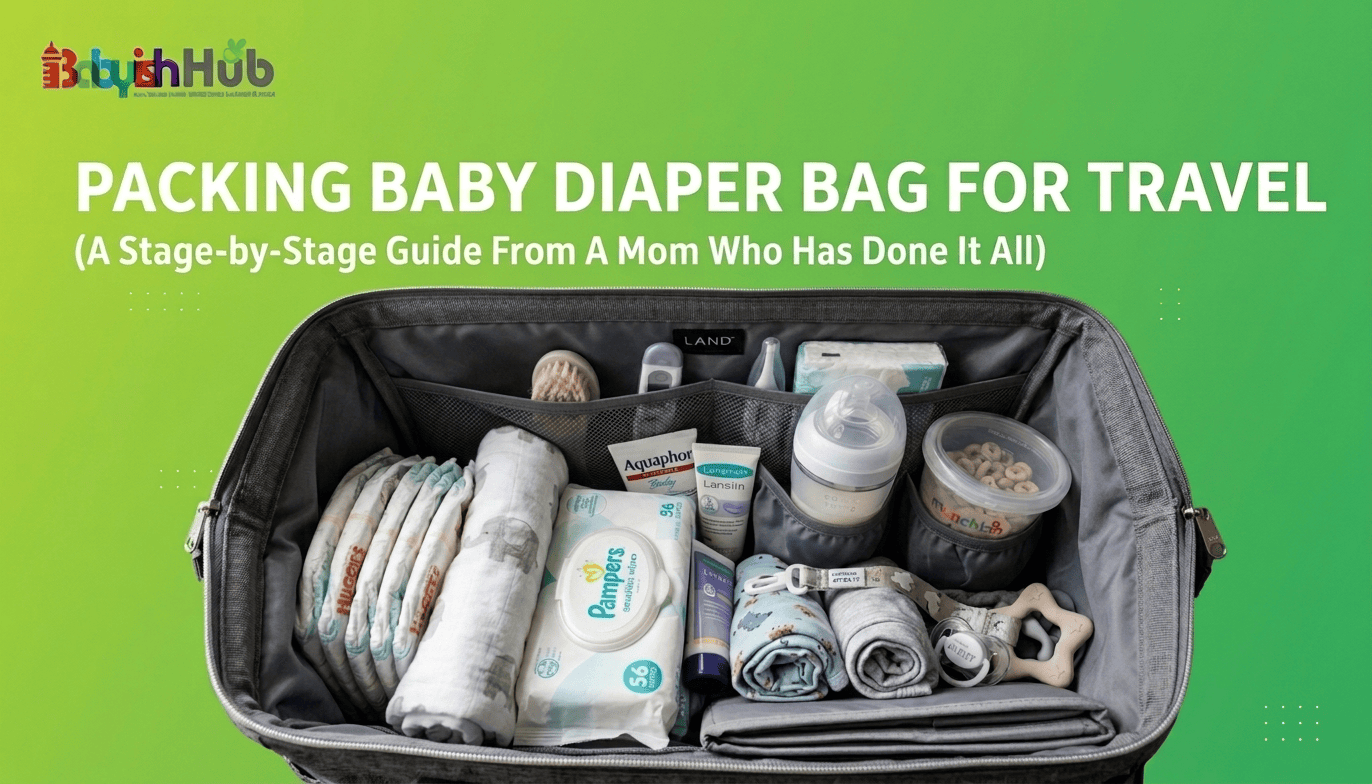
My daughter was eleven weeks old the first time I had to pack a diaper bag for a long travel day, and I remember standing in the hallway surrounded by little piles of baby things, completely paralyzed. I did not know how many diapers was enough. I did not know whether to bring the full-size wipe pack or just the travel case. I had no sense of what I would need versus what I was just packing out of anxiety.
What I wish someone had told me then is that packing baby diaper bag for travel is a skill, and like most parenting skills, you get better at it through experience. But you do not have to learn everything the hard way. After three kids, multiple road trips, and more flights than I care to count, I have a very clear sense of what matters and what just adds weight to an already heavy bag.
What also changed my approach significantly was realizing that what you need in a travel diaper bag shifts meaningfully depending on your baby’s age and stage. A four-month-old and an eight-month-old have genuinely different needs on the road. This guide breaks it down that way, because a one-size-fits-all packing list has never actually fit any baby I have known.
How Do You Choose The Best Bag For Traveling With A Baby?
Your everyday diaper bag may not be the right bag for travel, and it is worth thinking about this before you start stuffing things in. The bag you use for a quick trip to the pediatrician does not need to function the way a bag needs to function during a six-hour travel day with two layovers.
For travel specifically, a backpack-style diaper bag is almost always the better choice. Why? Because it keeps your hands free, distributes weight across your back rather than pulling on one shoulder, and is much easier to manage when you are pushing a stroller, holding a baby, or navigating a crowded terminal. If your everyday bag is a shoulder tote, consider switching to a backpack just for travel days.
I would advise you to look for a bag with multiple exterior zip pockets, not just one big interior compartment. Being able to reach the pacifier or the wipe case without opening the whole bag and repacking it while your baby is mid-meltdown in an airport security line is honestly one of those small things that makes a big difference.
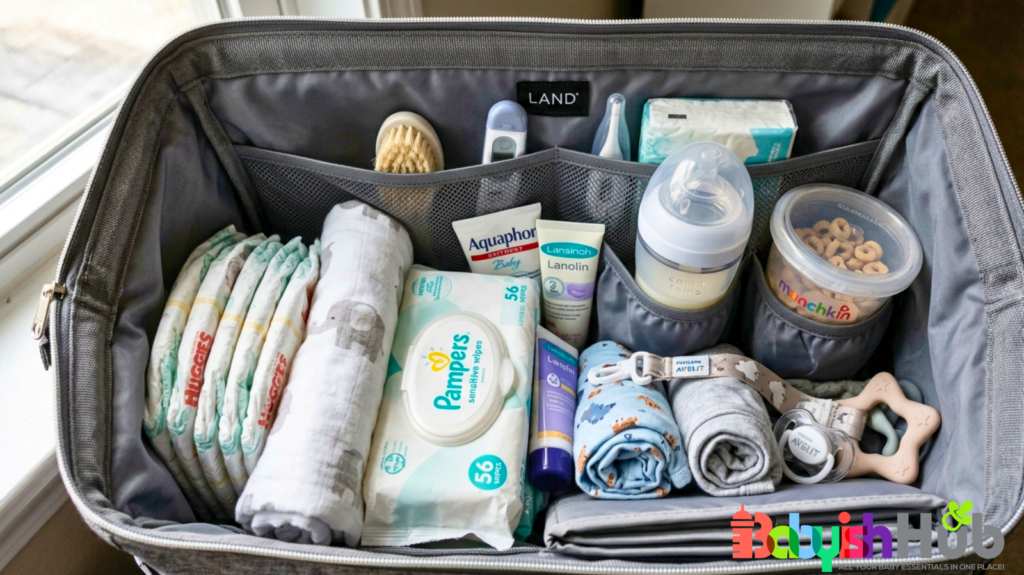
Interior organization is also important: separate pouches or packing cubes for different categories save you from the fishing-around-in-the-dark problem that hits at the worst possible moments.
Whatever bag you use, be sure to weigh it once it is packed. A travel diaper bag that is too heavy to carry comfortably for extended periods is going to become your source of physical strain on a long day. Every item in your diaper bag should justify its spot.
What To Pack In A Baby Diaper Bag for Travel With A Newborn (0 to 4 Months)
Young babies are both the most dependent travelers and, in some ways, the most portable. They stay where you put them, they sleep a lot, and their needs are relatively straightforward, even if they are frequent. The challenge with this stage is volume: newborns go through diapers and outfits at a pace that requires some good planning.
Newborn Diapering Essentials
For a full day of travel with a newborn, pack more diapers than any formula suggests. Newborns can soil a diaper with impressive speed and unpredictability, and you are not going to want to be calculating your remaining supply with a freshly changed baby on your lap.
A safe number for a travel day is roughly one diaper every one to two hours, plus four extras. A slim travel-changing mat is non-negotiable at this stage because you will be changing your baby in a lot of places that are not designed for it.
Infant Feeding Gear for Transit
If you are breastfeeding, bringing a nursing cover for more privacy in public is useful if that is your preference, along with several breast pads, because engorgement and leaking are common and unpredictable in the early months. A small manual pump tucked into a side pocket is a good backup on a longer travel day.
If you’re formula-feeding your baby, you should pre-measure servings at home and tuck them into a formula dispenser, along with pre-boiled water in a thermos if your baby takes warm bottles. Do not count on being able to source reliably warm water in transit. See tips on how to travel with baby formula.
Emergency Clothing Changes
Pack a minimum of three full outfit changes for your baby and at least one spare top for yourself. Newborn blowouts are frequent and spectacular. At this stage, a spare outfit is not a precaution; it is a certainty you will need. Roll each outfit into a bundle with socks tucked inside so you can grab a complete change without sorting through individual pieces while a screaming baby waits.
Multi-Use Comfort Items
Swaddle blankets double as nursing covers, sunshades for the carrier or pram, a surface layer on a changing table you do not quite trust, and a general comfort object for a young baby who finds being wrapped and held close soothing. Pack two. They weigh almost nothing and earn their space ten times over on a travel day.
Packing A Baby Diaper Bag For Travel With Infants 4 To 8 Months Old
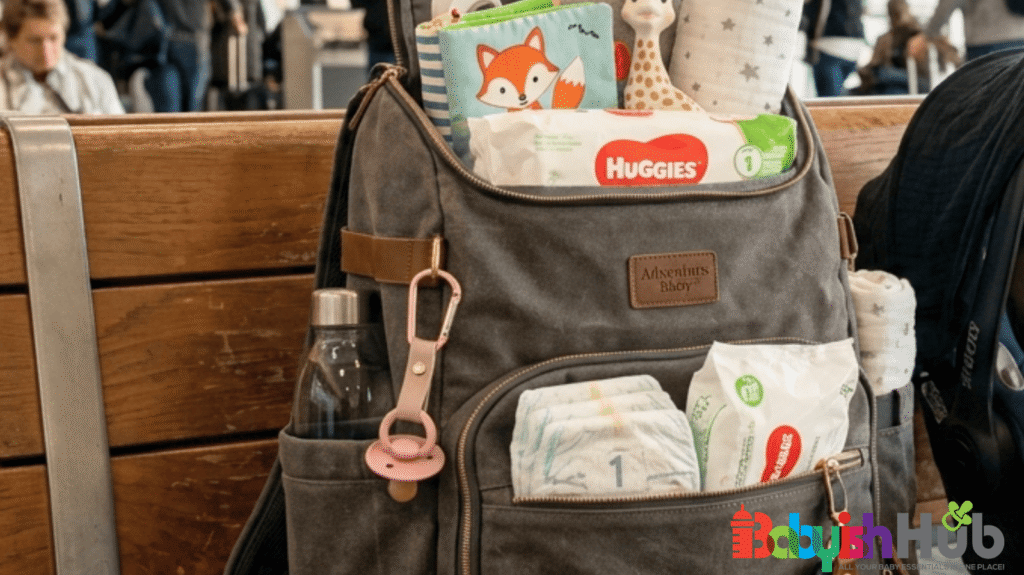
This window is often called the golden travel period for a good reason. Babies in this range are alert and social enough to find new environments genuinely interesting, but they are not yet mobile in a way that makes every outing a containment exercise.
Sleep is often more settled than it was in the newborn stage, and feeding schedules are more predictable. The diaper bag gets a little easier to manage here, though it takes on some new elements.
Diapering
Solid foods have often not started yet, which means diapers are still relatively easy to manage. Your count does not need to be quite as aggressive as the newborn stage: plan for one diaper every two to three hours plus a couple of extras. If solids have begun, you will notice immediately that diaper contents change character. Pack a few more disposal bags than you think you need.
Feeding
If your baby has started solids, food pouches are your best friend on travel days. They require no preparation, no refrigeration, no utensils, and very little cleanup. Pack two to three per travel day. Continue bringing your usual milk feeding supplies alongside them. If you are introducing new foods at home, do not introduce anything new during travel. Stick to what your baby already knows and tolerates well.
Entertainment and Stimulation
This is the stage where a small, dedicated entertainment pouch becomes worth adding to the bag. A simple teething toy, a soft crinkly book, and one familiar small toy are genuinely enough. Babies at this age are fascinated by new faces, movement, and environment, so you often need less active entertainment than you expect. Save the new toy for a desperate moment on the plane rather than bringing it out straight away.
Packing A Baby Diaper Bag for Travel With Older Babies (8 To 12 Months)
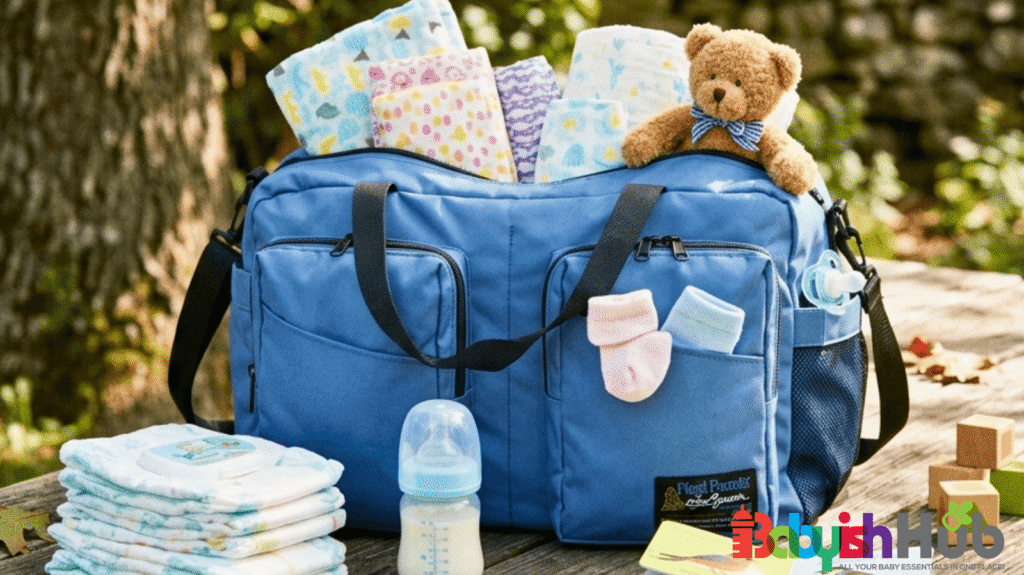
This is where things get genuinely more complicated, and I say that with full affection for this age. Babies approaching and crossing the one-year mark are curious, determined, and absolutely committed to interacting with everything around them.
Separation anxiety peaks. Sleep can be disrupted by new environments more than it was at earlier stages. And the fact that your baby is now pulling to stand, cruising, or possibly walking means they want to be moving, not sitting quietly in a lap.
Diapering Essentials
Solids are well established by now, and diaper changes have entered new territory. Pack more wipes than in earlier stages and include a small container of nappy cream if your baby is prone to irritation, since diet changes during travel can affect skin. Portable changing pads matter even more here because a wriggly baby who wants to flip over mid-change on a public changing table is a genuine challenge.
Snacks
Finger foods and snacks become a significant part of the diaper bag at this stage. Easy, familiar options that require minimal preparation and create limited mess are what you want: small rice crackers, soft fruit pieces in a snack cup, teething wafers, or whatever your baby eats reliably at home. Travel is not the time to test new foods or textures. Keep a snack within easy reach in an exterior pocket so you can produce it quickly when distraction or hunger hits.
Managing A Mobile Baby in Transit
A lightweight carrier or soft-structured wrap becomes genuinely useful at this stage for moments when the stroller is impractical, and you need your baby contained and close. Airport security, boarding queues, busy train stations: these are environments where a carrier gives you mobility and keeps your baby settled in a way that a stroller cannot match. Pack the carrier compressed into its own pouch in the diaper bag so it is always there when you need it.
Essential Items To Pack for Every Stage of Baby Travel
Regardless of your baby’s age, some things belong in a travel diaper bag every single time. For instance, you should always pack a small first aid and health pouch with infant pain reliever in the right dose for your baby’s weight, a digital thermometer, saline drops, and any regular medication your baby takes.
Babies get sick with very little warning, and being caught without basic supplies in an unfamiliar place is stressful in an entirely preventable way.
A resealable waterproof wet bag for soiled clothes or used cloth diapers. Once you start using one of these, you will wonder how you managed without it. A spare set of your own essentials: lip balm, a small snack for yourself, your ID, and any important documents tucked in an accessible inner pocket.
And water. Bring a small, insulated bottle of water for you. Travel days are dehydrating, and as a breastfeeding or pumping parent who is not staying hydrated, you’ll only be making your own day harder. It takes up almost no space and matters more than you might expect.
How To Keep Your Bag Organized Through The Trip
The best-packed diaper bag falls apart by day two of a trip if you do not have a system for maintaining it. After every significant stop, take sixty seconds to repack categories back into their designated spots:
- Wipes back in the wipe pocket
- Dirty nappy bags disposed of or put into the wet bag
- Snacks restocked from your main luggage at the accommodation each evening
Do a full restock every night before you go to bed. Check the diaper count, refill the wipe case, replace any clothing you used during the day, and top up the snack supply.
The morning of a travel day or an outing is not the time to discover you are short on diapers or that the formula dispenser is empty.
If you’re anything like most parents, you might believe that managing your travel days with a baby smoothly comes down to packing the most. But that’s not always the case!
The secret lies in packing your diaper bag with intention, keeping the bag organized, and building in enough buffer to handle the surprises that always come. Because some surprises always come, and that is just traveling with a baby. You learn to work with it rather than against it.
Frequently Asked Questions: How To Pack A Diaper Bag For Travel FAQs
Now let’s look at some of the most common questions about packing your diaper bag for travel:
How many diapers should I pack in a diaper bag for a travel day?
Pack one diaper for every hour of travel for newborns, or one every two hours for older babies. Always add four extra diapers to protect against unexpected travel delays. This ratio ensures you maintain an abundant supply throughout your entire journey without overinflating your bag.
Is a diaper bag counted as a carry-on when flying?
Major airlines permit parents to bring one diaper bag as a free additional personal item. This allowance sits completely outside your standard carry-on baggage limits. Check your specific airline policies directly before departure because international carriers occasionally enforce stricter individual cabin rules.
How do I handle formula or breast milk in a diaper bag through airport security?
Security regulations explicitly exempt liquid breast milk, prepared formula, and baby food pouches from standard passenger fluid limitations. Declare these liquids voluntarily to agents at the security checkpoint for independent screening. Store them in a clear, accessible pouch to accelerate the inspection process.
What should I do if I forget something essential on a travel day?
Locate a terminal pharmacy, convenience store, or supermarket to purchase immediate replacements. Major transport hubs consistently stock diapers, standard wipes, and basic formula brands. Keep prescription medications inside your personal pocket because specialized medical items represent the only truly irreplaceable baby travel gear.
Should I pack differently for a flight versus a road trip?
A flight requires a self-contained, highly disciplined packing approach because you lack access to backup supplies. Road trips allow you to pack a minimalist diaper bag for the cabin while storing bulk refills inside the vehicle trunk. Tailor your gear density to your transport method.
You Will Get Better At This With Every Trip!
The first time you pack a diaper bag for travel, it will probably take too long, weigh too much, and still not include something you end up wishing you had. That is completely normal. Every experienced traveling parent has a story about the thing they forgot or the moment the bag fell apart.
What changes with practice is your confidence in knowing what your specific baby needs, your ability to pack efficiently without second-guessing every item, and your trust in your own ability to handle whatever comes up. Packing a baby diaper bag for travel gets easier the more you do it, and the trips get easier too.
Pack thoughtfully, restock consistently, and leave a little grace for yourself when things do not go perfectly. They rarely do, and the trip is usually still worth it.