Can A Baby Monitor Be Hacked If It’s Not on WiFi? The Truth
The first time I plugged in a video monitor, I didn’t just see my daughter sleeping; I saw a headline I’d read the week before about a stranger who was speaking to a 3-year-old through a camera. That “what if” is a heavy shadow that follows us into the nursery. We want the convenience of seeing those rhythmic chest rises, but we don’t want to invite the entire internet into our most private spaces.
If you’ve been losing sleep worrying about baby monitors and hacking risks, you’ve likely looked into non-WiFi monitors as a safer and more secure option. But a nagging question remains: Can a baby monitor be hacked if it’s not on WiFi? Let’s break down how these monitors work, whether they can be hacked, and how to protect your nursery.
Can A Baby Monitor Be Hacked If It’s Not on WiFi? Quick Answer:
Generally, a non-Wi-Fi baby monitor is difficult to hack because it is not connected to the internet. However, it can still be compromised in rare cases if someone is physically close enough to the device, such as a neighbor or someone standing just outside your home.
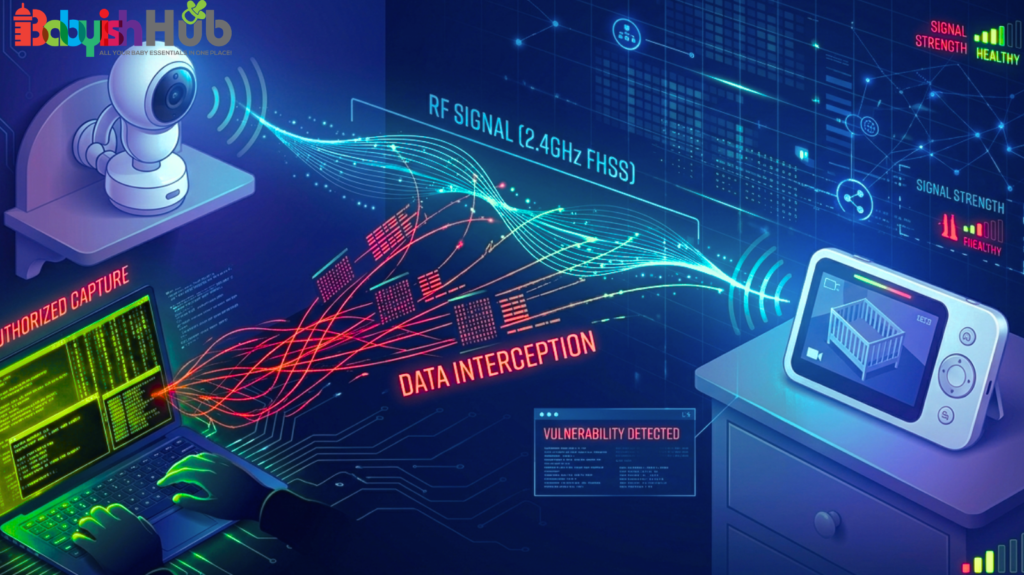
To intercept the non-WiFi baby monitor signal, the hacker would typically need specialized radio equipment and technical knowledge to capture and decode the transmission.
Traditional hacking happens over the internet, where someone thousands of miles away exploits a weak password or a cloud server. Because a non-WiFi monitor has no “door” to the internet, a remote hacker cannot get in.
For someone to see your video feed, they would typically need to be physically standing outside your house with specialized equipment—and even then, with modern technology, they’d likely see nothing but static.
How Do Non-WiFi Baby Monitors Work?
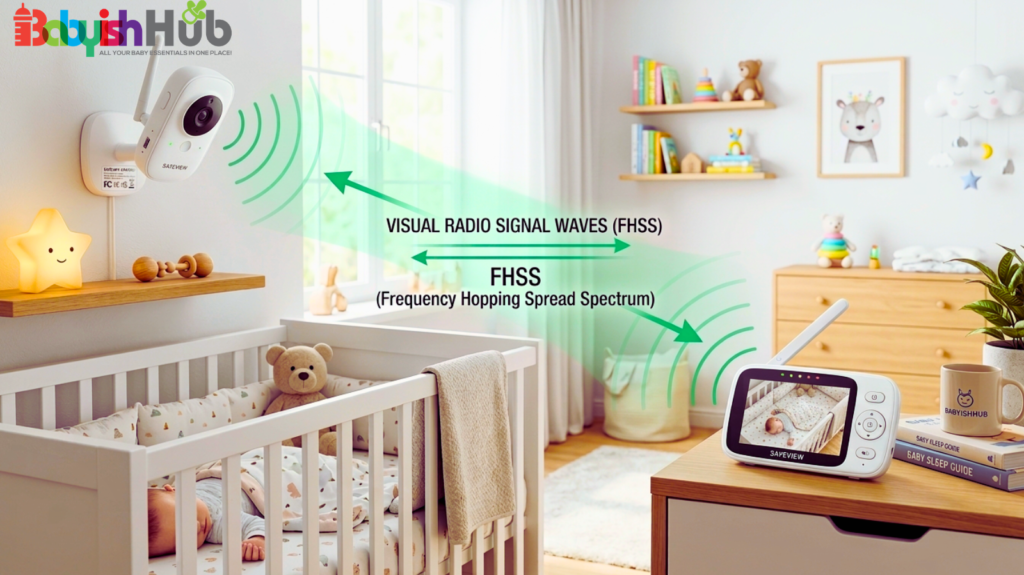
To understand why baby monitors without WiFi are so secure, we have to look at how the camera talks to the handheld unit.
1. Local Radio Frequency (RF) Connection
Unlike a Wi-Fi baby monitor, which sends video through your home router and over the internet, a non-WiFi monitor operates as a closed system.
It functions more like a high-tech walkie-talkie; the camera sends a direct radio signal to the parent unit, and only that unit receives it. There is no cloud connection, no apps, and no internet involved.
2. FHSS Technology (The Secret Sauce)
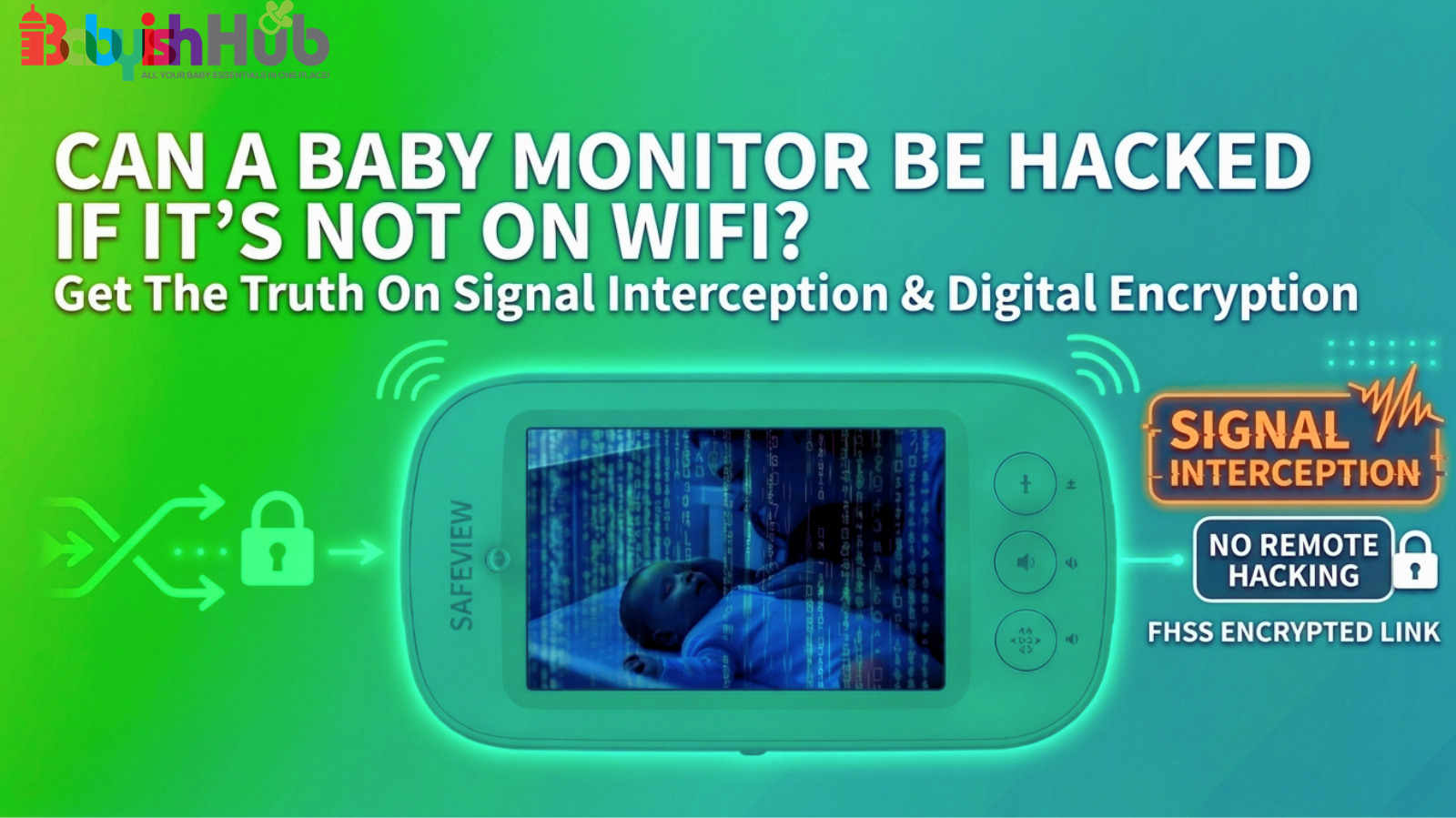
Most top-rated non-WiFi baby monitors today use FHSS (Frequency Hopping Spread Spectrum).
Imagine the camera and the monitor are having a conversation, but they are jumping between 50 different “channels” every second in a specific, synchronized pattern.
If someone nearby tried to tune in, they might catch a split-second “blip” of sound before the devices hopped to a new frequency.
Without knowing the specific hopping pattern (which is encrypted during the pairing process), an outsider can’t follow the conversation. That alone makes non-wifi baby cameras the safe baby monitors that can’t be hacked!
Why Non-WiFi Monitors Are Considered More Secure:
By keeping the entire conversation between the camera and the handheld unit, no-WiFi baby monitors eliminate the risk of a remote breach. For parents asking, “Can a baby monitor be hacked if it’s not on WiFi?” the answer lies in this device’s “closed loop” system; there is simply no digital bridge for an outsider to cross.
Can Someone Intercept The Signal Instead of “Hacking” It?
“Hacking” and “interception” are two different beasts. Hacking is remote while interception is local. That said, if you are using an old-school analog baby monitor (the kind with a dial for Channel A or B), your signal is “open.” In the early 2000s, it wasn’t uncommon to pick up a neighbor’s baby on your monitor because you were both on the same frequency.
However, modern digital monitors encrypt the data. Even if a neighbor is using the same brand of monitor next door, your devices are “paired” using a unique digital handshake. You won’t see their baby, and they won’t see yours.
Which Baby Monitors Are Most Vulnerable to Hacking?
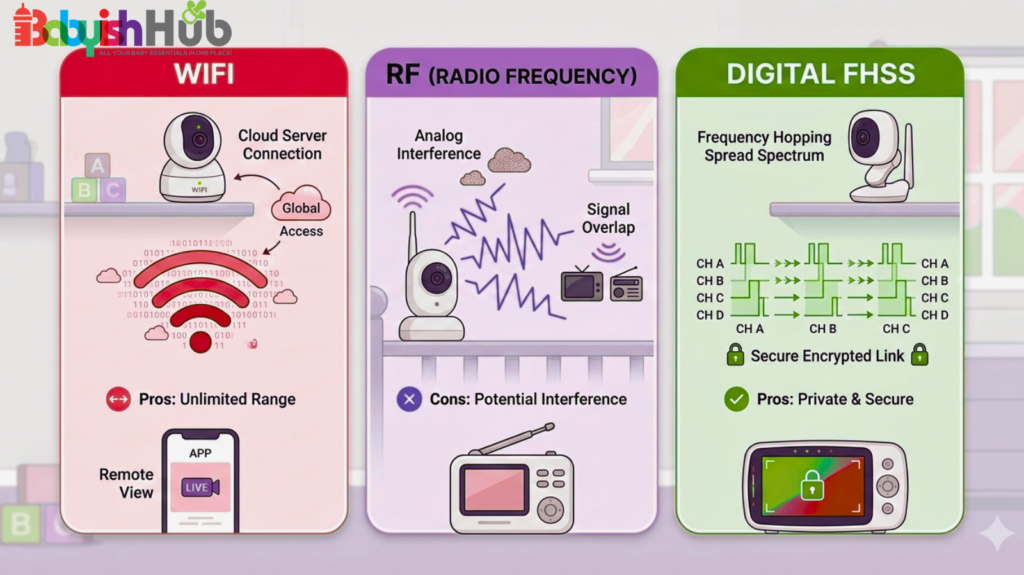
WiFi baby monitors are considered the most vulnerable devices to hackers. This is especially true if you don’t put in place various security measures, such as strong passwords and regular firmware updates.
Analog monitors also have a high risk of accidental eavesdropping due to open, unencrypted frequencies.
If you’re looking for the safest baby monitor from hackers, or the safest unhackable baby monitor, you can’t go wrong with non-WiFi baby monitors (using FHSS/DECT technology). These units are considered the “Fort Knox” of monitors. They offer the highest level of privacy for families who want to stay off-grid.
Here’s a quick table showing a comparison between different baby monitors and their risk level against hacking:
| Monitor Type | Connection Type | Risk Level | Why? |
| WiFi Monitors | Internet/App-based | Moderate | Vulnerable to weak passwords or server breaches. |
| Analog Monitors | Open Radio Wave | Low/Moderate | Anyone nearby on the same frequency can listen in. |
| No-Wifi Monitors (FHSS) | Private RF Signal | Very Low | Encrypted, local-only, and no internet entry point. |
5 Signs Your Baby Monitor Is Hacked:

While actual interceptions are rare with modern digital monitors, knowing what to look for can help you distinguish between a dying battery and a security breach.
Here are the top 5 signs of a baby monitor that has been hacked:
1. Strange Voices or Unexplained Sounds
On an older analog monitor, this is the “smoking gun.” If you hear a voice that isn’t yours or your partner’s, or even the faint sound of a television that isn’t on in your house, your monitor is likely picking up a neighbor’s frequency.
- The Reality: On a non-WiFi digital monitor (FHSS), this rarely happens. If you hear a “ghost” voice, it’s usually a literal cross-talk glitch from a very powerful nearby radio source, but it’s still a sign the signal isn’t as private as it should be.
2. The Camera Moves Without Your Input
This applies to “Pan-Tilt-Zoom” cameras. If you walk into the nursery and the lens is pointed at the door instead of the crib, or if you see it rotating while you aren’t touching the parent unit, this is a major red flag.
- Non-WiFi Note: For a non-WiFi monitor to move on its own, someone would have to be within a few hundred feet of your house with a matching parent unit that has somehow bypassed your encryption, which is incredibly difficult. On a WiFi monitor, however, this is a clear sign of a remote hack.
3. Unexpected “LED” Activity
Most cameras have a small light that blinks when someone is actively viewing the live feed. If that light is on or changing colors when you know your handheld unit is turned off, someone else may be accessing the stream.
4. Frequent or Sudden Connection Drops
We often blame the “out of range” beep on thick walls, but if your monitor has worked perfectly for months and suddenly starts dropping the connection every time you sit in a specific spot, it could be signal interference.
- This isn’t always a “hacker.” It can be a new 2.4GHz router next door or a microwave “crowding” the airwaves. However, if your digital handshake is being interrupted, it means your private “tunnel” is being crowded by outside signals.
5. Settings Have Been Changed
If you wake up and the “Night Vision” on your baby monitor is toggled off, or the “VOX” (sound activation) sensitivity has been adjusted without you doing it, that’s another sign of unauthorized access!
A Note: If you are using a Digital FHSS monitor (non-WiFi baby monitor) such as the Infant Optics DXR-8 Pro and you hear static or a “click,” it is almost 99% likely to be electronic interference from a nearby smartphone or a baby wipe warmer, not a spy in a van outside.
Digital monitors are designed to “mute” when they don’t recognize a signal, so you’ll usually get silence or a “Searching for Camera” message rather than someone else’s audio.
For a full list of warning signs and what to do next, see my step-by-step guide: How to Tell If Your Baby Monitor Is Hacked.
How To Make Your Baby Monitor More Secure
Even if you’re convinced that you’re using a baby monitor that can’t be hacked, a little “mom-intuition” and setup discipline go a long way in preventing surprises along the way.
Here are additional measures you can take to ensure maximum security of your baby monitoring system:
- Choose Non-WiFi: If privacy is your #1 concern, skip the WiFi models and look specifically for non-WiFi monitors running on “FHSS” or “DECT” digital technology.
- Avoid Second-Hand “Smart” Tech: I love a good thrifted find, but skip used WiFi monitors. You can’t always be sure the previous owner’s account has been fully scrubbed from the hardware.
- Pair in Close Proximity: When you first set up your monitor, pair the camera and the handheld unit in the same room to ensure the digital “handshake” is strong and exclusive.
- Position for Signal, Not Range: Keep the parent unit within the recommended range. A struggling signal is more prone to interference (though still not easily hacked).
- Never Skip Firmware Updates: If you do use a WiFi monitor, never click “ignore” on those firmware updates. Those updates are often security patches designed to block new hacking methods.
Are Non-WiFi Baby Monitors Safer Than WiFi Monitors?
Choosing between WiFi and Non-WiFi baby monitors is really a trade-off between absolute privacy and total convenience.
If you want a monitor that is physically impossible for a stranger in another city to access, non-WiFi is your best friend.
But if you’re a working parent who needs to “peek in” from the office to see how your little one is doing, the WiFi route offers you a lifeline that a local signal just can’t match.
Here is how the two monitors stack up when you look at the daily reality of using them:
| Feature | Non-WiFi Monitor | WiFi Monitor |
| Internet Access | No (Offline only) | Yes (Connects to your Router) |
| Remote Viewing | No (Only via Parent Unit) | Yes (via Smartphone App) |
| Hacking Risk | Near Zero (Requires physical proximity) | Moderate (Depends on your security) |
| Privacy Level | High (Closed-loop system) | Variable (Uses Cloud/Servers) |
If you want a deeper look at the differences, see our comparison of WiFi vs. non-WiFi baby monitors.
Situations When You Might Need A WiFi Monitor
I’m not here to scare you off WiFi monitors entirely. For many of us, they are the only thing that makes the “working parent” juggle feel manageable.
If you’re at the office and just need to see those sweet, sleepy stretches to get through a long afternoon of meetings, a WiFi monitor is your go-to option. It helps bridge the gap when you can’t be physically there.
WiFi baby monitors are also a practical necessity for families living in larger homes or houses with thick concrete walls where a standard radio signal just drops out the moment you step into the backyard.
With a WiFi setup, your range is essentially unlimited. You also get access to “smart” features like sleep tracking, humidity sensors, and growth analytics that a basic handheld unit simply can’t provide.
The truth is, security isn’t just about the device itself but your digital habits. If you use a strong, unique password and enable Two-Factor Authentication (2FA), a WiFi monitor can be a perfectly safe, high-tech window into your nursery.
Can A Baby Monitor Be Hacked If It’s Not On WiFi FAQs:
Before we wrap up, I know your mind is probably spinning with “what-if” scenarios. To help clear the air, I’ve pulled together the most common questions I hear from parents who are worried about non-WiFi baby monitor hacking…
Can someone hack a baby monitor that is not connected to WiFi?
Remote hacking for a baby monitor not connected to WiFi is impossible. While an older analog signal could be intercepted by someone physically standing within a few hundred feet, modern digital (FHSS) monitors are encrypted and nearly impossible to listen into without the paired parent unit.
What is the safest type of monitor?
A digital, non-WiFi monitor using FHSS technology is widely considered the gold standard for privacy-conscious parents.
How do you know if your baby monitor has been hacked?
Watch for unexplained camera movements, strange voices or music, and blinking LED lights when you aren’t using the monitor. On WiFi models, check for unrecognized devices on your network or sudden changes to your password and security settings.
How common is it for someone to hack a baby monitor?
True hacking is statistically rare but most often targets WiFi monitors with weak passwords or outdated firmware. Most “scary stories” involve unsecured internet-connected cameras. Using a non-WiFi monitor or a strong password with Two-Factor Authentication (2FA) makes the risk negligible.
Why do people want non-WiFi baby monitors?
Parents choose them for “off-grid” privacy, reliability during internet outages, and ease of use. They eliminate the risk of remote hackers and prevent tech companies from collecting or storing sensitive video data on cloud servers, keeping your nursery completely private.
Which baby monitors cannot be hacked?
No wireless device is 100% “unhackable,” (or 100% “unhackable baby monitor” for the context of baby cameras), but digital non-WiFi monitors using FHSS (Frequency Hopping Spread Spectrum) are the closest you can get. Since they don’t connect to the internet, they are shielded from remote attacks and are considered the safest option.
Can HelloBaby monitors be hacked?
HelloBaby monitors use 2.4GHz FHSS digital encryption. Because they do not connect to WiFi or the internet, they cannot be hacked remotely. To see the feed, someone would need physical access to your camera to manually pair it with a matching parent unit.
Final Thoughts: Should You Worry About Baby Monitor Hacking?
The “hacker in the nursery” is a terrifying thought, but it’s a risk mostly tied to home networks and passwords, not the monitor itself. If you’re always asking, “Can a baby monitor be hacked if it’s not on WiFi?” the answer is simple: by choosing a quality FHSS/DECT non-WiFi monitor, you are essentially closing the curtains and locking the door to potential outside external access. You can sleep knowing the only person seeing those sweet, sleepy stretches is you.