Best Affordable Baby Monitor for Every Budget (9 Picks) | Tested & Reviewed
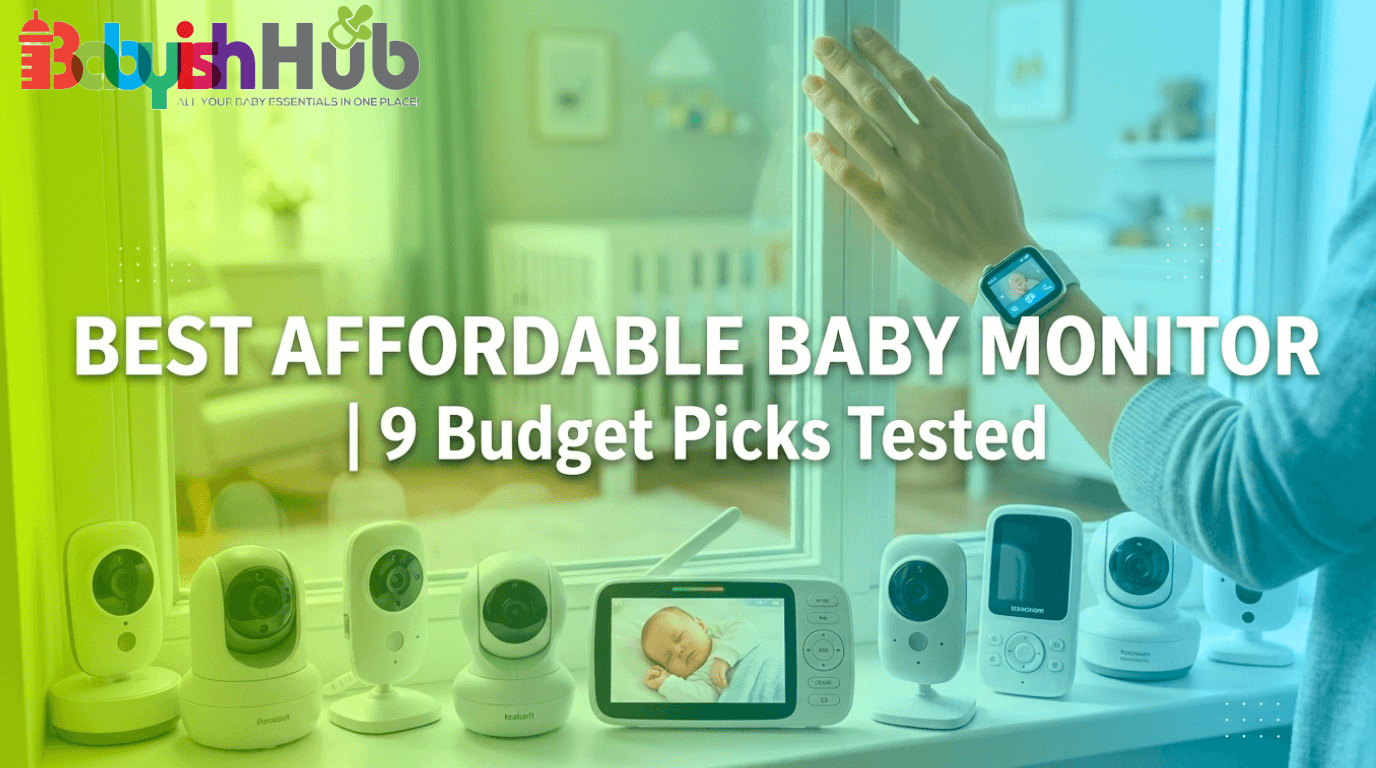
Finding the best affordable baby monitor usually starts with a simple desire: to keep an eye on your baby without spending more than you need to. But once you start looking, things get messy fast. Some monitors promise video but struggle with battery life. Others look budget-friendly until you realize they depend on WiFi or hidden subscriptions. And then there are the ones that seem perfect at first look but fall short the first time you use them.
This guide breaks down the inexpensive baby monitors that hold up when it comes to getting the job done. Each pick focuses on what parents feel every night: clear video or audio, reliable connection, and a setup that does not add stress to an already full day. You’ll find 9 budget-friendly monitors that balance cost, performance, and real-world usability so you can choose the one that works for you.
A Quick Summary of Our 9 Best Affordable Baby Monitor Picks:
- HelloBaby HB6550: Best for most parents who want a reliable video monitor with a large screen, long battery life, and no WiFi.
- HelloBaby HB6550Plus (2 Cameras): Best for twins or monitoring two rooms at the same time with true split-screen viewing.
- VTech VM819: Best for parents who want a trusted brand, excellent battery life, and a compact, easy-to-carry monitor.
- VTech VM819-2: Best for families needing two cameras on a budget who don’t mind switching between camera views.
- VTech DM111 Audio: Best for travel, grandparents’ homes, or anyone who only needs audio monitoring.
- LeapFrog LF2423: Best for parents who care most about screen and night vision image quality at a budget price.
- ANMEATE Video Baby Monitor (Original): Best for the lowest-cost video monitor that still covers the essentials.
- ANMEATE 5″ Split Screen: Best for budget-conscious families who need to watch two rooms simultaneously.
- ANMEATE 5″ HD 48H: Best for parents who hate charging devices frequently and want the longest battery life possible.
Quick Comparison Of Affordable Baby Monitors:
| Monitor | Type | Screen | Cameras | WiFi | Best For |
| HelloBaby HB6550 | Video | 5″ | 1 (expandable to 4) | No | Best overall value with camera |
| HelloBaby HB6550Plus Split Screen | Video | 6″ | 2 | No | Best split screen |
| VTech VM819 | Video | 2.8″ | 1 | No | Best compact no-WiFi video |
| VTech VM819-2 | Video | 2.8″ | 2 | No | Best dual camera budget pick |
| VTech DM111 | Audio only | None | N/A | No | Best for travel, smallest footprint |
| LeapFrog LF2423 | Video | 2.8″ IPS | 1 | No | Best value IPS screen |
| ANMEATE (Original) | Video | 2.4″ | 1 (expandable) | No | Best entry-level price |
| ANMEATE 5″ Split Screen | Video | 5″ | 2 | No | Best budget split-screen dual |
| ANMEATE 5″ HD 48H | Video | 5″ | 1 | No | Best for battery life priority |
Our Testing Methodology:
Choosing the best affordable baby monitor requires more than comparing spec sheets. We approached this as real parents would, focusing on how each monitor performs during everyday routines rather than relying on manufacturer claims.
We started by narrowing the list to monitors that are widely available, consistently reviewed, and commonly used by families in real homes. From there, we filtered out models that rely heavily on subscriptions, unstable apps, or unclear connectivity claims.
Our focus stayed on standalone monitors that parents can set up quickly and trust during night and daytime use.
Each monitor was then evaluated in typical home environments, including bedrooms with different lighting conditions, multi-room layouts, and varying levels of household noise. We paid close attention to how each unit behaves during overnight use, when reliability matters most and small frustrations become more noticeable.
We tested battery performance based on realistic usage patterns rather than ideal settings. This meant comparing continuous video use, sound-activated modes, and mixed daytime and nighttime routines.
We also looked at how often a monitor needed recharging in a normal week of parenting, not just how long it lasted in a single session.
Audio clarity, connection stability, and delay between sound and response were also key factors. A monitor that picked up crying quickly and transmitted it without noticeable lag ranked higher than one with stronger visual features but slower response time.
For video monitors, we evaluated screen visibility from different angles, night vision clarity in fully dark rooms, and how easy it was to interpret what was happening at a glance. We avoided overemphasizing resolution alone, since real-world usability mattered more than technical labels.
Finally, we considered setup experience and long-term usability. Monitors that required minimal configuration, stayed reliable over time, and felt intuitive for sleep-deprived parents scored higher than feature-heavy systems that added unnecessary complexity.
This approach allowed us to focus on baby cameras that truly deliver at 2 a.m., when you are tired, half awake, and simply need a monitor that works without thinking about it.
9 Best Affordable Baby Monitor Picks Reviewed:
Here are the 9 affordable baby monitor options worth considering
1. HelloBaby HB6550
Best Affordable Baby Monitor with Camera Overall
Quick Verdict:
Buy this if: You want a video monitor with a camera that covers a full nursery view, runs all night on battery, and never touches your home WiFi network.
Skip this if: You want video on your phone or need remote access from outside the house.
Biggest strength: 30-hour battery life in voice-activated mode, 5-inch screen, pan-tilt-zoom, and no-WiFi security. You get all this at a budget price that competes with monitors costing twice as much.
Biggest weakness: Screen resolution isn’t 1080p; daytime clarity is good, but night vision shows typical infrared image grain at this price point.
Product Overview
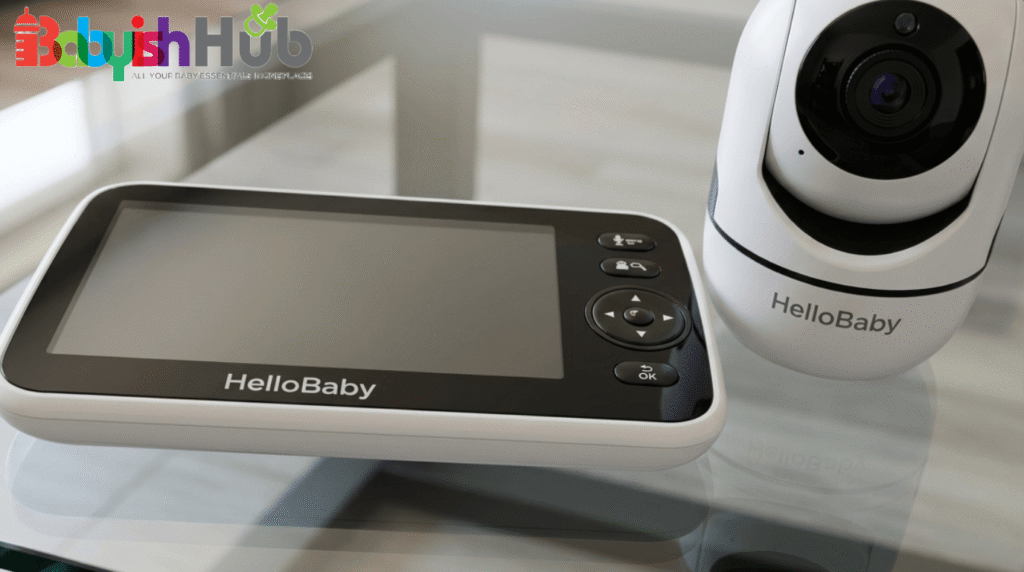
The HelloBaby HB6550 has become one of the most widely used affordable baby monitors in the US for one reason: it delivers the features parents use most. This includes a large screen, remote pan-tilt-zoom, long battery, and no WiFi dependency—all without the premium pricing of brands like Nanit or Owlet. It’s a purpose-built, standalone video monitor that starts working the moment you plug in the camera, with no app download, no router configuration, and no monthly subscription.
Real-World Performance
The 30-hour battery rating applies in ECO/VOX mode, where the screen stays off and only activates when the microphone picks up sound above a set threshold. In practice, parents monitoring overnight report the battery lasting through a full night and into the following afternoon before needing a charge. In continuous video mode, expect closer to 16 hours, which is still enough for a full night on a single charge.
The 5-inch IPS screen displays a wide-angle view of the nursery. Remote pan covers 355 degrees horizontally and 120 degrees vertically, which means you can reposition the camera view from the parent unit without walking into the nursery. This is particularly useful for naptime check-ins that would otherwise risk waking the baby.
The temperature display on the parent screen shows the nursery ambient temperature in real time. At its price point, the HB6550 with one camera covers everything most parents need from a video baby monitor.
What We Like:
- The expandability to four cameras makes this system future-proof. As your family grows or monitoring needs change (nursery plus playroom, for example), additional cameras can be added to the same parent unit without buying a new system.
- The VOX mode works well. The microphone picks up crying quickly, the screen activates with minimal delay, and the sensitivity level is adjustable so parents aren’t woken up by minor rustling.
What Could Be Better:
- The screen brightness in very bright environments isn’t exceptional. Monitoring in a sunlit room makes the display harder to read than it would be indoors at normal lighting. This is rarely an issue during the primary overnight monitoring use case, but it’s worth noting for daytime nap monitoring in brighter spaces.
2. HelloBaby HB6550Plus with 2 Cameras
Best Affordable Split-Screen Baby Monitor
Quick Verdict:
Buy this if: You have two children in separate rooms, twins sharing a nursery, or you want to monitor both the nursery and another space simultaneously.
Skip this if: You only need one camera and want to minimize cost.
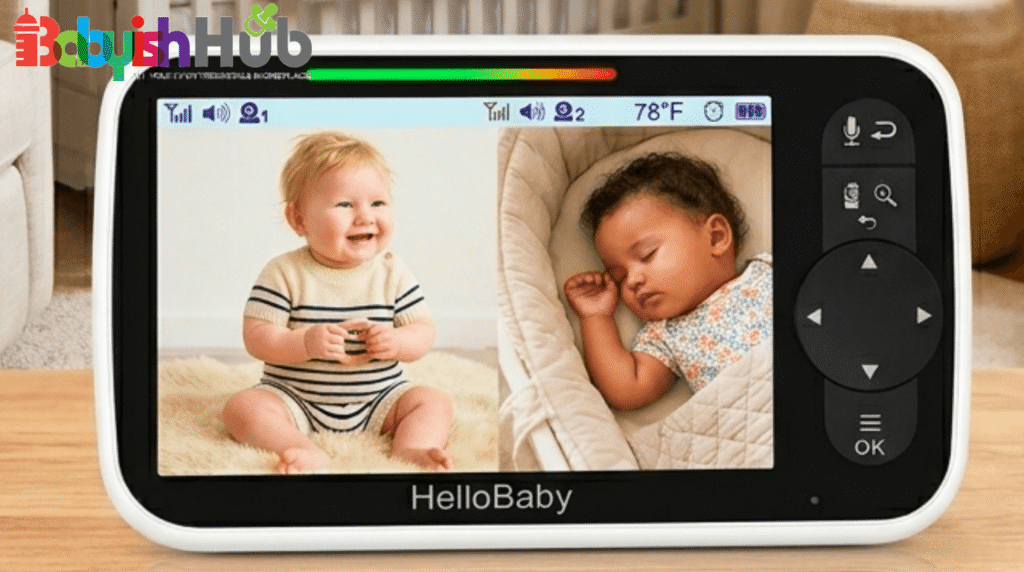
Biggest strength: True 6-inch IPS split-screen display showing two camera feeds simultaneously — one of the few genuinely split-screen-capable affordable baby monitors on the market.
Biggest weakness: The 6-inch screen draws more power; battery life in continuous split-screen video mode is shorter than the VOX-mode figures suggest.
Product Overview
The HB6550Plus takes the HB6550 platform and expands it with a larger 6-inch IPS screen specifically designed for split-screen viewing with two cameras. The no-WiFi FHSS connection applies to both cameras, meaning neither camera touches your home network. The 30-hour battery claim applies in ECO mode; parents running both cameras in continuous split-screen video should expect a shorter runtime.
Real-World Performance
Split-screen mode shows both camera feeds simultaneously on the 6-inch display, with audio focused on the camera detecting the most sound. A scan mode alternates audio between cameras every 15 seconds for parents who want audio awareness of both rooms without staring at the screen.
The 355-degree remote pan on each camera operates independently from the parent unit. Repositioning camera one to check one side of the crib while keeping camera two static doesn’t require touching either physical camera.
The IPS panel’s 178-degree viewing angle means the screen remains clear when viewed from the couch at an angle, rather than washing out the way standard LCD screens can when viewed off-axis.
What We Like:
- The true split-screen display at this price point is unusual. Most “dual-camera” monitors at budget pricing alternate between cameras rather than showing both simultaneously. The HB6550Plus shows both feeds at once, which is the feature twin parents and multi-room families need most.
- The feeding timer allows parents to set reminders. This is particularly relevant for nighttime feeding schedules where keeping track of timing is difficult without an alert.
What Could Be Better:
- The 6-inch screen increases the system’s weight compared to the 5-inch HB6550. For parents who carry the parent unit around the house rather than setting it on a nightstand, the size difference is noticeable.
3. VTech VM819
Best Affordable No-WiFi Video Baby Monitor for Compact Use
Quick Verdict
Buy this if: You want a trusted US brand, a compact and portable parent unit, and industry-leading battery life in a no-WiFi video monitor.
Skip this if: You want a screen larger than 2.8 inches or need to monitor two rooms simultaneously.
Biggest strength: 19-hour video battery life and 29-hour audio-only runtime; the best battery-to-price ratio in the compact video monitor category.
Biggest weakness: The 2.8-inch screen is the smallest on this list. Fine for nightstand monitoring; limiting for parents who want to see detail from across the room.
Product Overview
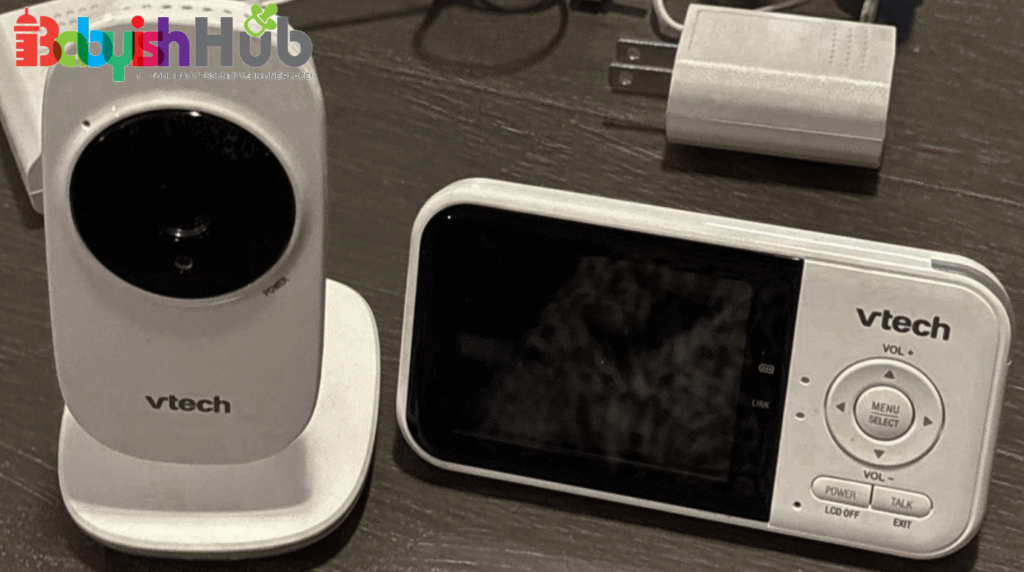
VTech has been manufacturing baby monitors for the US market for over three decades. The VM819 uses encrypted 2.4GHz FHSS technology to connect the camera directly to the parent unit without WiFi, app, or cloud. Sound-Activated Screen Mode keeps the display off until the microphone detects sound, extending battery life through the night without constant manual adjustment.
Real-World Performance
The 2,600mAh battery delivers on its 19-hour video streaming claim during typical overnight monitoring. Parents who run Sound-Activated Screen Mode throughout the night consistently report waking to a parent unit still carrying significant charge.
The automatic infrared night vision activates when room light drops below a threshold without manual intervention. The 2x digital zoom lets parents check a specific area of the crib without physically moving.
Two-way talk works with low latency. Pressing the talk button and speaking results in near-immediate audio transmission to the baby unit, a great feature for parents who use their voice to settle a stirring baby without fully walking into the room.
What We Like:
- The brand reliability is a real factor at the budget tier. VTech’s US presence means warranty claims, customer support, and firmware updates are more accessible than with lesser-known brands. For parents who want a monitor they can rely on to work the same way six months from now as it does on day one, VTech’s consistency record is a meaningful advantage.
- The compact parent unit fits comfortably in a hand or pocket, making it easier to carry during nighttime check-ins on other children or pets without setting it down.
What Could Be Better:
- The 2.8-inch screen limits detail visibility from any distance over about three feet. Parents who monitor from across a large bedroom or who want to zoom in on small details will find the screen limiting.
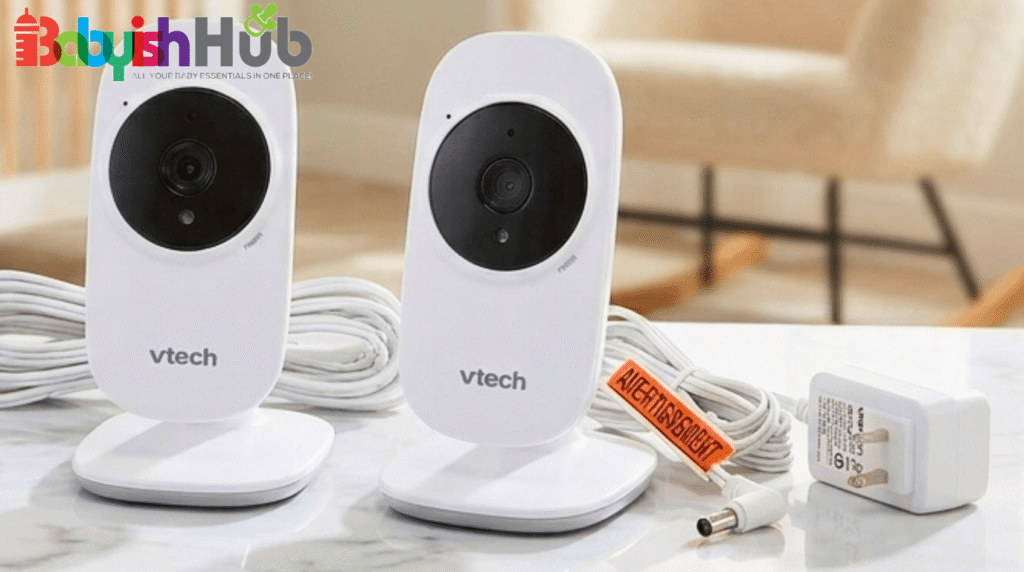
4. VTech VM819-2
Best Affordable Dual Baby Monitor
Quick Verdict:
Buy this if: You need two cameras, say one for baby in the nursery and toddler in another room, without spending over $100.
Skip this if: You only need one camera, or you want split-screen simultaneous display rather than toggle-between-cameras viewing.
Biggest strength: Two cameras at a competitive price, with VTech’s reliability, 19-hour battery, and no-WiFi security. This is the best value dual baby monitor on this list.
Biggest weakness: The parent unit switches between cameras rather than showing both simultaneously (no split screen). You see one feed at a time.
Product Overview
The VM819-2 pairs two cameras with one parent unit using the same VM819 platform. Both cameras connect using encrypted 2.4GHz FHSS, and the parent unit toggles between them. This configuration serves families with two sleep spaces who want a single parent unit rather than carrying two separate systems.
Real-World Performance
Camera switching on the parent unit takes about one to two seconds. In practice, parents develop a routine of checking one camera, toggling to the second, and returning to monitoring. The system does not display both feeds simultaneously — this is a sequential view, not split-screen.
VOX mode applies to both cameras, and the parent unit’s screen activates when either camera’s microphone detects sound above the threshold. This means a single-parent unit responds to crying in either room without requiring the parent to manually select which camera to monitor.
The temperature sensor on each camera reads independently, so the parent unit can report the temperature of whichever room the camera covers.
What We Like:
- The price-to-capability ratio is strong. Two cameras, a reliable brand, 19-hour battery, night vision, temperature monitoring, and no WiFi requirement — covered at a price point that many single-camera premium brands exceed.
- The pre-pairing from the factory means both cameras link to the parent unit out of the box without setup steps.
What Could Be Better:
- Families who specifically need split-screen simultaneous display should look at the HelloBaby HB6550Plus or ANMEATE 5″ Split Screen instead. The VM819-2 alternates between cameras rather than showing both at once.
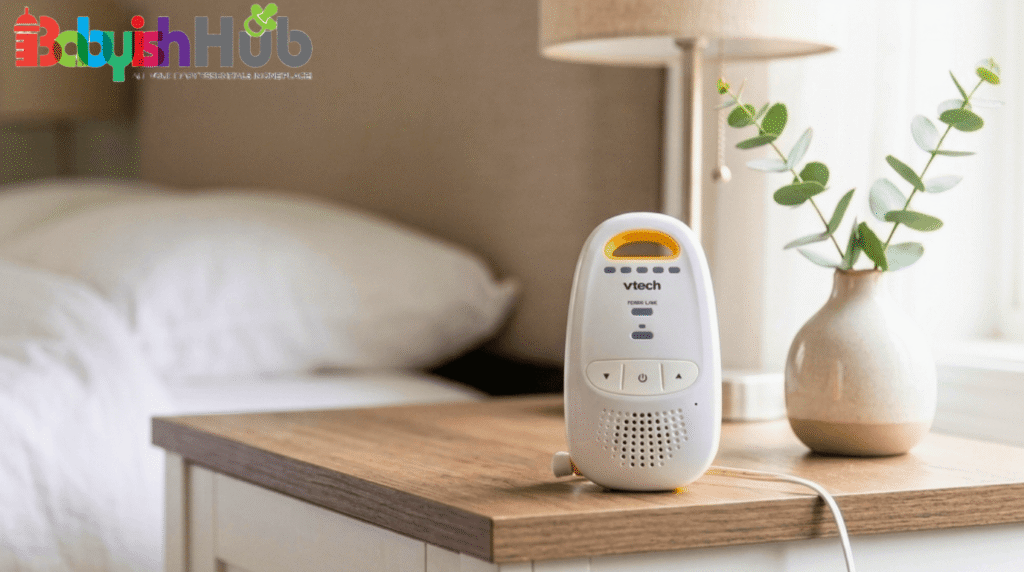
5. VTech DM111 Audio
Best Affordable Baby Monitor for Travel
Quick Verdict:
Buy this if: You travel frequently, want the lightest and most packable monitor option, or need a budget audio-only monitor for a grandparent’s home or secondary location.
Skip this if: You need to see your baby, not just hear them.
Biggest strength: The smallest, lightest, most packable option on this list. It fits in a toiletry bag, runs on an 8-hour rechargeable battery, and clips to a belt or pocket with no setup required.
Biggest weakness: No video, no screen, no camera. Audio only.
Product Overview
The VTech DM111 is the monitor you pack instead of the one you install. DECT 6.0 technology produces completely static-free audio. And unlike older analog monitors, the DM111 is silent until your baby makes a sound, with no background hiss or radio interference to cut through. The parent unit’s belt clip and rechargeable battery make it the most hands-free option in this guide.
Real-World Performance
DECT 6.0’s interference-free operation is noticeable compared to older 2.4GHz audio monitors. The channel stays clear of router interference, cordless phone overlap, and microwave noise. The only sounds you hear are the sounds in the baby’s room.
The 8-hour battery covers a standard overnight monitoring period. For longer stays, the parent unit charges via USB, making it compatible with any standard phone charger or power bank.
The five-level LED sound indicator on the parent unit shows audio levels visually when the speaker is muted; useful in situations where parents want visual awareness without audio (late-night meetings, quiet gatherings).
What We Like:
- The simplicity is the point. No WiFi, no app, no screen, no battery-draining camera. For travel situations where the baby sleeps in an adjoining hotel room or the next tent at a campsite, a lightweight audio monitor solves the monitoring need without the bulk and battery demands of a video system.
- The price puts this monitor in the impulse-purchase range for grandparents, babysitters, or anyone who needs occasional monitoring capability without a major investment.
What Could Be Better:
- Parents who use video monitoring at home and want the same capability while traveling will find the audio-only format limiting. The Roar Outdoor Baby Monitor (reviewed separately in our camping monitors guide) covers travel with full wireless video if video away from home is the priority.
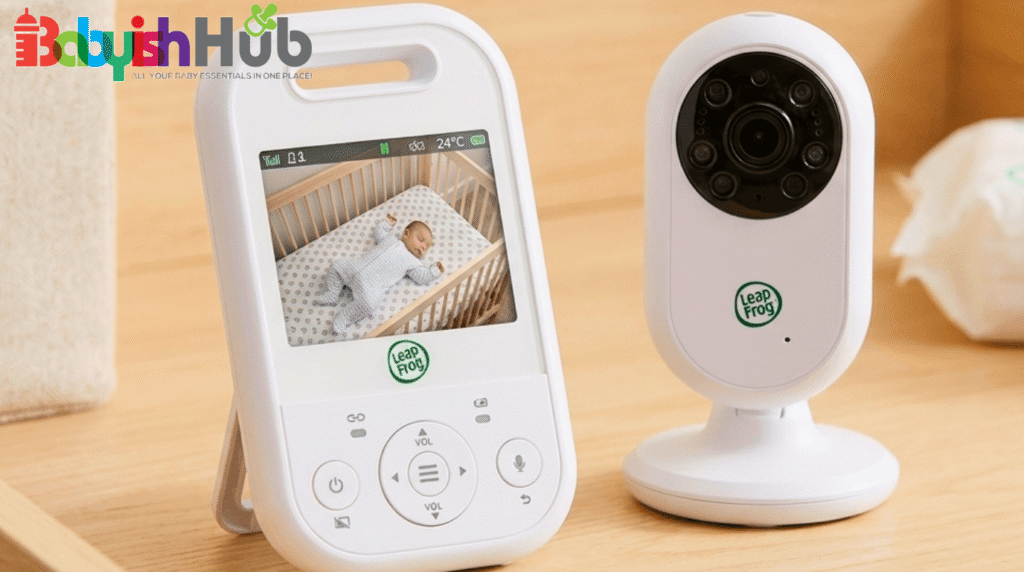
6. LeapFrog LF2423
Best Value Baby Monitor with IPS Screen
Quick Verdict:
Buy this if: Screen quality (color accuracy and viewing angle) matters to you, and you want the best image quality at the lowest price point.
Skip this if: Battery life is the priority and you want the longest runtime between charges.
Biggest strength: Full-color starlight night vision technology produces a more detailed, warmer-toned night image than standard infrared systems at a comparable or lower price.
Biggest weakness: 12-hour video battery life is shorter than VTech’s VM819 at a similar price point.
Product Overview
LeapFrog entered the baby monitor category with a focus on image quality at accessible pricing. The LF2423 uses starlight sensor technology in the camera to capture ambient light rather than relying purely on infrared LEDs, which produces a more natural-looking night image without the stark white-on-black infrared look that budget monitors typically deliver. No WiFi, no subscription, no app.
Real-World Performance
The starlight sensor’s output in a typical nursery with minimal ambient light produces a noticeably warmer image than standard infrared night vision. The image shows subtle color information from whatever ambient light enters the room (a streetlight through curtains, a nightlight glow from the hallway) rather than converting everything to infrared grayscale. This is a preference question as much as a performance one, but parents accustomed to premium monitors find the LeapFrog’s night image more familiar.
The 2.8-inch IPS screen maintains color and contrast when viewed from up to 45 degrees off-center, which matters when the parent unit sits on a nightstand and the parent views it from a lying position rather than directly in front.
Setup takes under two minutes: plug in the camera, power on the parent unit, and the two devices pair automatically.
What We Like:
- The image quality at the price point is the defining advantage. Parents who previously used a premium monitor and downgraded to budget options often find image quality to be the biggest disappointment. The LF2423 closes that gap more than most comparable-priced options.
- The temperature sensor alerts parents when the nursery exceeds a set range, a feature more common in $150+ monitors that the LF2423 includes at budget pricing.
What Could Be Better:
- The 12-hour video battery requires overnight charging discipline. Parents who forget to charge before bed and monitor continuously through an early-waking phase may find the battery depleted before the baby’s wake-up time. VTech’s VM819 offers more battery headroom at the same screen size.
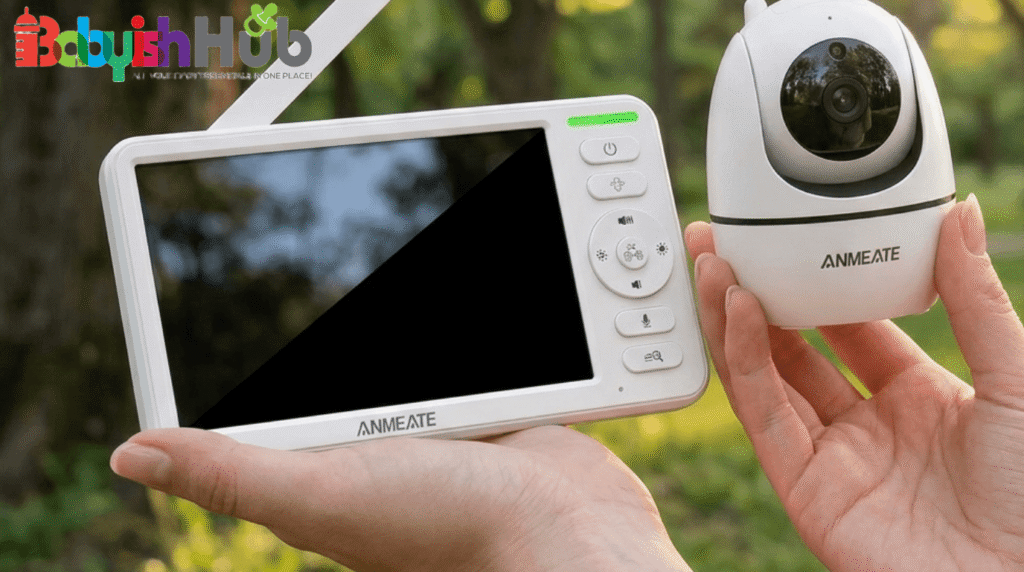
7. ANMEATE Video Baby Monitor
Best Entry-Level Affordable Baby Monitor
Quick Verdict:
Buy this if: Budget is the hardest constraint and you need a functional, no-WiFi video monitor at the lowest possible price.
Skip this if: You want a larger screen, longer battery, or a no-rethread harness experience. This is a basic monitor that does the job without extras.
Biggest strength: Lowest price point on this list for a video monitor with camera, night vision, two-way audio, and temperature display.
Biggest weakness: The 2.4-inch screen is the smallest on this list, and battery life is more modest than higher-priced options.
Product Overview
ANMEATE has produced affordable no-WiFi video monitors since well before the budget monitor category became crowded. The original ANMEATE monitor uses 2.4GHz FHSS for a private, direct camera-to-parent-unit connection, expandable to four cameras on one parent unit, with infrared night vision, two-way audio, temperature monitoring, and VOX mode.
Real-World Performance
The 2.4-inch screen shows a functional image at close range. From a nightstand two to three feet away, the image is clear enough to confirm the baby’s position and movement. From across a larger bedroom, detail becomes harder to discern than it would be on a 4- or 5-inch screen.
Two-way audio functions cleanly for its price point. The microphone in the camera unit picks up infant sounds at standard nursery volumes, and the parent unit speaker carries enough volume to soothe a stirring baby without requiring the speaker volume to be maxed out.
The VOX mode sensitivity adjustment is one of ANMEATE’s more practical features — three levels of sensitivity allow parents to calibrate whether the screen activates from rustling sounds or only from crying, which reduces unnecessary wake-ups.
What We Like:
- The entry price makes this monitor accessible to families who’ve exhausted their new-baby budget and genuinely cannot stretch further. At this tier, having a no-WiFi, hackproof video connection with temperature monitoring and expandable camera support is a genuine value proposition.
- The four-camera expandability allows the system to grow without buying a new parent unit. This is great if you start with one camera and add rooms later.
What Could Be Better:
- The screen size limits usefulness for detailed monitoring from any distance. Parents who need to see subtle breathing or face positioning from across a room will find themselves walking closer to the parent unit rather than glancing from a comfortable distance.
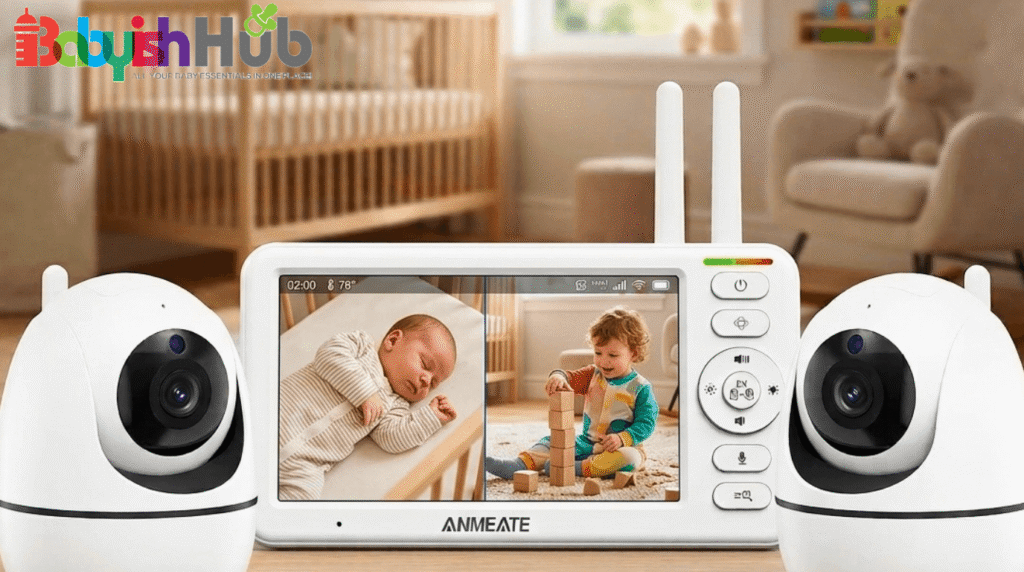
8. ANMEATE 5″ Split Screen
Best Budget Split-Screen Baby Monitor
Quick Verdict:
Buy this if: You need a split-screen dual-camera system and want the lowest-cost option that delivers that feature.
Skip this if: Screen quality or battery life is a higher priority than split-screen capability at the lowest price.
Biggest strength: 5-inch split-screen display with two cameras, 30-hour battery, and no-WiFi FHSS connection; covering the primary split-screen use case at a significantly lower price than premium alternatives.
Biggest weakness: The split-screen display is functional (rather than exceptional); image quality at each camera’s split portion is modest by 2025 standards.
Product Overview
The ANMEATE 5″ Split Screen monitor addresses the gap between single-camera budget monitors and premium dual-camera systems. It connects two cameras to one 5-inch parent unit, shows both feeds simultaneously in split-screen mode, and includes an audio scan mode that alternates between camera audio every 15 seconds for parents who want audio awareness without manually toggling.
Real-World Performance
Split-screen mode shows both camera feeds simultaneously. With two cameras each filling half the 5-inch screen, each feed occupies roughly a 2.5-inch portion of the display; great for confirming the baby is in the crib and not moving, less detailed for observing specific facial expressions or subtle movement.
The 30-hour battery applies in VOX mode. In continuous split-screen video, battery draw increases substantially. Parents running two cameras in continuous split-screen should expect around 8 to 10 hours rather than 30.
SCAN mode alternates audio every 15 seconds, with visuals on both screens constantly active. This prevents the situation where a parent focuses the audio on the wrong room and misses crying from the other.
What We Like:
- The price-to-feature ratio for split-screen capability is the defining advantage. Parents who specifically need two-room simultaneous monitoring and cannot stretch to premium dual-camera options will find this monitor delivers the core function without the premium price.
What Could Be Better:
- The split-screen image quality at each half-screen is a real tradeoff. Parents comparing this monitor to a single-camera 5-inch display will notice the reduction in visible detail when each feed occupies only half the screen. For a clear view of the full nursery from both cameras, the physical camera positioning becomes more important. Centering cameras carefully in each room covers more ground within the limited split-screen resolution.
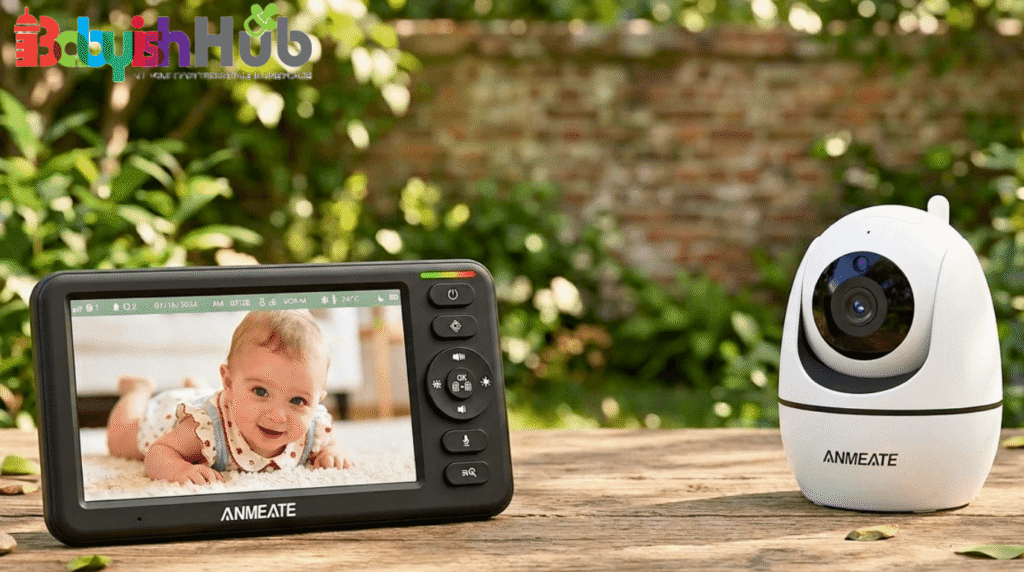
9. ANMEATE 5″ HD 48-Hour Battery
Best Budget Baby Monitor for Battery Life
Quick Verdict:
Buy this if: Battery life is the single most important feature and you want the longest possible runtime between charges among affordable options.
Skip this if: You need split-screen or dual-camera capability, or want a more established brand name.
Biggest strength: 48-hour battery life in VOX mode; the longest claimed runtime on this list, covering multiple nights between charges for parents who find nightly charging disruptive.
Biggest weakness: Newer product with a shorter track record than VTech or HelloBaby on Amazon.
Product Overview
ANMEATE’s 5″ HD version targets parents for whom recharging the parent unit every night is a genuine friction point. The 48-hour battery claim represents VOX mode operation, where the screen activates only on sound detection. The 5-inch screen, remote pan-tilt-zoom, and 1,000-foot range place it in direct competition with the HelloBaby HB6550 at a comparable price, with battery life as the differentiator.
Real-World Performance
The 48-hour battery claim in VOX mode is consistent with what parents using sound-activated monitoring report: a parent unit that goes two to three nights between charges rather than one. For parents who are heavy sleepers and worried about waking up to a dying battery alert, this headroom is practically meaningful.
The no-WiFi closed-loop system provides the same privacy advantage as others in the no-WiFi category: no cloud exposure, no router dependence, no app to maintain.
Pan-tilt-zoom is remote-controlled from the parent unit, covering the same range as comparable monitors in this guide.
What We Like:
- Two nights between charges remove one more daily task from the first-year parenting load. For parents who find themselves consistently forgetting to charge devices in the scramble of infant care, a monitor that needs charging twice a week rather than every night reduces one point of friction.
What Could Be Better:
- As a newer listing with fewer reviews than the more established monitors on this list, parents who weigh community review history heavily may prefer the HelloBaby HB6550 or VTech VM819 with their larger review bases for comparison.
What Should You Look for In A Budget Baby Monitor?
Follow these criteria to help you quickly filter truly useful budget baby monitors from ones that disappoint within a week:
1. Connection Type: WiFi vs No WiFi
A budget monitor can still feel expensive if it depends on your home internet. WiFi monitors send video through your router and often require apps, updates, or subscriptions.
No WiFi monitors use a direct connection between the camera and parent unit. This removes internet dependency and usually reduces setup stress.
For most families looking for the best affordable baby monitor, this option feels more stable and predictable, especially during overnight use.
2. Battery Life That Matches Real Usage
Battery numbers on packaging rarely reflect how parents use monitors.
Most claims come from ECO or VOX mode, where the screen stays off until sound is detected. That can stretch runtime significantly. However, continuous video use drains power much faster.
When comparing monitors, focus less on headline battery claims and more on how long the unit lasts during the way you will use it at night.
3. Screen Size vs Daily Comfort
A larger screen makes it easier to see your baby without leaning in or adjusting position. Smaller screens often last longer on a single charge and feel lighter to carry around the house.
The right choice depends on your routine. If you keep the monitor on a nightstand, a compact screen works well. If you move between rooms often, a larger display may reduce friction during the day.
4. Video Quality That Works at Night
Night vision is where many budget monitors either succeed or disappoint.
Infrared cameras typically show a grayscale image that focuses on visibility rather than detail. Some newer budget monitors improve this with better sensors or color-enhanced night modes.
What matters most is not cinematic clarity but whether you can quickly tell your baby’s position and movement without guessing.
5. Audio Reliability You Can Trust
Sound is still the most important feature in any baby monitor. A good affordable baby monitor should pick up crying quickly, transmit clearly, and avoid delay. Two-way audio can also help settle your baby without walking into the room every time they stir.
6. Expandability for Growing Needs
Many families start with one camera and later need more coverage for siblings or multiple rooms. Some monitors support additional cameras on a single parent unit. This can save money long-term and reduce the need to replace your system as your family grows.
What You Need To Know Before Buying A Budget Baby Monitor
Most buying mistakes happen when parents focus on features and miss how the monitor performs in real everyday use. Knowing these things will save you from making the same mistakes parents make:
- The difference between “no WiFi” and “no privacy risk” is not automatic: No-WiFi monitors using FHSS technology create a private, direct connection between camera and parent unit that doesn’t touch your network. However, some budget monitors marketed as “no WiFi” use 2.4GHz connections that, while not router-dependent, still operate on frequencies that can theoretically be intercepted.
- The safest no-WiFi baby monitors explicitly state FHSS (Frequency Hopping Spread Spectrum) technology, which scrambles the signal across frequencies to prevent interception. Every monitor on this list uses FHSS or DECT 6.0, both of which are much more secure than basic 2.4GHz.
- Battery life claims always reflect best-case conditions: Every manufacturer measures battery life in VOX mode (screen off, sound-activated). Continuous video mode, which is the way most parents use the monitor while awake and checking it, consumes battery three to five times faster depending on screen size and brightness. When comparing battery claims across monitors, you should assume that you’ll get roughly 25 to 40% of the advertised figure in continuous video mode.
- Screen size is not always better for your use case: A 6-inch split-screen display is impressive, but it draws more power and weighs more. If you spend most of your monitoring time with the unit on a nightstand three feet from your face, a 2.8-inch screen with high battery life may serve you better than a 6-inch screen that needs charging every morning.
- Two-way audio quality varies more than video quality at the budget tier: Most parents focus on night vision and screen specs. The microphone sensitivity in the camera unit and the speaker volume and clarity in the parent unit affect whether you can soothe a stirring baby with your voice from another room or whether your voice comes through garbled and too quiet to matter. Both ANMEATE and HelloBaby have improved microphone quality in their 2024 and 2025 model iterations; older units from the same brands had more significant issues here.
Final Recommendations
Choosing the best affordable baby monitor comes down to your specific needs. Some parents need a large screen they can glance at from across the room. Others care more about battery life that lasts through multiple nights without charging. For some, a simple compact monitor or a dual-camera setup is enough.
If you are a first-time parent setting up a nursery, a simple video monitor like the HelloBaby HB6550 gives you a reliable balance of screen size, battery performance, and ease of use without adding unnecessary complexity. If you are managing multiple rooms or twins, a split-screen setup or dual-camera system can reduce the need to constantly switch views. If portability matters most, smaller monitors like the VTech VM819 or audio-only options keep things light and simple during travel or quick check-ins.
There is no single perfect budget-friendly monitor for every home. The right choice is the one that fits your routine, your space, and how often you plan to use it during the day and night.