Best Baby Monitor for Camping | 5 Battery-Operated Picks
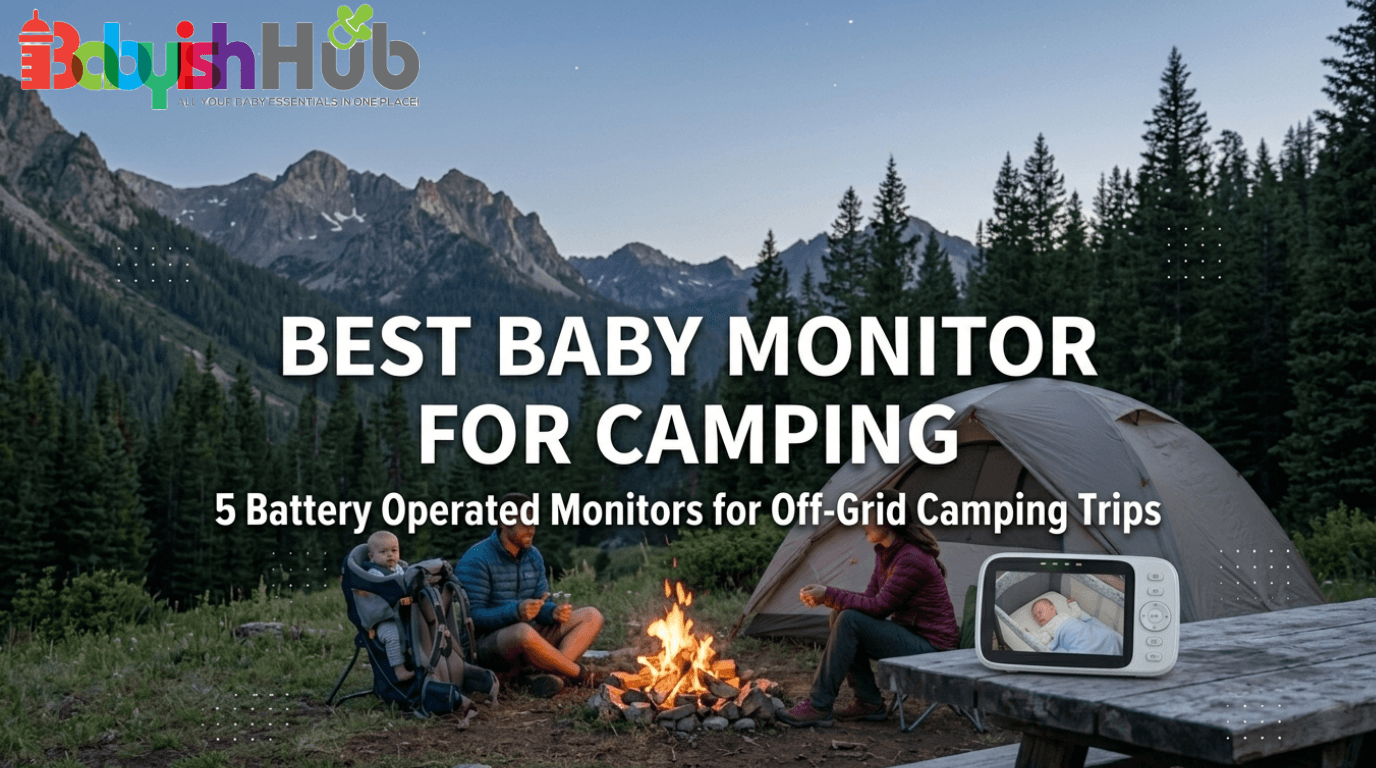
Planning a camping trip with a baby brings a long list of questions, and sleep is usually near the top. Once your baby falls asleep in the tent, camper, or travel crib, you still want a reliable way to keep an ear on them while you sit by the campfire, wash dishes at the campground sink, or relax a short distance away. That’s where finding the best baby monitor for camping becomes surprisingly complicated.
Many monitors marketed as wireless still require the camera or baby unit to stay plugged into a power outlet. That limitation can create problems at off-grid campsites, in tents, or during trips where power access remains limited. A true camping baby monitor needs battery-powered operation, dependable range, and a secure connection that doesn’t rely on WiFi or cell service.
In this guide, we’ll look at the top camping battery-powered baby monitor options for off-grid adventures, explain the features that make a monitor practical for camping, and help you avoid spending money on a model that works well at home but falls short outdoors.
What Makes A Baby Monitor Work for Camping?
Before getting into specific products, it’s important to understand the TWO key aspects that separate monitors that work in the field from those that don’t.
- Choose Battery-Powered Baby Monitor for Camping: This sounds obvious, but the industry has a long history of calling the parent unit “portable” while requiring the baby unit to stay plugged in. Always confirm that the camera or baby unit operates on a rechargeable or alkaline battery before assuming a monitor will work camping.
- A no-WiFi baby monitor is ideal for Camping: WiFi-dependent monitors route audio and video through your home network or a cloud server. Without a router at the campsite, they go offline. Monitors without WiFi that use direct radio transmission (DECT 6.0, FHSS 2.4GHz) connect the two units directly without any network in between.
With that in mind, choosing a true camping-capable monitor becomes much easier.
5 Best Baby Monitor for Camping Picks At A Glance:
| Monitor | Type | Both Units Battery? | Range | Price |
| Roar Baby Monitor | Audio | Yes | ~1,000 ft | Check Price on Amazon |
| TimeFlys Paladin | Audio | Yes (AAA) | ~2,000 ft | Check Price on Amazon |
| HelloBaby HB6550 | Video | Baby unit needs power | ~1,000 ft | Check Price on Amazon |
| VTech DM221 | Audio | Parent unit only | ~1,000 ft | Check Price on Amazon |
| Motorola MBP36XL | Video | Camera is battery-powered | ~1,000 ft | Check Price on Amazon |
How We Evaluated These Camping Baby Monitors
Finding the best camping baby monitor requires a different approach than evaluating a monitor for everyday use at home. Features that work well in a nursery often become much less useful once you move into a tent, camper, or off-grid campsite.
For this guide, we focused on the factors that have the biggest impact on real-world camping use. We compared each monitor’s power requirements, battery performance, connection type, outdoor range, and overall practicality for families spending time away from traditional power sources.
We paid particular attention to whether both the parent unit and baby unit are battery-operated (i.e., they could operate without being plugged into an outlet). This single detail eliminates many monitors that are frequently advertised as wireless but still require constant power for the camera or baby unit.
We also evaluated the following:
- Battery life during extended use
- Outdoor range in open camping environments
- Performance without WiFi or cellular service
- Ease of charging from portable power banks
- Durability for outdoor conditions
- Video and audio quality where applicable
- Overall value for different camping styles
Because every family’s camping setup looks different, we considered a variety of use cases, including tent camping, RV travel, campervan adventures, and campground stays with electrical hookups. Our recommendations prioritize practical off-grid performance over features that add complexity without improving the camping experience.
5 Best Baby Monitors For Camping (Battery-Powered) Reviewed:
These baby monitors offer you the most practical solutions for keeping an ear on your little one while camping. They work whether you’re sleeping in a tent deep in the woods, spending the weekend in a campervan, or staying at a full-hookup campground.
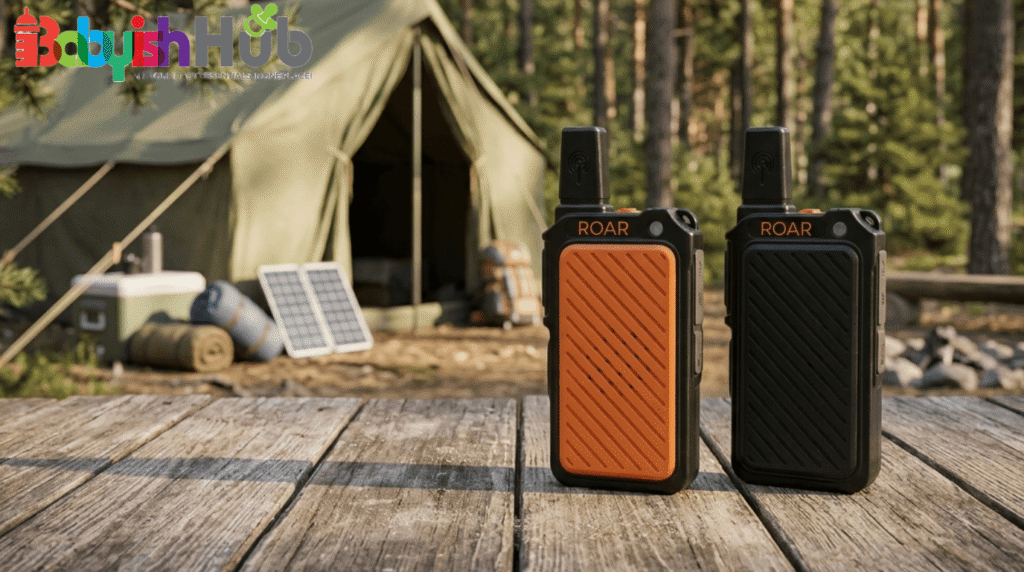
1. Roar Baby Monitor
Best for: Families who regularly tent camp without access to electricity.
Pros:
- Both units run on rechargeable batteries
- Water-resistant design
- More than 20 hours of battery life
- No WiFi or cell service required
Cons:
- Audio only
- Higher price than basic audio monitors
Why It Works for Camping:
The Roar Baby Monitor solves the biggest problem parents run into when shopping for a camping baby monitor. Unlike most models marketed as wireless, both the parent unit and baby unit operate on rechargeable batteries. You don’t need an outlet, extension cord, or portable power station to keep it running through the night.
The monitor was designed with outdoor use in mind. The housing handles moisture better than most nursery monitors, which helps during damp mornings, unexpected drizzle, or humid camping conditions. That extra durability makes a difference when you’re packing gear into a tent or moving equipment around a campsite.
Battery life is another major advantage. Long runtimes reduce the need for constant charging and give parents one less thing to worry about during a multi-day trip. The direct connection between units also means you don’t need campground WiFi or cellular service.
The biggest compromise is the lack of video. Parents who rely on visual monitoring at home may miss having a screen. For many camping situations, clear audio and dependable battery performance prove more valuable than video.
Who Should Buy It?
Choose the Roar if you spend a lot of time tent camping, dispersed camping, or visiting sites without electrical hookups. It offers the most complete off-grid solution in this guide.
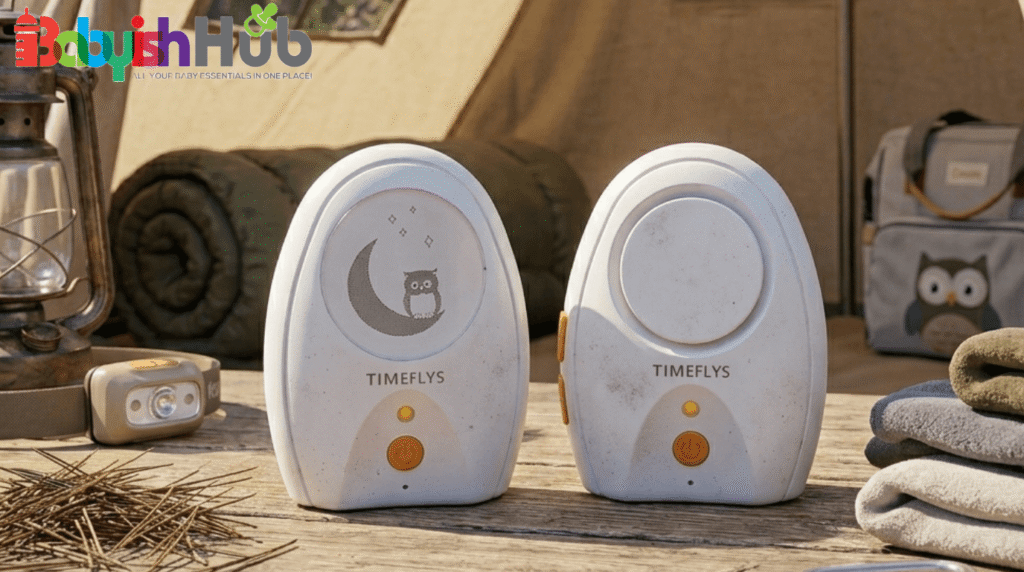
2. TimeFlys Paladin Upgrade
Best for: Families who prioritize maximum range.
Pros
- Up to 2,000 feet of advertised outdoor range
- Both units can operate without wall power
- USB charging support
- Two-channel capability
Cons
- Uses AAA batteries
- Less rugged than outdoor-focused alternatives
Why It Works for Camping
The TimeFlys Paladin stands out because of its impressive range. Parents camping on large properties, farms, or oversized campsites may appreciate the additional signal coverage compared to typical audio monitors.
Like the Roar, both units can operate away from an outlet. That gives it genuine off-grid capability, which many competing monitors cannot match. Parents can power the units with AAA batteries and recharge compatible batteries through a power bank during longer trips.
The flexibility of replaceable batteries creates both advantages and drawbacks. Fresh batteries provide a quick solution when power runs low, but families need to keep track of extras throughout the trip. Some parents will prefer the convenience of integrated rechargeable batteries.
The housing feels more like a traditional indoor monitor than a rugged outdoor product. It works well for camping, but it doesn’t offer the same level of weather resistance or durability as purpose-built outdoor options.
Who Should Buy It?
The Paladin makes the most sense for families who need extra range and don’t mind managing rechargeable AAA batteries during their trip.
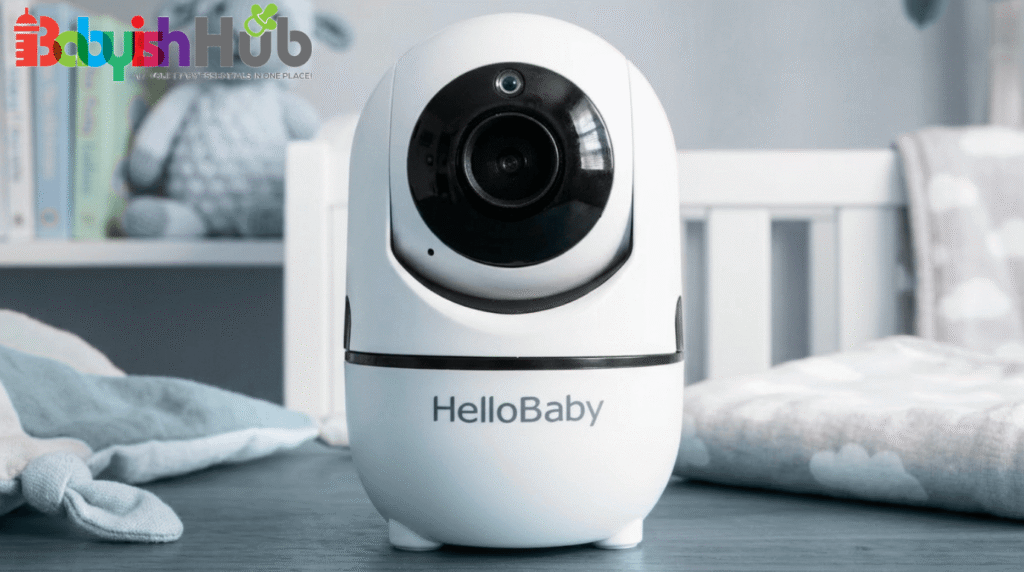
3. HelloBaby HB6550
Best for: RV camping and campsites with electrical hookups.
Pros
- Large 5-inch display
- No WiFi required
- Strong battery life on the parent unit
- Remote pan, tilt, and zoom controls
Cons
- Camera requires constant power
- Not suitable for true off-grid tent camping
Why It Works for Camping
Parents who want video monitoring often struggle to find a camping-friendly solution. The HelloBaby HB6550 offers one of the better options for RVs and powered campsites because it delivers video without relying on internet access.
The parent unit runs on a rechargeable battery and can last through long evenings around the campsite. The large display provides a clear view of your sleeping child, and the camera controls allow adjustments without physically entering the sleeping area.
Its biggest limitation is also the reason it doesn’t rank higher for off-grid use. The camera must remain plugged into a power source while operating. For RV owners and families staying at campsites with electricity, this isn’t a major issue. For tent campers at primitive sites, it becomes a significant obstacle.
The included temperature display can be useful when monitoring sleeping conditions inside a camper or enclosed tent setup.
Who Should Buy It?
Choose the HelloBaby HB6550 if you camp primarily in an RV, travel trailer, or campground with electrical hookups and want video monitoring without WiFi.
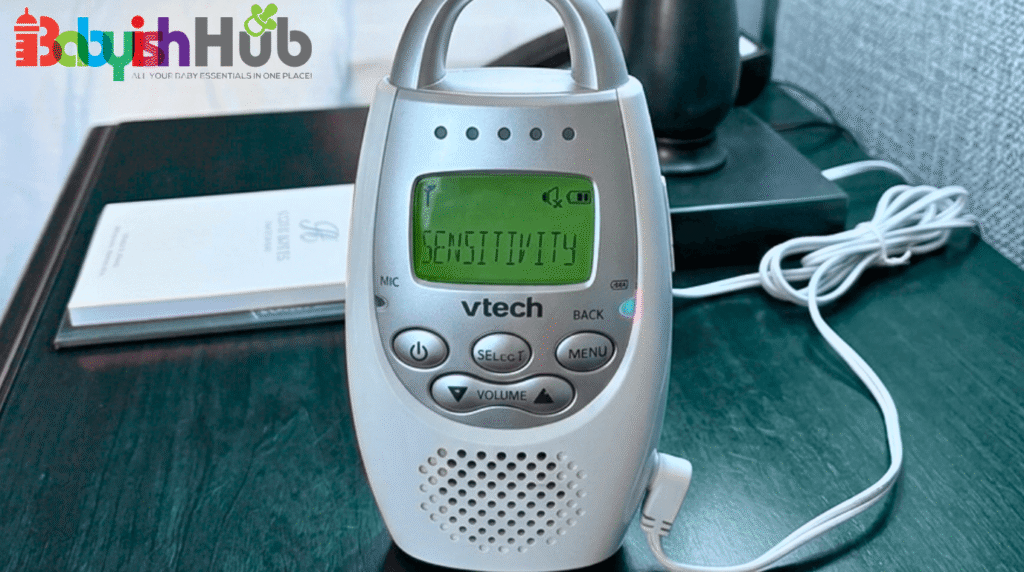
4. VTech DM221
Best for: Budget-conscious families who already own a portable power station.
Pros
- Affordable price
- Reliable DECT 6.0 audio connection
- Strong reputation for dependability
- Vibrating sound alerts
Cons
- Baby unit requires continuous power
- Limited usefulness for primitive camping
Why It Works for Camping
The VTech DM221 remains one of the most popular audio monitors for home use, and it can serve some camping families well under the right conditions. Audio quality is consistently strong, and the DECT connection provides a secure signal without relying on WiFi.
For camping, the biggest challenge comes from the baby unit’s power requirements. The monitor works well if you already bring a portable power station, camp in an RV, or stay at sites with electricity. Without one of those power sources, the baby unit quickly becomes impractical.
Parents often appreciate the vibrating alert feature in busy camping environments. Around a campfire or during group gatherings, vibration notifications can grab your attention more effectively than a quiet audio alert.
The DM221 offers solid value, but it doesn’t provide the same level of off-grid flexibility as monitors designed around battery-powered operation.
Who Should Buy It?
This monitor works best for families who want a dependable budget option and already have a power solution available at camp.
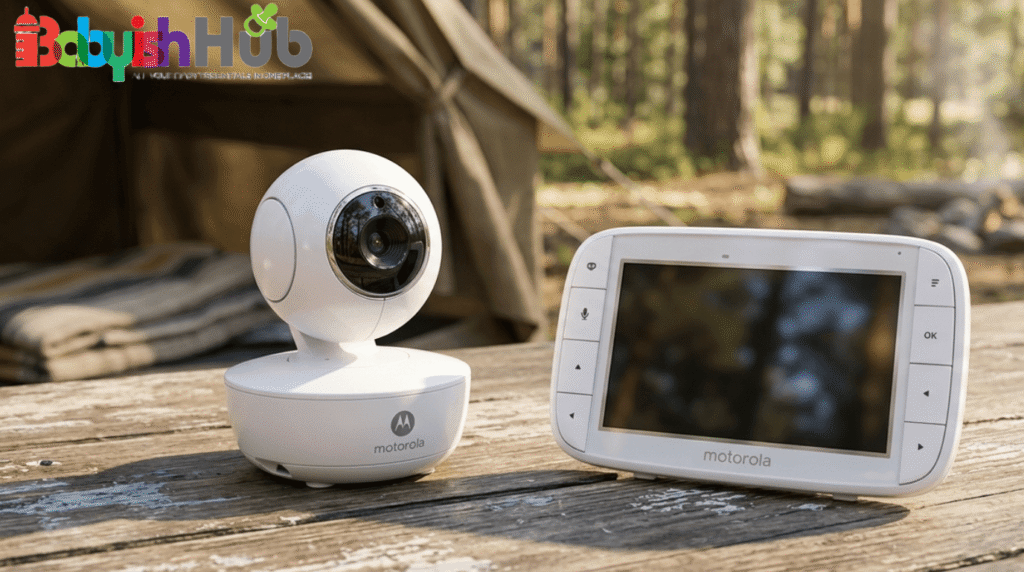
5. Motorola MBP36XL
Best for: Campervan and RV families who want video monitoring.
Pros
- Large 5-inch screen
- Portable camera with rechargeable battery
- Remote pan, tilt, and zoom controls
- Good image quality for close-range monitoring
Cons
- Camera battery lasts only a few hours
- Not weather-resistant
- Requires regular recharging
Why It Works for Camping
The Motorola MBP36XL occupies a middle ground between traditional home monitors and fully portable camping solutions. Unlike many video monitors, the camera includes its own rechargeable battery, which makes setup more flexible when positioning the camera around a camper or RV.
That flexibility comes with limitations. The camera battery lasts only a few hours, so most parents will still need to keep it connected to power overnight. For vehicle-based camping, this usually isn’t a major problem because onboard power is readily available.
The large screen and remote camera controls create a comfortable monitoring experience, particularly in smaller spaces where parents want to check on a sleeping child without opening doors or moving around unnecessarily.
Parents planning to camp entirely off-grid should look elsewhere. The short battery life and lack of weather protection reduce its practicality for tent camping.
Who Should Buy It?
The MBP36XL is best suited for RV and campervan families who want the convenience of video monitoring and have reliable access to onboard power.
What Most Parents Overlook When Choosing A Camping Baby Monitor
Most camping monitor problems do not come from the product itself, but from a few overlooked details parents rarely check before buying. These details include:
Problem 1: Many “wireless” monitors still depend on power at the baby unit
This is the most common surprise parents run into. A monitor may look completely cordless in product photos, but only the parent unit runs on battery. The camera or baby unit still needs to stay plugged in.
At home, this feels normal because outlets are everywhere. At a campsite, it becomes a problem. If you do not have a power station, RV hookup, or generator, the monitor simply will not function the way you expected. Before buying, always check whether both units run on battery power or if only one side does.
Problem 2: Advertised range does not match real campsite conditions
Range numbers often look impressive on the box, but they come from ideal, open environments with no obstacles.
Camping adds real-world interference. Trees, uneven ground, tents, vehicles, and even other electronic devices can reduce signal strength. A monitor that claims 1,000 feet may only give you a fraction of that in a wooded or crowded campsite.
The practical approach is to think in zones instead of maximum distance. Ask yourself how far you realistically plan to sit from the tent, and choose a monitor with an extra buffer beyond that.
Problem 3: Temperature inside sleeping spaces gets overlooked
A closed tent or small camper can warm up faster than most parents expect, especially during daytime naps or early evenings when airflow is limited.
The challenge is that checking on your baby often means unzipping a tent or opening a door, which can wake them up or disrupt sleep. That is usually the last thing you want after a long bedtime routine outdoors.
A monitor with a built-in temperature reading helps you keep an eye on conditions without disturbing your baby. It gives you a quick sense of whether the space is getting too warm or staying comfortable.
Problem 4: Audio alerts are harder to notice outdoors
Camping environments are rarely quiet. Between campfires, conversations, cooking sounds, and general background noise, softer alerts can get lost easily.
At home, a subtle beep is enough to catch your attention. Outside, you may need something stronger or more noticeable, like vibration alerts or louder notification settings.
This small detail can make a big difference in how quickly you respond during light sleep cycles or early wake-ups.
Once you understand these four areas, choosing a camping baby monitor becomes less about marketing claims and more about how the monitor will actually behave in your specific camping setup.
Related: Best Travel Baby Monitors (for Hotel, Backpackers, Digital Nomads, Etc.)
Final Recommendations
Buy the Roar Baby Monitor if: You regularly tent camp without electricity and want the only monitor on this list purpose-built for that situation. Both units are fully wireless, the housing handles outdoor conditions, and the battery lasts longer than a typical camping night.
Buy the TimeFlys Paladin if: Range is your top priority, or your camping footprint is larger than a standard campsite. Bring rechargeable AAAs and a small power bank, and this monitor covers extensive outdoor distances.
Buy the HelloBaby HB6550 if: You camp in an RV or at hookup sites and want video monitoring without WiFi. The long parent-unit battery and no-internet design make it well-suited for powered camping.
Buy the VTech DM221 if: Budget is tight, you already own a portable power station, and your camping stays involve electrical hookups. It’s a reliable audio monitor that does exactly what it says at a price most families can absorb.
Buy the Motorola MBP36XL if: You camp in a vehicle with onboard power and want a video monitor with a portable camera for repositioning within the RV without hunting for outlets.
Skip all video monitors entirely if you’re a minimalist camper who moves fast and travels light. A rugged audio monitor weighs less, costs less, charges faster, and solves the core safety need without the complexity. The Roar or Paladin handles the job without the screen.
Choosing the best baby monitor for camping depends less on features and more on how you travel, where you sleep, and how much access you have to power during your trip.