How To Travel With Baby Stroller And Car Seat (Without Losing Your Mind)
The first time I flew alone with my oldest, she was four months old, and I had a full-size stroller, an infant car seat, a diaper bag, and a carry-on. By the time I reached the gate, I had sweated through my shirt, bumped approximately eleven strangers with the stroller, and dropped the car seat twice.
Nobody warns you how physically demanding it is to travel with a baby stroller and car seat until you’re already doing it. If you just searched for how to travel with baby stroller and car seat, you’re most probably planning a trip and trying to figure out how to make this gear situation work.
Here’s what I wish someone had told me before that first flight (and how to avoid the mistakes most parents make on their first trip)
Why This Combination Feels So Overwhelming At First
A stroller and a car seat together represent two of the bulkiest, most awkward pieces of baby travel gear you own. Moving through an airport, a train station, or a parking garage with both travel items plus a baby in your arms is genuinely hard.
The good news is that millions of parents do it every year, and with the right approach and a few key tools, the whole system becomes manageable. The strategy you use depends on what type of stroller and car seat you have, how you’re traveling, and what you’re doing at your destination.
How To Travel With A Baby Stroller And Car Seat: Know Your Options Before You Pack
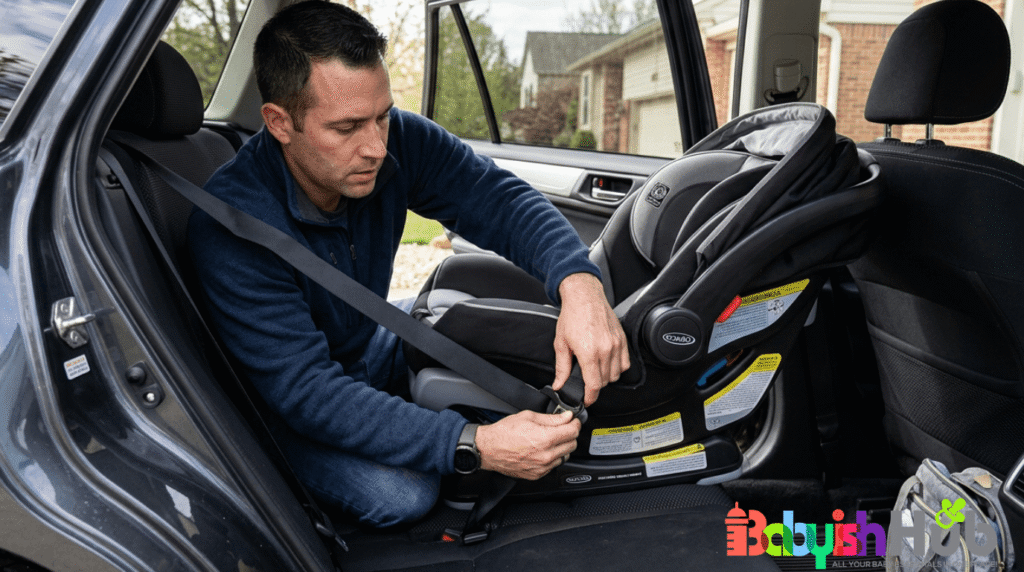
Before you figure out the logistics, it’s important to understand what options you have at hand. Not every family needs to bring both pieces of gear on every trip, and sometimes a different setup makes the whole journey easier.
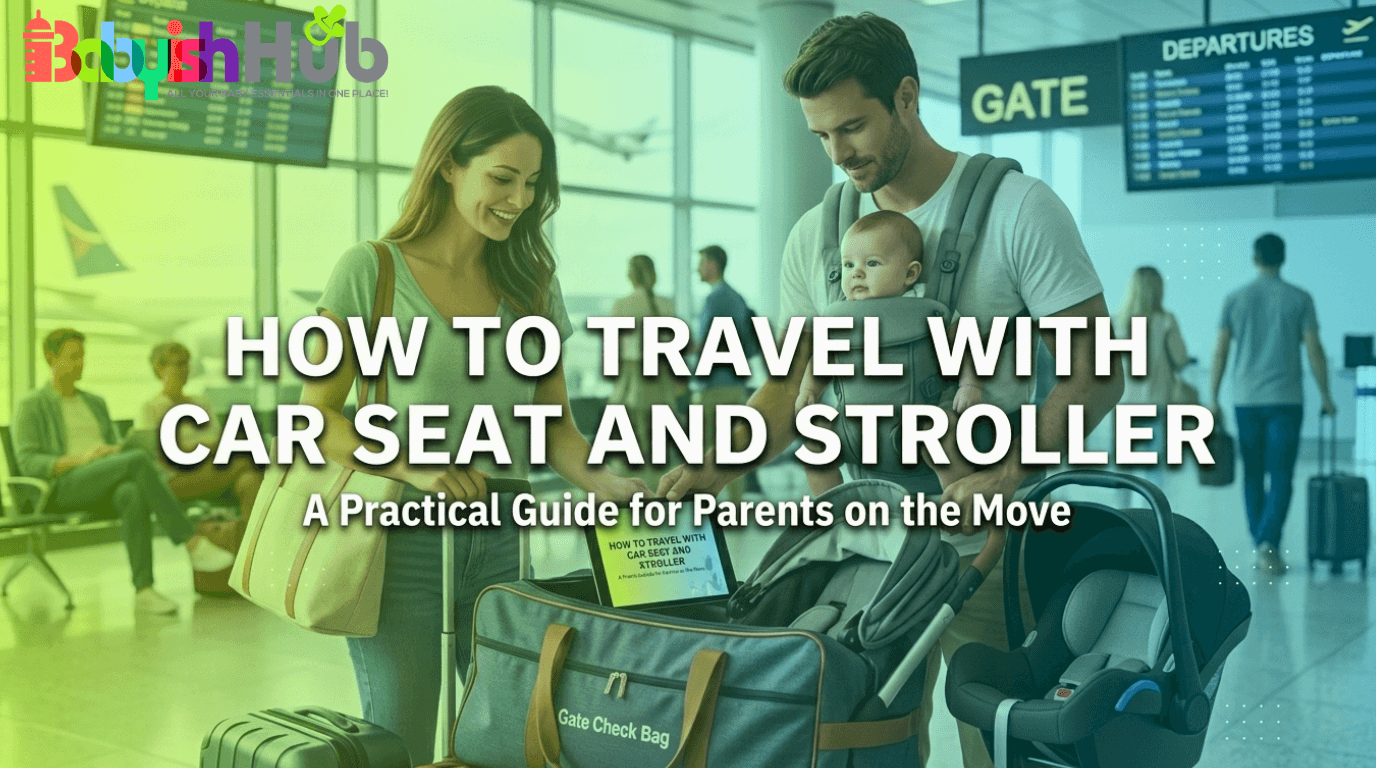
If your infant car seat clicks into a compatible stroller base to form a travel system, you already have one of the best setups for airport travel. You can push the whole unit through the terminal, keep your baby settled in the car seat while you navigate check-in and security, and then separate them as needed.
This combination is far easier to manage than carrying a detached car seat and pushing an empty stroller at the same time.
If you have a convertible car seat that doesn’t detach from the base, your options shift. You cannot carry a convertible seat through an airport the way you can an infant bucket seat. For families with convertible seats, the car seat typically goes checked, and the stroller does the work of moving the baby through the airport.
For very short trips or trips where you won’t need a car at your destination, some families choose to leave the car seat at home entirely and travel with only a lightweight stroller or carrier. That only works if you won’t be in a car at your destination, but it dramatically reduces the gear load.
Related: How To Choose A Baby Stroller (Tips For Parents)
Flying With A Stroller: Gate-Check Vs. Full Check
Most airlines allow you to gate-check a stroller for free, and this is usually the better choice over checking it with your luggage at the counter. Gate-checking means you push the stroller all the way to the jet bridge, collapse it, and hand it off right before you board. When you land, it comes back to you at the jet bridge before you even reach baggage claim.
The advantage is obvious: you have the stroller available throughout the entire airport, which means your baby has a place to sit, you have somewhere to hang your packed diaper bag, and you’re not carrying everything through a terminal.
For long layovers or delayed flights, having the stroller available keeps a wiggly baby contained and your back intact.
The downside is that gate-checked strollers go into the cargo hold without the same protective handling as regular checked baggage. They get stacked, jostled, and sometimes rained on.
A good stroller travel bag protects against most of this damage. Gate-check bags made specifically for strollers run anywhere from budget fabric options to padded rolling cases.
If you own a stroller worth protecting, a padded gate-check bag is a worthwhile investment. The J.L. Childress Gate Check Bag fits most full-size and umbrella strollers and holds up well over multiple trips.
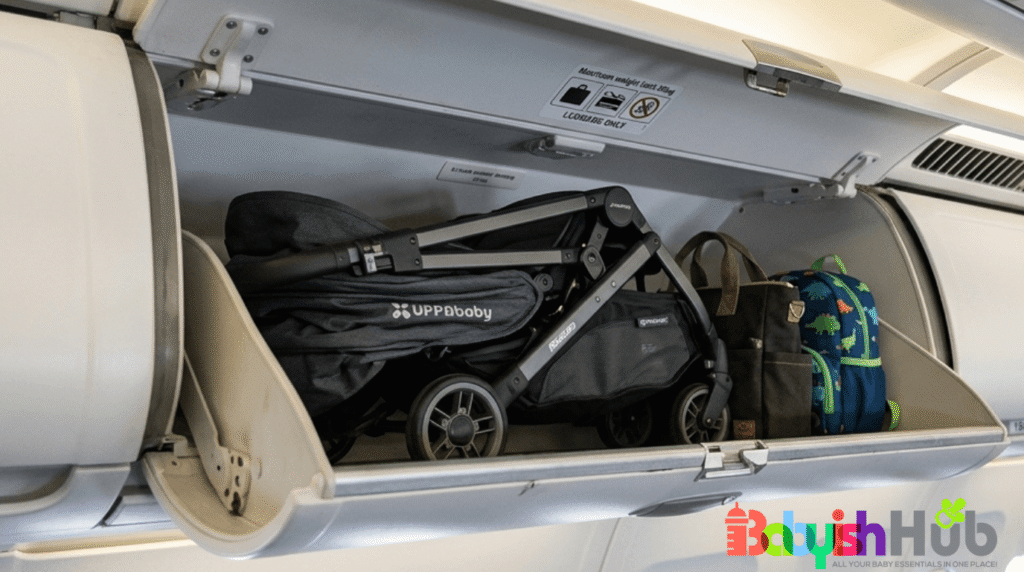
For parents with a lightweight umbrella stroller, some airlines allow it as a carry-on if it fits in the overhead bin. This works with very compact models like the GB Pockit, which folds down small enough to fit in a standard overhead compartment on most aircraft.
Flying With A Car Seat: Your Four Main Options
This is where parents have the most confusion, so it helps to lay out what your choices are. The FOUR main options you have in this case include:
- Option #1. Check the car seat with your luggage at the airport counter: Airlines check car seats for free. The risk is the same as any checked item: it might arrive damaged, delayed, or not at all. A hard-sided car seat travel bag offers some protection, though no bag makes a car seat fully immune to baggage handling. If you check your seat, put a luggage tag with your contact information directly on the seat itself, not just on the bag.
- Option #2. Gate-check the car seat the same way you gate-check a stroller: This keeps it with you longer and generally results in slightly less rough handling than counter-checked gear. A car seat travel bag still makes sense here for protection.
- Option #3. Bring the car seat on the plane and use it for your baby during the flight: The FAA strongly recommends this for safety reasons. If you purchase a seat for your child, an FAA-approved car seat gives them a secure, familiar space for the flight and significantly reduces risk during turbulence or emergency situations. Infant bucket seats and many convertible seats carry FAA approval. Look for the label on the seat that states it’s certified for use in motor vehicles and aircraft. You’ll need to install it in the window seat, and your baby must be buckled in during takeoff, landing, and whenever the seatbelt sign is on.
- Option #4. Use a CARES harness instead of a full car seat on the plane: The CARES harness is FAA-approved for children between 22 and 44 pounds who can sit upright unassisted. It attaches to the airplane seat and provides a four-point harness system without the bulk of a full car seat. It doesn’t work for infants, but for older babies and toddlers who meet the weight and developmental requirements, it’s a legitimate alternative that packs into a small bag.
Navigating The Airport With A Stroller And Car Seat
If you’re managing both a stroller and a car seat through an airport without another adult, the setup matters a lot. A car seat travel cart is one of the most underrated travel tools for parents. It attaches to your car seat and lets you roll it through the airport like a piece of luggage, with your baby buckled in.
The Go-Go Kidz Travelmate and the BubbleBum Car Seat Travel Trolley both work this way. You push the car seat like a stroller, then snap the wheels off when you reach security or the gate.
Combined with a gate-checked stroller, this gives you a rolling system for both pieces of gear and keeps your arms free.
If you use an infant travel system where the car seat clicks into the stroller frame, push the whole unit through the terminal and separate them at the gate. The stroller gets gate-checked in its bag, and the car seat either comes on the plane with you or gets gate-checked separately, depending on your plan.
Security is the moment that requires the most coordination. You’ll need to collapse the stroller, remove the car seat if it’s attached, place both on the belt, and manage your baby simultaneously.
If you’re traveling alone, ask a TSA agent for assistance. They’re required to help, and most are quite accommodating when a parent is clearly managing a lot.
PRO TIP: Wear your baby through security in a carrier if you can. It keeps your hands free and your baby calm during what is inevitably the most chaotic two minutes of airport travel.
Road Trips: Managing The Stroller And Car Seat In A Car
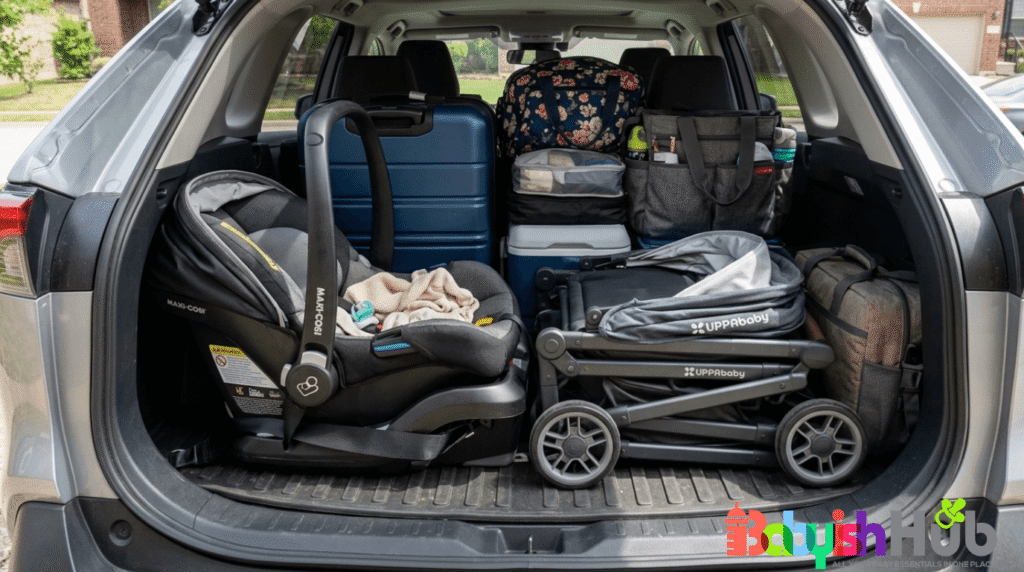
Road trips simplify the car seat question significantly because your baby stays in the car seat for the drive. The stroller question is really about trunk space and how much you want to deal with loading and unloading at rest stops.
For road trips, a compact stroller that folds flat and fits alongside your luggage is worth considering if your everyday stroller is full-size. Full-size strollers eat trunk space on road trips in a way that becomes frustrating by day two.
A lightweight umbrella stroller like the Babyzen YOYO or the Summer 3Dlite folds small, weighs under fifteen pounds, and handles most destination needs without dominating your packing space.
If you need your full-size stroller at the destination, a rooftop cargo carrier or a hitch-mounted cargo rack can carry it without sacrificing trunk space. For minivan or SUV families, a full-size stroller usually fits in the cargo area alongside bags without any creative solutions needed.
How Do You Protect Your Gear in Transit?
Car seats and strollers take a beating during travel, so having some basic protection can go a long way.
For car seats, a padded travel bag with wheels can prove quite handy if you’re checking it. Hard-sided cases offer the best protection but are expensive. A padded soft-sided bag like those from J.L. Childress or Britax provides good protection at a more reasonable price point and stores flat at your destination.
For strollers, even a lightweight nylon gate-check bag prevents the worst of the scratching and grime that happens in cargo holds. If your stroller has a fabric seat that you care about, a bag also keeps it from absorbing jet fuel smell and cargo dust, both of which are genuinely unpleasant discoveries when you unfold your stroller on the other end.
Label everything: Put your name, phone number, and destination address on both the car seat and the stroller, directly on the gear itself. Luggage tags fall off (always!). A strip of masking tape with your information written in permanent marker, placed somewhere protected on the frame, survives much better.
How To Choose The Right Gear (If You’re Still In The Shopping Stage)
If you haven’t yet bought your travel system and you know you’ll travel frequently, I strongly advise you to think about travel-friendliness from the start.
The most travel-friendly infant car seats are:
- Lightweight (under eight pounds)
- Have a carry handle with a comfortable grip
- Fit FAA-approved standards.
The Chicco KeyFit 35 and the Nuna PIPA Lite are both great options that balance safety, weight, and ease of travel.
For strollers, the most travel-friendly options are those that:
- Fold in one motion
- Stand independently when folded
- Qualify for gate-check or overhead storage
The Babyzen YOYO folds small enough to fit in an overhead bin on most airlines and is one of the most airport-friendly strollers available. The UPPAbaby MINU is another compact option that gate-checks easily and handles varied terrain at your destination.
If you want a full travel system that moves through airports smoothly, look for an infant seat and stroller combination where the seat snaps directly into the frame without an adapter.
Fewer connection points always translate to faster setup and less fumbling when you’re tired and navigating an unfamiliar airport at midnight.
Final Thoughts On Traveling With A Stroller And A Car Seat
Traveling with a baby stroller and car seat gets easier with every single trip. The first time feels challenging because you’re learning a new routine while caring for your baby on the go. Once you understand how to set up your gear, move through airport security, and protect your equipment during transit, the process becomes much smoother. Hopefully, I have fully answered your question on how to travel with baby stroller and car seat. The secret lies in preparation, practice, and choosing a setup that fits your specific travel needs. Before long, you’ll know what works for your family, and traveling will feel much less stressful.